BTC_POWER_LA

vip
Age 2.1 Yıl
Peak Tier 0
No content yet
"The Physics of Bitcoin" with Giovanni and Stephen #41 3/25/2026
BTC0,18%
  • Reward
  • Comment
  • Repost
  • Share
My dad died of ALS. I wish he could have used this technology.
This makes me very happy.
It is just the beginning.
  • Reward
  • Comment
  • Repost
  • Share
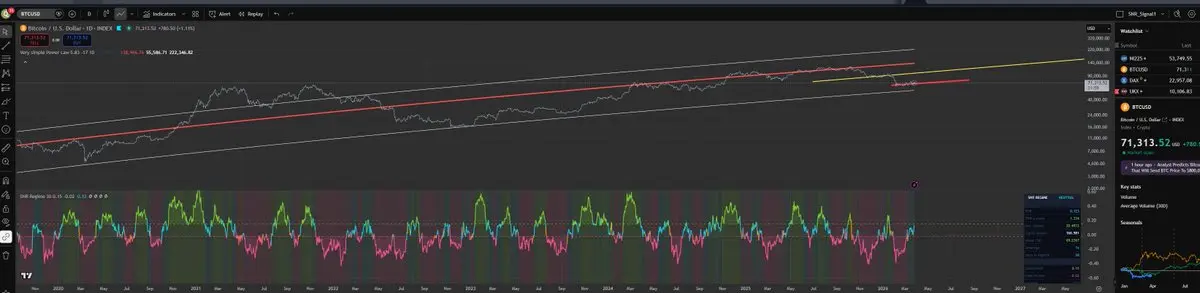
The Power Law Slope Signal to Noise ratio wants to get out of this transition zone to bullish behavior.
Just saying.
post-image
  • Reward
  • Comment
  • Repost
  • Share
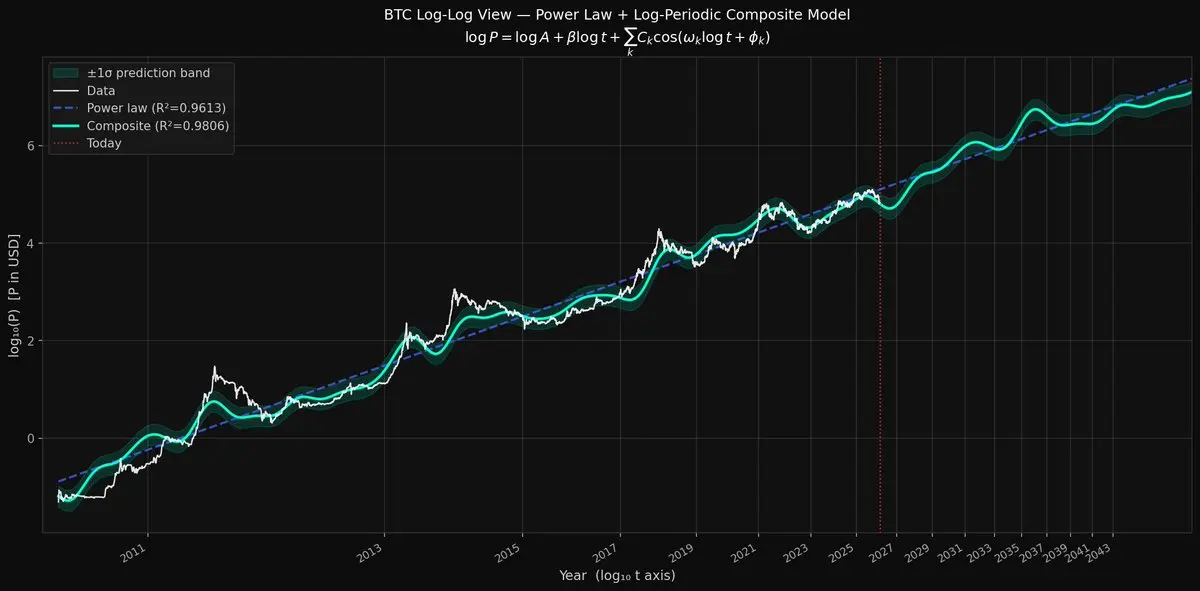
Updated log-periodic model with confidence level to 1 sigma.
I wouldn’t put too much weight on the exact values of the tops and bottoms, but the timing may be more meaningful. According to the model, the next bottom is around August of this year.
What I find compelling about this approach is that it uses a single power law with a complex exponent, rather than imposing an external cycle. In this framework, the oscillatory behavior emerges naturally from the data itself as part of the power-law structure.
The model fits the data well up to the present. The key question, as always, is whether th
post-image
  • Reward
  • 1
  • Repost
  • Share
areejfatimakhizarnaseemvip:
jsiksnzmmMmZhhshhZjjzjzjzjzjzjz
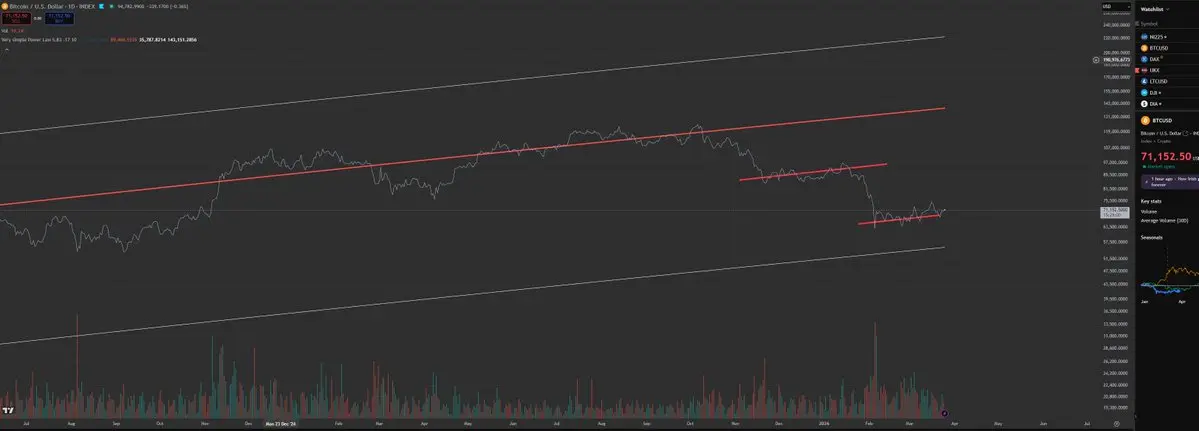
There is something almost absurd about it, once you see it.
Even when Bitcoin's price deviates from the reference power law — trading above or below the central trend — it tends to move parallel to it.
The trajectory shifts, but the slope holds.
This is because what matters is not where you are on the chart, but which direction you are moving.
The power law defines a direction in log-space. And Bitcoin, stubbornly, keeps moving in that direction.
BTC0,18%
post-image
  • Reward
  • 2
  • Repost
  • Share
GateUser-414e2323vip:
let's go to join the event let's keep support keep support for this projects and sponsor let's keep support
View More
I know people are disappointed that we are not recovering from this drawdown very fast but given how other assets are performing in this turbulent time I think Bitcoin is holding well.
In the meanwhile you can order my book and support the scientific study of Bitcoin.
It is a really good book.
BTC0,18%
  • Reward
  • Comment
  • Repost
  • Share
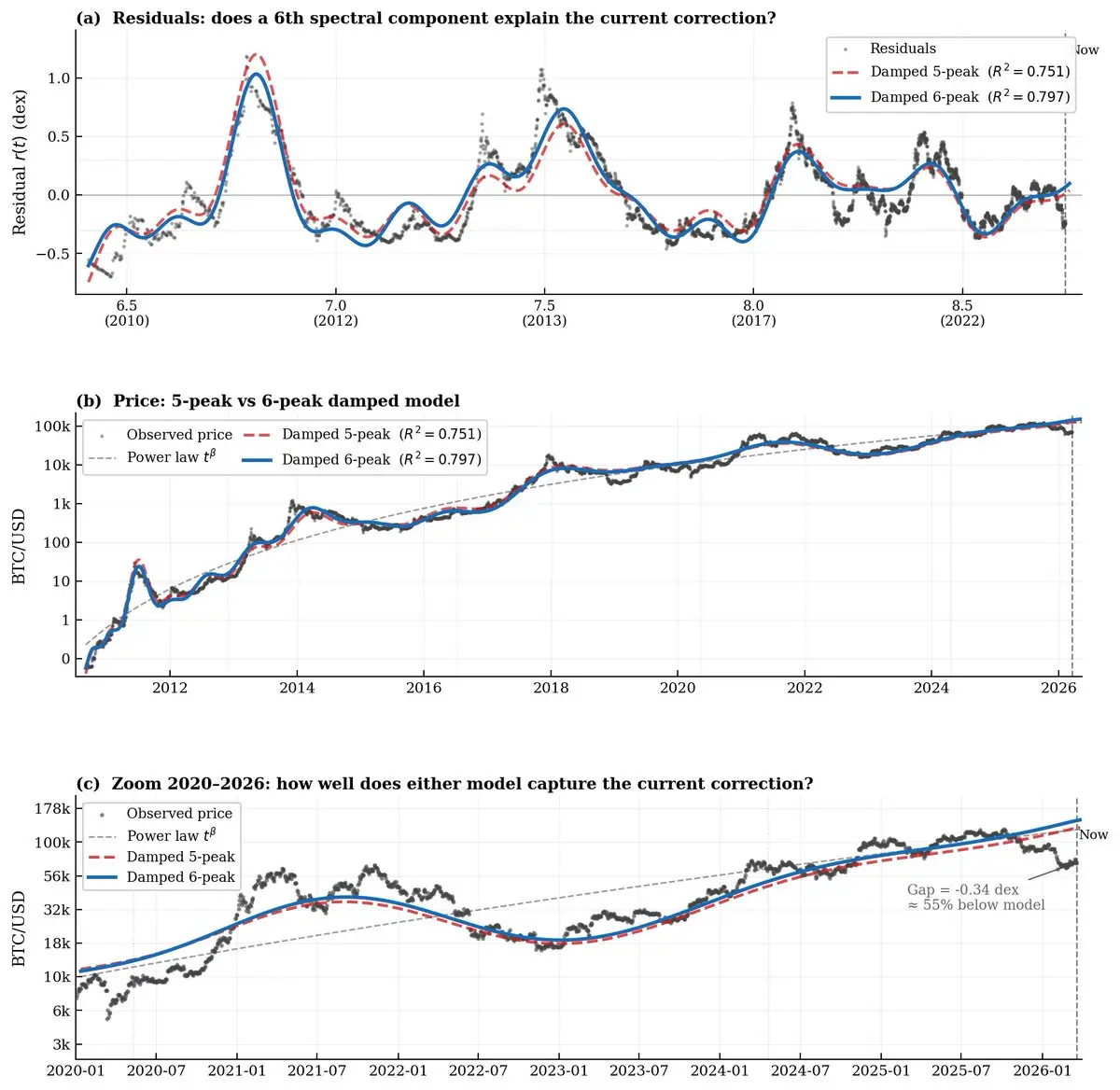
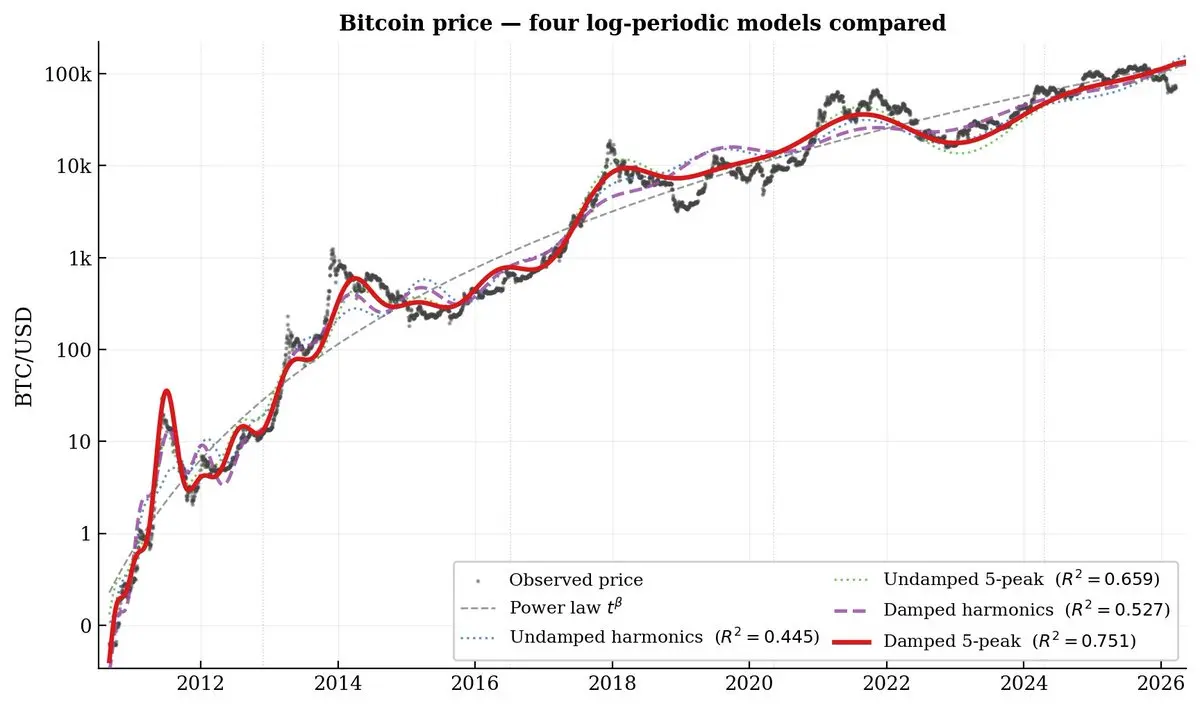
Several people noticed that the log-periodic model doesn't catch the current drawdown. I asked if a 6th peak could explain it. But it doesn't.
The 5-peak damped model predicts the current price at ~$156k — the actual is ~$71k, a gap of 0.28 dex.
Adding the 6th component (ω ≈ 5.15, corresponding to a longer sub-harmonic cycle with λ ≈ 3.4) improves the overall R² marginally from 0.751 to 0.797, but at the current moment it makes the prediction worse, not better — it actually pushes the model to predict ~$175k.
Two possible interpretations, none of which require adding parameters:
1) Pure nois
post-image
  • Reward
  • Comment
  • Repost
  • Share
If you add a damping term then the model is really good.
post-image
  • Reward
  • Comment
  • Repost
  • Share
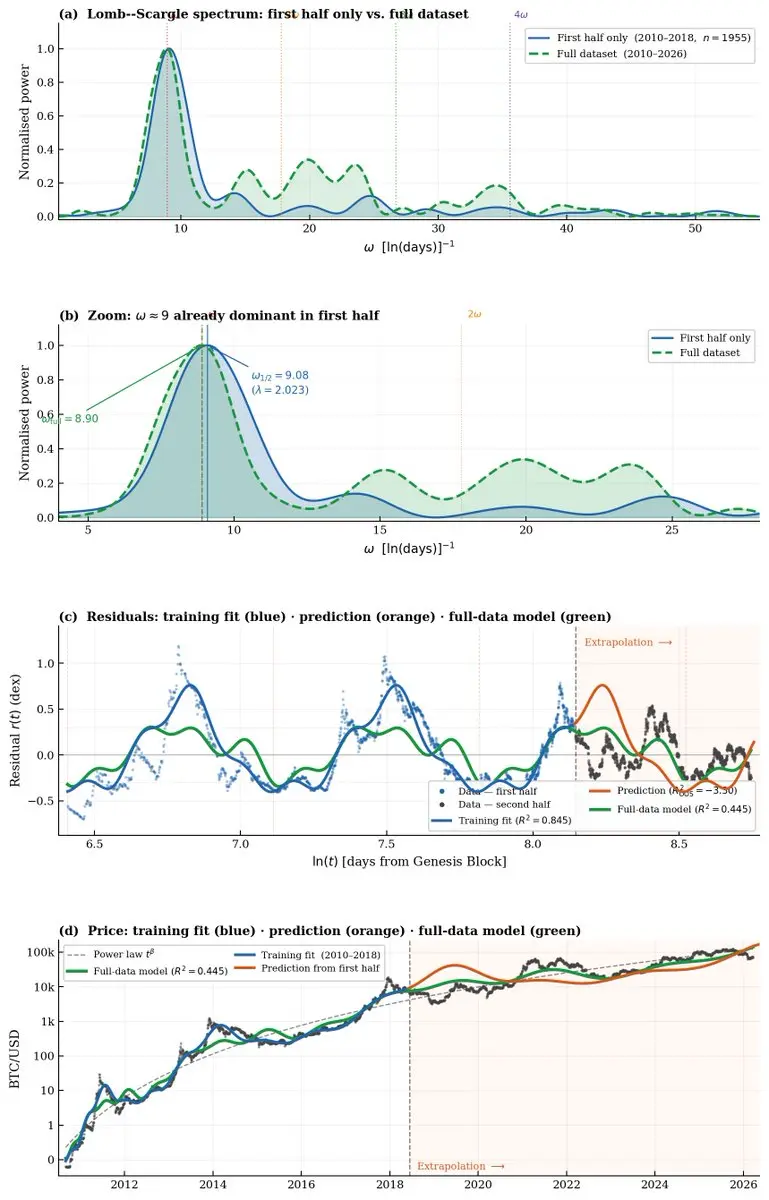
Could we have seen this coming?
Fitting a repeating pattern from just three cycles is genuinely hard. Think of trying to identify the rhythm of a song from hearing only three beats — you can make a reasonable guess, but you won't be certain. That is roughly the situation here.
Yet something important shows up in the Figure below. The spectrum computed from Bitcoin data up to mid-2018 — before the 2021 cycle even began — already shows the same dominant frequency we recover from the full fifteen years of data. The fundamental oscillation was already clearly encoded in the first half of the histo
BTC0,18%
post-image
  • Reward
  • Comment
  • Repost
  • Share
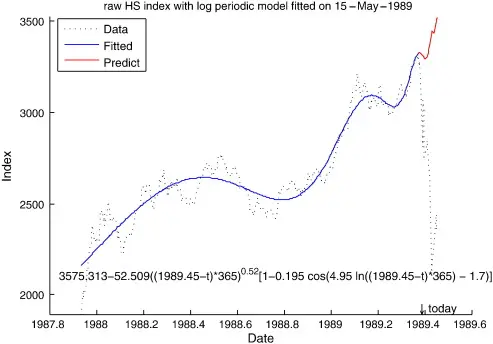
Bitcoin is not a bubble—it is the opposite: an anti-bubble.
The physicist Didier Sornette showed that financial bubbles exhibit log-periodic oscillations that accelerate as a system approaches a critical point—a crash. The oscillations compress in time, becoming faster and more unstable as the market moves toward collapse.
Bitcoin also displays log-periodic behavior, but with a fundamental difference.
In Sornette’s framework, the log-periodicity is anchored to a finite critical time (the crash), and the oscillations are driven by the system’s proximity to that point. As time progresses, everyt
BTC0,18%
post-image
  • Reward
  • Comment
  • Repost
  • Share
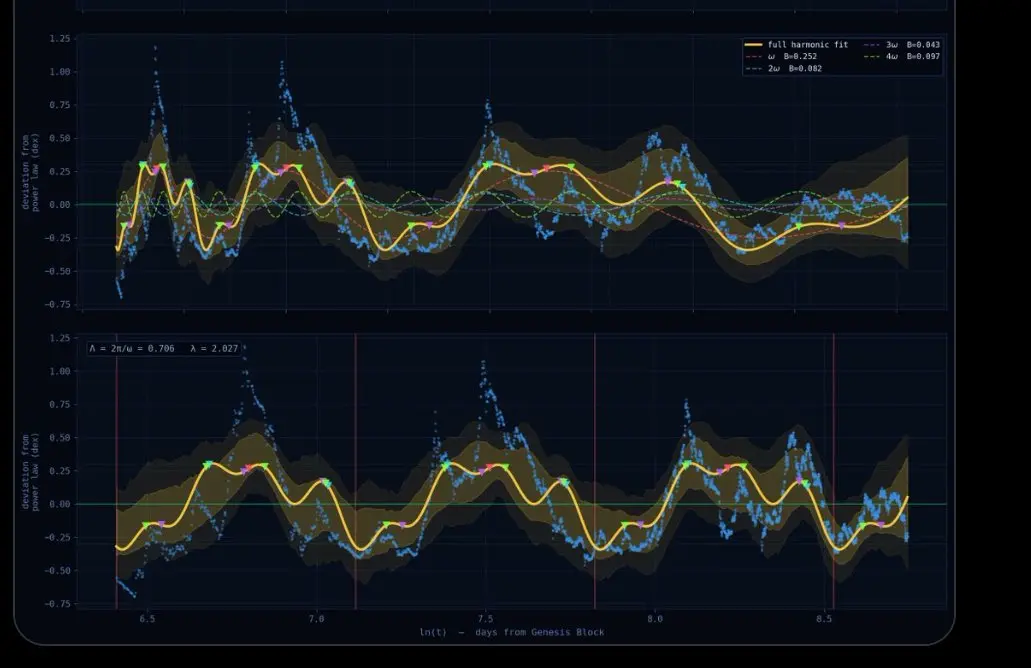
Let me explain this. You see how the 3 peaks structure repeats itself in the top panel but it is stretched over time?
Do you see how it looks perfectly repeating when you plot on the x axis the log of time instead of time?
This is what log periodic means, Bitcoin is not periodic in time but periodic in the log of time, exactly how it is a straight line not in time but in the log of time.
BTC0,18%
post-image
  • Reward
  • Comment
  • Repost
  • Share
Love this one. The ultimate knowledge, one single power law explains both the Bitcoin long term trajectory and the cycles:
P(t) = Re[ C’ · t^(β + iω) ]
BTC0,18%
  • Reward
  • Comment
  • Repost
  • Share
It is happening.
  • Reward
  • Comment
  • Repost
  • Share
This result is more significant than it might appear at first glance.
The two lower panels show what remains of Bitcoin's price history after the long-run power law trend is removed — the raw oscillations, stripped of growth.
That residual is not noise. It is fit almost entirely by a single frequency and its integer multiples: 2×, 3×, 4×. These are harmonics, the same mathematical structure that governs resonance in physical systems from vibrating strings to quantum wells.
But the significance goes deeper than ordinary resonance. The spectrum here is not periodic in time — it is periodic in t
BTC0,18%
  • Reward
  • Comment
  • Repost
  • Share
Projections for the next 15 years.
  • Reward
  • Comment
  • Repost
  • Share
This shows the uncertainties in the log periodic model. The noise explains some of the misalignments and uncertainty on the peak tops and bottoms. But in general the cyclic nature of Bitcoin is reconstructed quite accurately.
This may show the bubbles are not external but internal phenomena with some coupling to macroeconomic factors that need to be studied.
BTC0,18%
  • Reward
  • Comment
  • Repost
  • Share
Models with confidence levels.
  • Reward
  • Comment
  • Repost
  • Share
The Complex Exponent: Trend and Cycles as One
The Long-Run Trajectory
The central result of this book is that Bitcoin's price follows a power law in time. Fitting the full price history in logarithmic scale yields a relationship of the form:
P(t) = a · t^β
where t is the number of days elapsed since the Genesis Block, ais a scaling constant, and β ≈ 5.65 is the power law exponent. In log–log space this is a straight line, and the fit to observed data achieves an R² above 0.96 across more than fifteen years of trading history. The equation is not a model in the conventional financial sense — it
  • Reward
  • Comment
  • Repost
  • Share
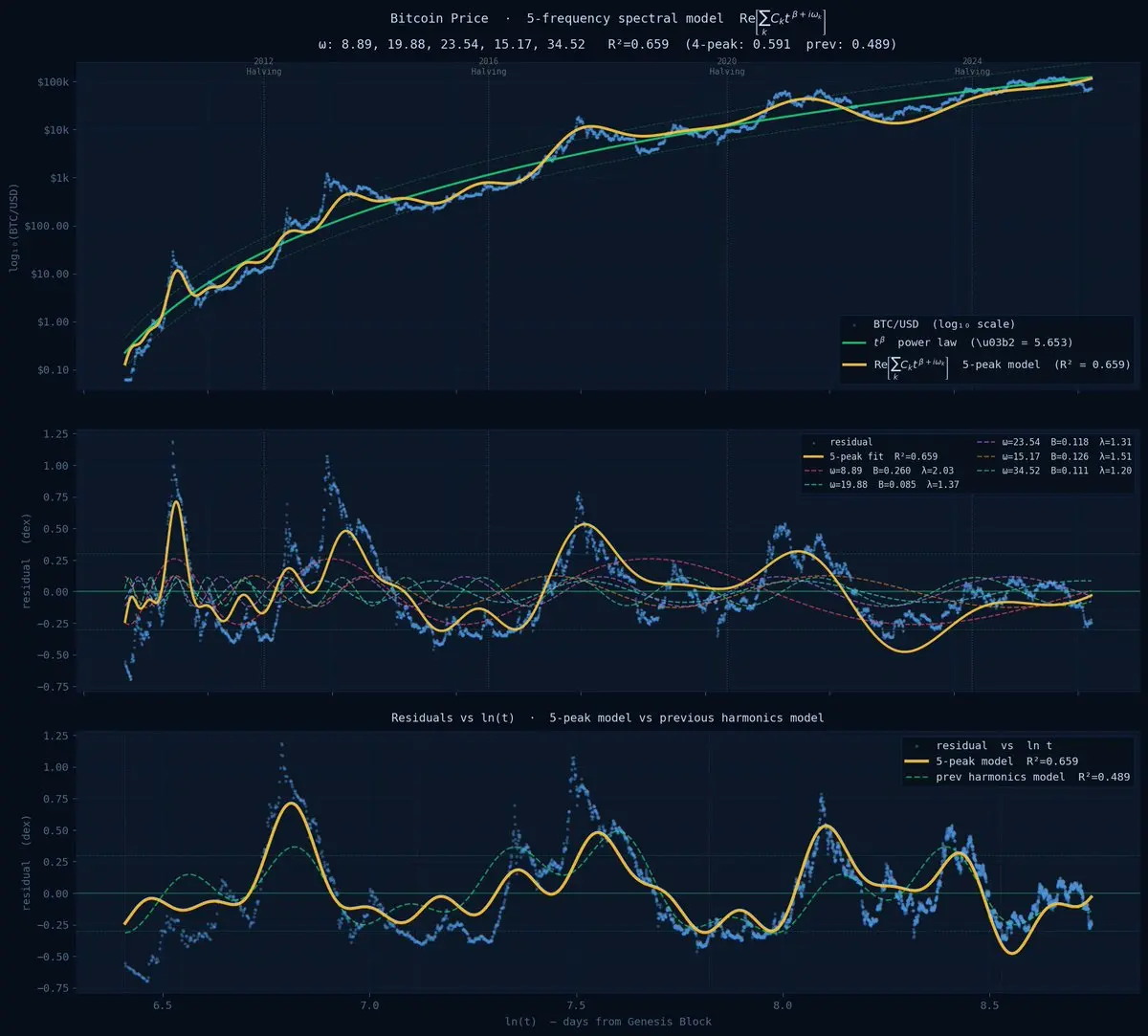
Of course as we add more and more frequencies we tend to overfit based on past data but it is interesting these frequencies are harmonics of the main one so one could in theory add them in a natural way.
Also this works so much better in a log periodic spectrum than a linear one.
post-image
  • Reward
  • Comment
  • Repost
  • Share
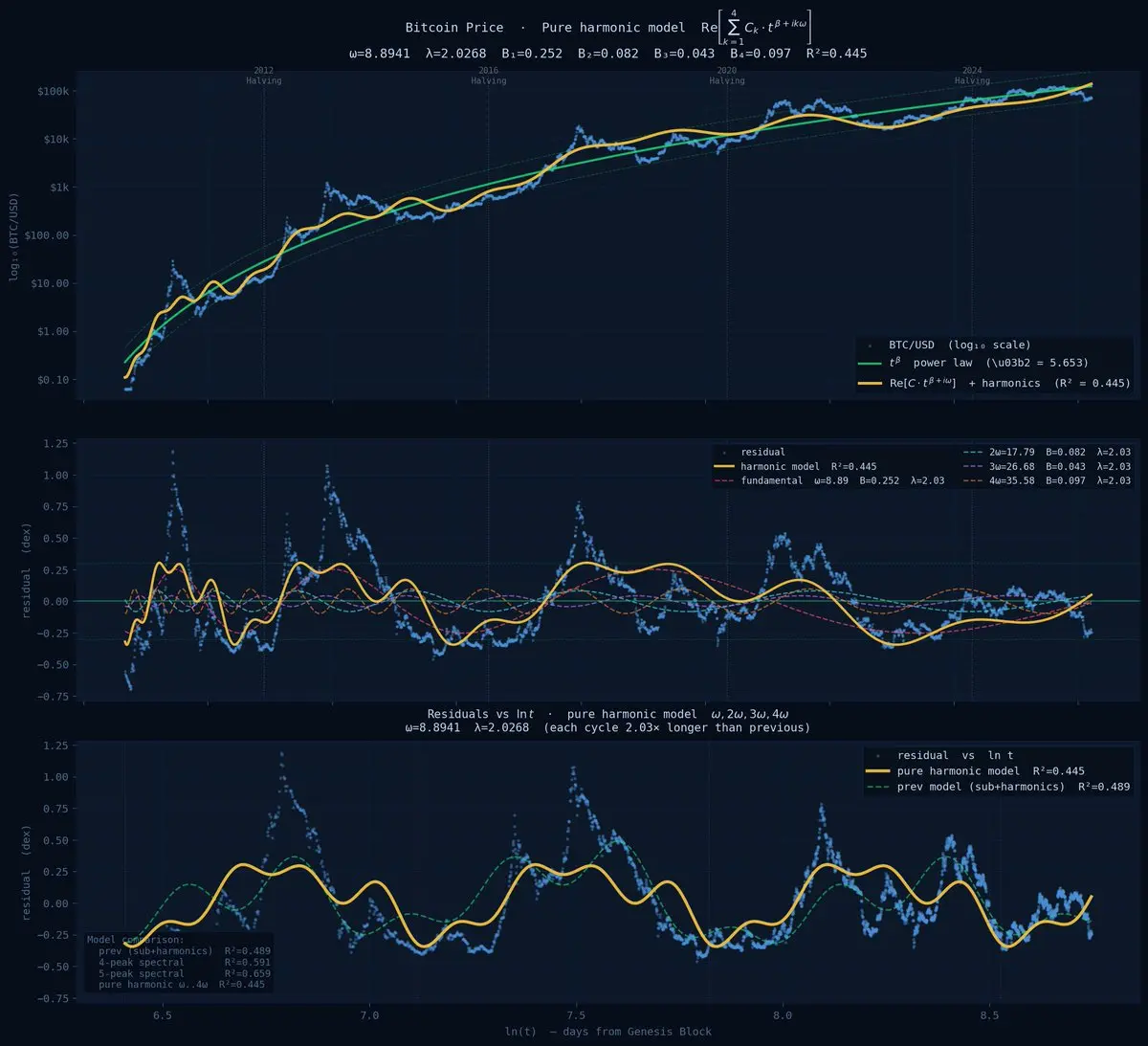
Even just adding more pure harmonics of the main frequency does a pretty good job.
This is really cool.
post-image
  • Reward
  • Comment
  • Repost
  • Share
  • Pin