Juttmunda

vip
Age 0.6 Year
Peak Tier 0
No content yet
#VolatileMarketTradingStrategy
Weekend Volatile Market Trading Strategy: The Harbor Plan
Weekend crypto trading is not about chasing opportunities—it is about surviving uncertainty with discipline. Unlike weekdays, where institutional liquidity provides structure and stability, weekends often become a battlefield of reduced volume, unpredictable spikes, and emotional decision-making.
The Harbor Plan is built on a simple principle:
Capital preservation always comes before capital expansion.
It is not designed for aggressive profit hunting, but for controlled survival in unstable conditions, wh
BTC0.57%
ETH0.59%
HighAmbition
#VolatileMarketTradingStrategy
Weekend Volatile Market Trading Strategy: The Harbor Plan
Weekend crypto trading is not about chasing opportunities—it is about surviving uncertainty with discipline. Unlike weekdays, where institutional liquidity provides structure and stability, weekends often become a battlefield of reduced volume, unpredictable spikes, and emotional decision-making.
The Harbor Plan is built on a simple principle:
Capital preservation always comes before capital expansion.
It is not designed for aggressive profit hunting, but for controlled survival in unstable conditions, where market behavior can shift rapidly without warning.
1. Defense Position During Weekend Volatility
My weekend strategy is built on three core pillars: capital protection, adaptive positioning, and controlled exposure.
In the current market environment, Bitcoin trades around $77,500 with a relatively tight intraday range, while Ethereum remains near $2,300+ levels, yet these calm-looking ranges often hide sudden volatility expansions that can trigger fast liquidations.
To manage this environment:
I maintain a high stablecoin allocation (40–60%), which serves two purposes:
Psychological stability during uncertain price action
Tactical liquidity for selective opportunities
When market sentiment leans toward fear, having liquidity available becomes more valuable than being fully exposed to price movement.
I also use small, controlled spot positions in major assets like Bitcoin and Ethereum, always backed by strict risk limits. Position sizing is kept extremely conservative—typically no more than 2–3% risk per trade, ensuring that even multiple losses cannot significantly damage overall capital structure.
Leverage is either completely avoided or kept at minimal levels, because weekend liquidity conditions often exaggerate price movements, leading to unpredictable swings that can trap over-leveraged positions very quickly.
On the analytical side, I monitor:
Exchange inflow/outflow behavior
Whale wallet activity
Funding rate shifts in derivatives markets
These metrics help identify early signs of volatility before it becomes visible on price charts.
2. Avoiding Weekend Market Traps
The most important skill in weekend trading is timing discipline combined with liquidity awareness.
Weekend markets behave differently because participation is uneven across global regions, leading to fragmented liquidity cycles. This creates false breakouts and sudden reversals that often trap emotional traders.
One practical approach is analyzing the Friday closing range, which often acts as a psychological boundary for weekend price action. Strong Friday closes tend to stabilize weekend structure, while weak closes often lead to unpredictable movement.
Another effective method is volatility bracketing, where expected price boundaries are calculated using recent market volatility. Instead of reacting emotionally, traders pre-define zones where action is valid—and outside of which, they simply stay inactive.
The most important discipline, however, is avoiding impulse trading during low-liquidity hours, where even small orders can create exaggerated price movement. Many weekend losses come not from wrong analysis—but from poor timing and emotional execution.
Sometimes the best trade is simply no trade at all.
3. What to Do When Markets Go Sideways
Sideways markets are not dead markets—they are preparation zones.
Instead of forcing trades, I shift focus to productivity and system improvement:
A. Yield & Passive Strategies
Capital can be temporarily allocated into staking or yield-generating instruments, allowing assets to remain productive during low volatility phases.
This turns inactive market periods into steady accumulation phases, rather than wasted time.
B. Strategy Development & Review
Sideways conditions are ideal for:
Reviewing past trades
Identifying behavioral mistakes
Backtesting strategies
Improving decision-making systems
This is where long-term trading edge is actually built—not during fast-moving markets.
C. Simulation & Paper Trading
Hypothetical trade tracking helps refine strategy logic without financial pressure. It exposes emotional biases and improves execution discipline over time.
D. Market Observation Without Pressure
Engaging with market data, community discussions, and macro trends helps maintain awareness without overexposure. However, emotional noise must be filtered carefully to avoid crowd-driven decision errors.
E. Mental Reset and Discipline Building
Trading performance is heavily dependent on psychology. Weekend markets provide the perfect opportunity to:
Reduce screen time
Improve physical routine
Reset emotional pressure
Avoid burnout cycles
A disciplined trader is not the one who trades constantly—but the one who knows when not to trade.
Final Conclusion
The Harbor Plan is not a strategy for maximizing every market movement—it is a framework for surviving unpredictable environments while protecting long-term capital structure.
Weekend volatility rewards patience more than aggression, discipline more than prediction, and restraint more than reaction.
In trading, survival is not just part of the game—it is the foundation of every future opportunity.
Because ultimately:
The most powerful position in any volatile market is not the one that makes the most profit—but the one that ensures you are still in the game when the next opportunity arrives.

repost-content-media
  • Reward
  • Comment
  • Repost
  • Share
#WCTCTradingKingPK
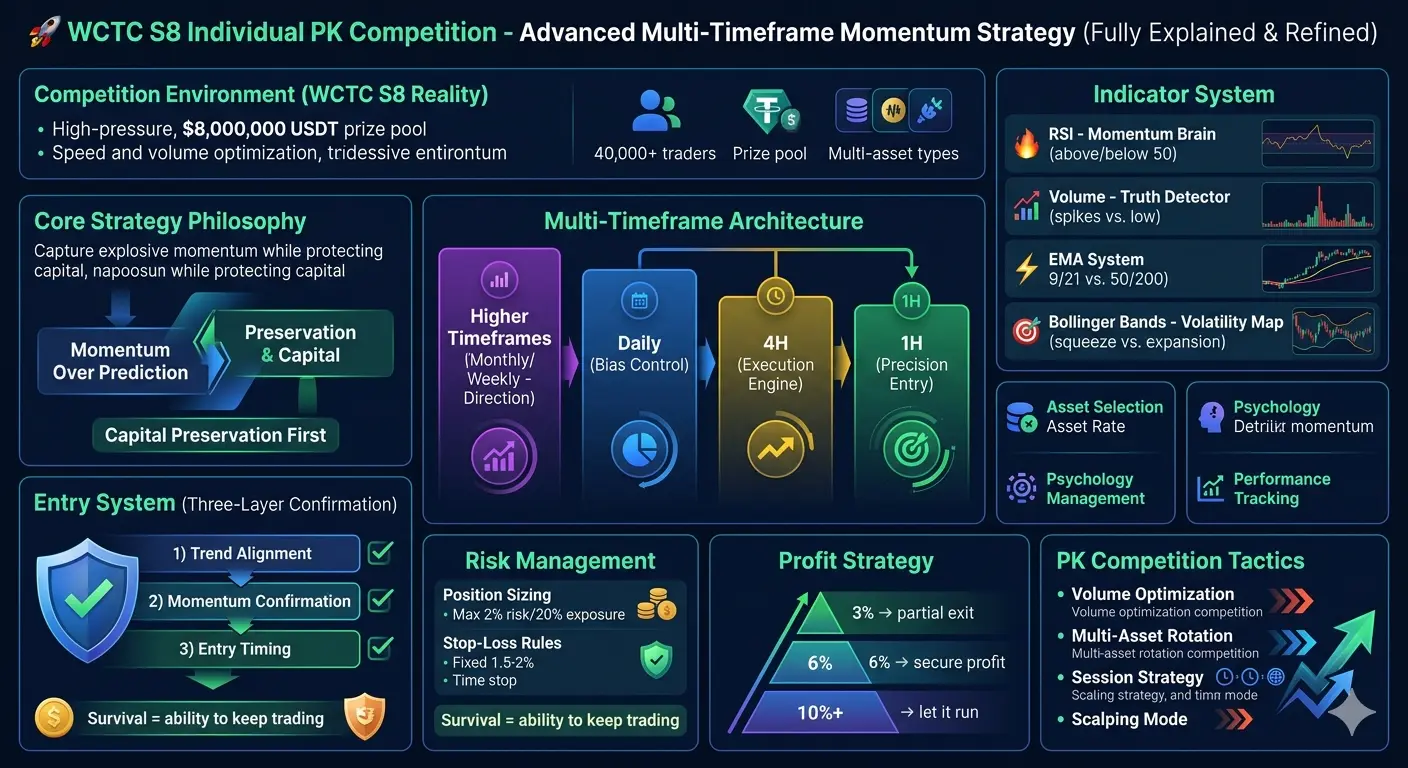
🚀 WCTC S8 Individual PK Competition
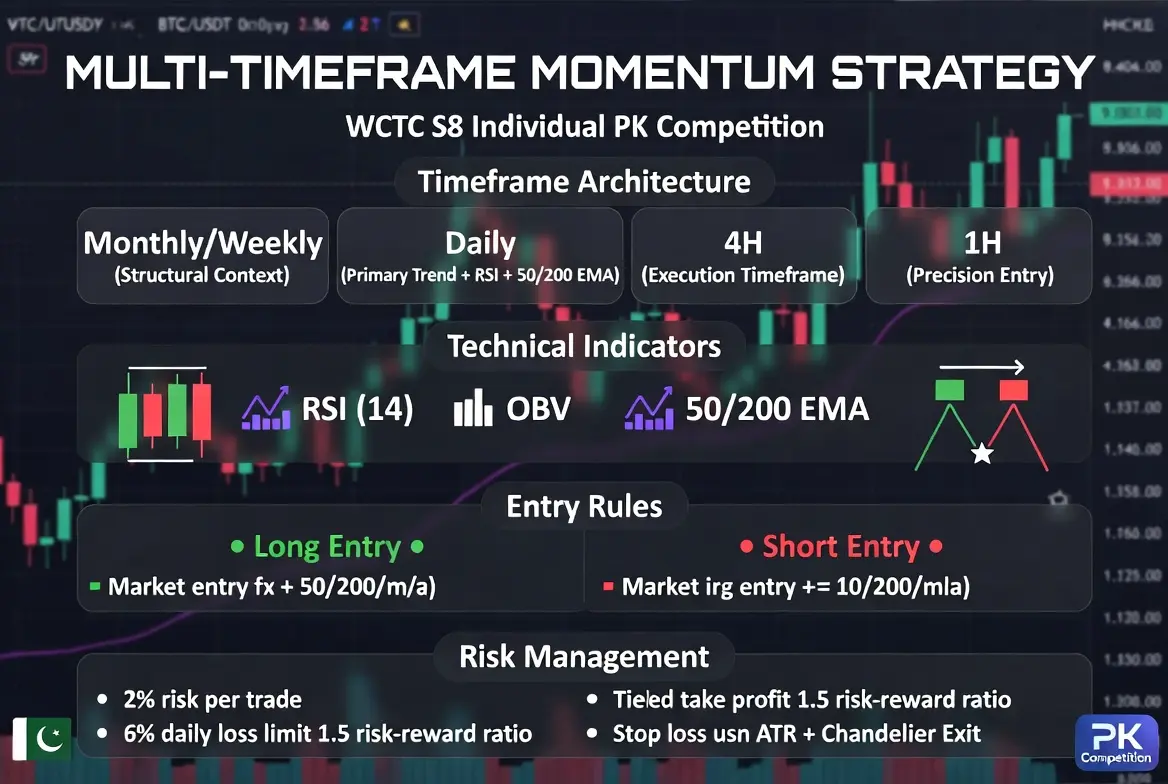
Advanced Multi-Timeframe Momentum Strategy
🧠 Understanding the Competition Environment (WCTC S8 Reality)
The WCTC S8 competition, launched on April 23, 2026, is not a normal trading environment—it is a high-pressure, high-frequency, performance-driven battlefield where both profitability and trading volume determine your ranking.
With a massive $8,000,000 USDT prize pool, over 40,000 traders, and multi-asset integration (crypto + TradFi), this season introduces a completely new dynamic:
👉 You are not just trading for profit
👉 You are
BTC0.57%
ETH0.59%
SOL0.18%
XRP-0.27%
HighAmbition
#WCTCTradingKingPK
🚀 WCTC S8 Individual PK Competition
Advanced Multi-Timeframe Momentum Strategy
🧠 Understanding the Competition Environment (WCTC S8 Reality)
The WCTC S8 competition, launched on April 23, 2026, is not a normal trading environment—it is a high-pressure, high-frequency, performance-driven battlefield where both profitability and trading volume determine your ranking.
With a massive $8,000,000 USDT prize pool, over 40,000 traders, and multi-asset integration (crypto + TradFi), this season introduces a completely new dynamic:
👉 You are not just trading for profit
👉 You are trading for efficiency, speed, and volume optimization
⚙️ Core Strategy Philosophy (Deep Explanation)
This strategy is built on one core idea:
Capture explosive momentum while strictly protecting capital
Unlike traditional trading where patience is key, in PK competition:
Opportunities are short-lived
Moves are fast and aggressive
Decision-making must be instant but structured
🔑 The 3 Core Pillars
1. Momentum Over Prediction
You are NOT predicting tops or bottoms.
You are riding confirmed momentum after it starts.
2. Capital Preservation First
Even in competition:
One bad trade can destroy your rank
Survival = ability to keep trading
3. High-Probability Filtering
You only trade when:
✔ Trend aligns
✔ Momentum confirms
✔ Entry structure is clean
⏱️ Multi-Timeframe Architecture (Why It Matters)
This strategy uses 4 timeframes working together, not separately.
🟣 Higher Timeframes (Direction)
Monthly / Weekly
Identify major zones
Understand long-term structure
Avoid trading into strong resistance/support
🔵 Daily (Bias Control)
Defines main trend direction
Acts as your filter
👉 If Daily is bullish → focus on LONGS
👉 If Daily is bearish → focus on SHORTS
🟡 4H (Execution Engine)
This is your main trading timeframe
Generates setups
Shows structure breaks
Confirms trend continuation
🟢 1H (Precision Entry)
Used for:
Tight entries
Stop-loss placement
Reducing risk
📊 Indicator System (Why Each Tool Matters)
🔥 RSI (Momentum Brain)
Above 50 → bullish momentum
Below 50 → bearish momentum
👉 Key insight:
Momentum shift happens when RSI crosses 50 with volume
📈 Volume (Truth Detector)
Price can lie. Volume cannot.
Use:
Volume spikes → real moves
Low volume → fake breakouts
⚡ EMA System
EMA 9/21 → short-term momentum
EMA 50/200 → trend direction
👉 When all align → high probability trend move
🎯 Bollinger Bands (Volatility Map)
Squeeze → big move coming
Expansion → trend in action
🎯 Entry System (Three-Layer Confirmation)
This is the heart of the strategy
✅ Layer 1: Trend Alignment
Daily + 4H must agree
Price must respect EMA direction
👉 No alignment = NO TRADE
✅ Layer 2: Momentum Confirmation
RSI breakout
Volume spike (important!)
Strong candle structure
✅ Layer 3: Entry Timing
Enter on 1H confirmation
Use structure for stop-loss
👉 This reduces fake entries significantly
🛡️ Risk Management (Critical for Survival)
💰 Position Sizing
Risk per trade: Max 2%
Total exposure: Max 20%
👉 Never go all-in—even in competition
❌ Stop-Loss Rules
Fixed SL: 1.5–2%
Time stop: Exit if no movement
👉 No movement = dead trade
🎯 Profit Strategy
3% → partial exit
6% → secure profit
10%+ → let it run
⚔️ PK Competition Tactics (Game-Changing Edge)
🔁 Volume Optimization
Because of 150% multiplier on spot:
👉 Use spot trading smartly
👉 Rotate positions quickly
🔄 Multi-Asset Rotation
Don’t stick to one market:
Crypto → high volatility
Gold → macro reaction
Indices → session-based moves
⏰ Session Strategy
Asian → slow, range
EU → trend builds
US → biggest moves
👉 Trade aggressively in US session
⚡ Scalping Mode
When needing volume:
Quick trades (1–2%)
Tight stops
High frequency
🧩 Asset Selection (Where to Focus)
🔵 Tier 1 (Main Focus)
BTC → trend leader
ETH → confirmation
SOL → volatility
🟡 Tier 2 (Volume Boost)
XRP, DOGE, ADA
High liquidity alts
🟢 Tier 3 (Diversification)
Gold (XAU)
Indices
Forex
🧠 Psychology (Most Underrated Edge)
✅ Winning Mindset
Focus on execution, not ranking
Stay consistent
Accept small losses
❌ Avoid These Mistakes
Overtrading
Revenge trading
Ignoring stop-loss
Overconfidenc
🔬 Advanced Edge Techniques
📌 Multi-Timeframe Confluence
More timeframes aligned = stronger trade
⚠️ Fake Breakout Detection
Wait for candle close
Confirm with volume
🚀 Volatility Expansion
Trade breakouts after squeeze
Ride momentum
🔗 Correlation Trading
BTC leads market
Alts follow
👉 Use this for better entries
📊 Performance Tracking (Professional Approach)
Daily Check
Win rate
Risk vs reward
Volume progress
Weekly Review
What worked
What failed
Adjust strategy
🧠 Final Strategic Insight
This competition is NOT about:
❌ One big trade
❌ High risk gambling
It IS about:
✔ Consistency
✔ Discipline
✔ Smart volume usage
🏁 Final Advice
Start slow → build rhythm
Focus on clean setups only
Protect capital at all costs
Adapt to market conditions
🔥 Ultimate Truth
In WCTC S8, the winners are not the smartest traders—
they are the most disciplined, consistent, and adaptable.
repost-content-media
  • Reward
  • Comment
  • Repost
  • Share
#CryptoMarketSeesVolatility
Crypto Market Volatility:
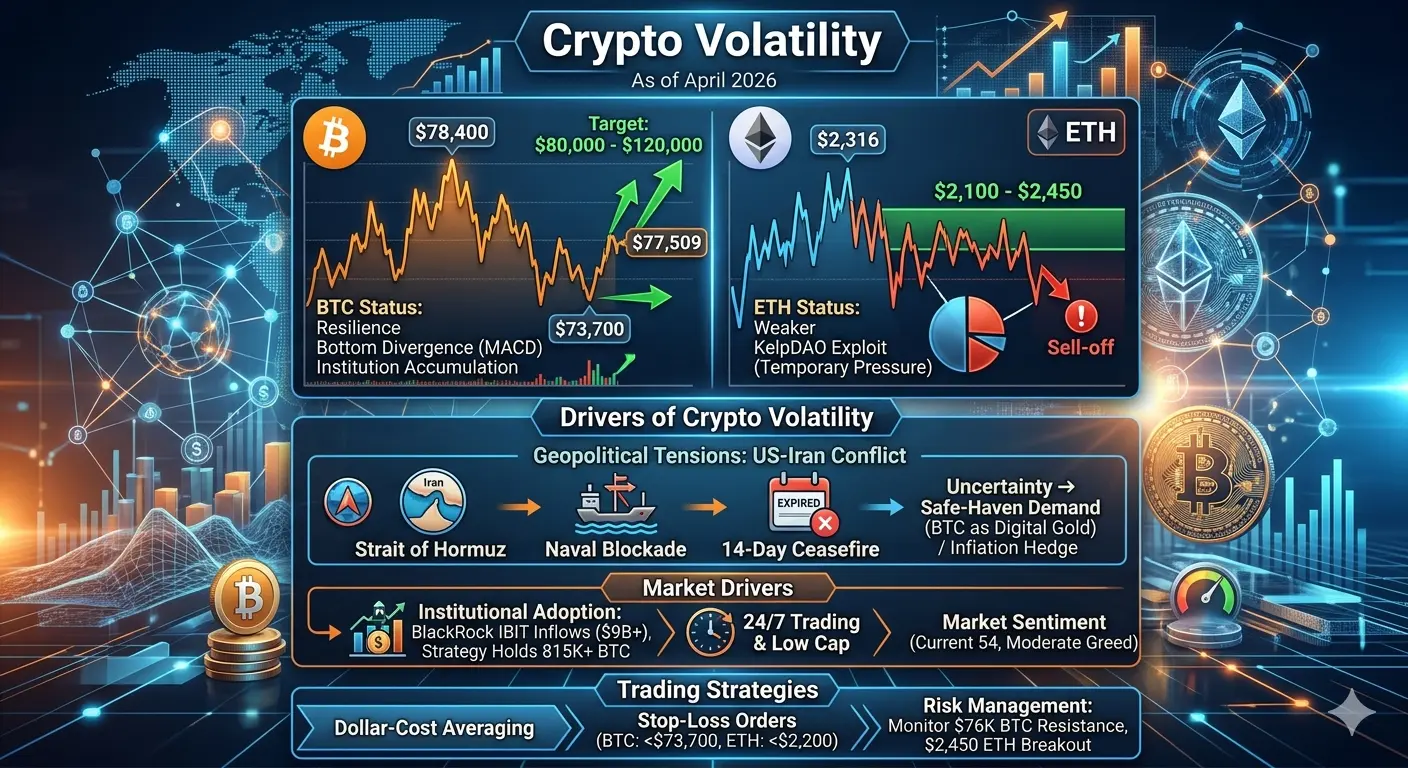
The cryptocurrency market is currently experiencing heightened volatility, with Bitcoin trading around $77,509 and Ethereum at $2,316 as of April 26, 2026. This article provides a detailed examination of the current market conditions, price forecasts, trading strategies, and the geopolitical factors influencing crypto volatility.
Understanding Crypto Market Volatility
Crypto markets are inherently more volatile than traditional financial markets due to several fundamental characteristics. Unlike stocks or bonds that trade during fixed hou
BTC0.57%
ETH0.59%
HighAmbition
#CryptoMarketSeesVolatility
Crypto Market Volatility:
The cryptocurrency market is currently experiencing heightened volatility, with Bitcoin trading around $77,509 and Ethereum at $2,316 as of April 26, 2026. This article provides a detailed examination of the current market conditions, price forecasts, trading strategies, and the geopolitical factors influencing crypto volatility.
Understanding Crypto Market Volatility
Crypto markets are inherently more volatile than traditional financial markets due to several fundamental characteristics. Unlike stocks or bonds that trade during fixed hours, cryptocurrencies operate 24/7, making them susceptible to price movements at any time. The limited supply of Bitcoin (capped at 21 million coins) creates scarcity-driven price swings when demand fluctuates. Additionally, the relatively smaller market capitalization compared to traditional assets means that large buy or sell orders can significantly impact prices.
Market sentiment plays a crucial role in crypto volatility. News events, regulatory announcements, and social media trends can trigger rapid price movements. The decentralized nature of cryptocurrencies means there is no central authority to stabilize prices, leaving markets to be driven purely by supply and demand dynamics. Leverage trading in crypto markets amplifies these movements, as liquidations of overleveraged positions can cascade into larger price swings.
Current Market Status: BTC and ETH Analysis
Bitcoin has shown resilience in recent weeks, with the price swinging from a 10-week high of approximately $78,400 to support levels around $73,700 before stabilizing near current levels. The 24-hour trading volume stands at over $142 million, indicating healthy liquidity. Technical indicators show mixed signals: the 4-hour chart displays a MACD底背离 (bottom divergence), suggesting potential upward momentum, while the daily SAR indicates a bearish trend.
Ethereum has been relatively weaker compared to Bitcoin, trading around $2,316 with a 24-hour volume of approximately $91 million. ETH has underperformed BTC recently, with the ETH/BTC pair breaking down from bearish patterns. The bandwidth on daily charts has narrowed significantly, indicating that a significant price move may be imminent.
US-Iran Tensions and Market Impact
Geopolitical developments between the United States and Iran have created additional uncertainty in global markets, indirectly affecting cryptocurrency prices. Recent negotiations between US and Iranian officials in Pakistan ended without agreement, with Iranian Foreign Minister Abbas Araghchi departing Islamabad before planned talks could commence. President Trump subsequently canceled the trip of US negotiators Steve Witkoff and Jared Kushner.
The conflict centers on control of the Strait of Hormuz, a critical chokepoint for global oil shipments. Iran has demanded that the US lift its naval blockade on Iranian ports before engaging in further negotiations. The 14-day ceasefire between the US, Israel, and Iran expired in late April, creating uncertainty about potential military escalation.
These geopolitical tensions impact crypto markets through several channels. First, uncertainty drives investors toward safe-haven assets, with Bitcoin increasingly viewed as digital gold. Second, disruptions to oil shipments can trigger inflation concerns, potentially benefiting cryptocurrencies as inflation hedges. Third, risk-off sentiment in traditional markets can spill over into crypto, causing correlated sell-offs during periods of extreme stress.
Price Forecasts and Technical Outlook
Analysts have varying outlooks for BTC and ETH prices in the near term. Bitcoin price predictions target the $80,000 to $120,000 range, with some analysts citing institutional accumulation and regulatory clarity as catalysts. The CLARITY Act, which has a 65% probability of passage according to prediction markets, could provide the regulatory framework needed for larger institutional allocations.
Ethereum price forecasts for April 2026 suggest a range between $2,100 and $2,450. ETH is currently trading near its 200-day moving average at $2,310, with the monthly RSI at 52 indicating neutral momentum. However, ETH faces challenges from the recent KelpDAO exploit, which resulted in the theft of over 100,000 ETH, creating temporary selling pressure.
Trading Strategy Recommendations
For traders navigating this volatile environment, several strategies merit consideration. Dollar-cost averaging remains effective for long-term investors, allowing purchases at various price levels to smooth out volatility. Setting stop-loss orders is essential to protect capital during sudden downturns, with recommended stops placed below key support levels at $73,700 for BTC and $2,200 for ETH.
Technical traders should monitor the $76,000 resistance level for Bitcoin, as a breakout above this level could trigger algorithmic buying and push prices toward $80,000. For Ethereum, watch for a break above $2,450 as a bullish signal or a drop below $2,200 as a bearish indicator.
Risk management is paramount in volatile markets. Position sizing should reflect the increased uncertainty, with smaller positions recommended until clearer directional trends emerge. Diversification across different crypto assets can help mitigate single-coin risk, though correlations tend to increase during market stress.
Why Markets Become Volatile
Crypto market volatility stems from multiple interconnected factors. Liquidity conditions play a major role, with thinner order books during weekends or holidays leading to larger price swings. Regulatory uncertainty continues to weigh on markets, with different jurisdictions adopting varying approaches to crypto oversight.
Macroeconomic factors including interest rates, inflation data, and currency movements influence crypto prices. The Federal Reserve's monetary policy stance affects risk assets broadly, including cryptocurrencies. Recent concerns about dollar weakness and potential hyperinflation scenarios have fueled interest in Bitcoin as an alternative store of value.
Technological developments and network upgrades can also drive volatility. Ethereum's ongoing evolution, including layer-2 scaling solutions and staking mechanisms, creates both opportunities and uncertainties for investors. Security incidents, such as the KelpDAO exploit, remind markets of the risks inherent in decentralized finance protocols.
Market Sentiment and On-Chain Data
Current market sentiment has shifted from extreme fear to moderate greed, with the Crypto Fear and Greed Index reading around 54. On-chain data reveals interesting dynamics: Strategy (formerly MicroStrategy) has accumulated over 815,000 BTC, surpassing BlackRock as the largest single-entity holder. BlackRock's IBIT ETF has seen significant inflows, with over $9 billion added recently.
Institutional accumulation contrasts with retail trader behavior, which has shown signs of exhaustion after months of downside pressure. Whale activity indicates that large holders are positioning for potential upside, with significant ETH purchases observed at current levels.
Conclusion
The crypto market is navigating a complex environment characterized by geopolitical uncertainty, regulatory developments, and evolving institutional adoption. Bitcoin and Ethereum remain the bellwethers of the market, with their price action likely to determine broader crypto sentiment.
Traders should remain vigilant regarding US-Iran developments, as escalation or resolution could trigger significant market movements. Technical levels provide guidance for entry and exit points, while risk management remains essential given the inherent volatility of crypto markets.
The path forward depends on multiple factors: successful resolution of geopolitical tensions, regulatory clarity from major economies, continued institutional adoption, and the technical development of blockchain networks. Investors who understand these dynamics and manage risk appropriately can navigate volatility while positioning for potential upside in this evolving asset class.
repost-content-media
  • Reward
  • Comment
  • Repost
  • Share
#rsETHAttackUpdate
rsETH Attack Update: A Comprehensive Analysis of the KelpDAO Exploit and Its Impact on Crypto Markets
April 18, 2026 will be remembered as a defining moment in DeFi history, when KelpDAO’s rsETH token became the center of a massive cross-chain exploit that sent shockwaves across the entire crypto market. This was not just a hack involving stolen funds, but a deep structural failure that exposed how fragile cross-chain systems can be, while at the same time testing the strength, behavior, and psychology of market participants in real time.
The Exploit: Technical Breakdown
Th
ZRO-4.43%
ETH0.59%
HighAmbition
#rsETHAttackUpdate
rsETH Attack Update: A Comprehensive Analysis of the KelpDAO Exploit and Its Impact on Crypto Markets
April 18, 2026 will be remembered as a defining moment in DeFi history, when KelpDAO’s rsETH token became the center of a massive cross-chain exploit that sent shockwaves across the entire crypto market. This was not just a hack involving stolen funds, but a deep structural failure that exposed how fragile cross-chain systems can be, while at the same time testing the strength, behavior, and psychology of market participants in real time.
The Exploit: Technical Breakdown
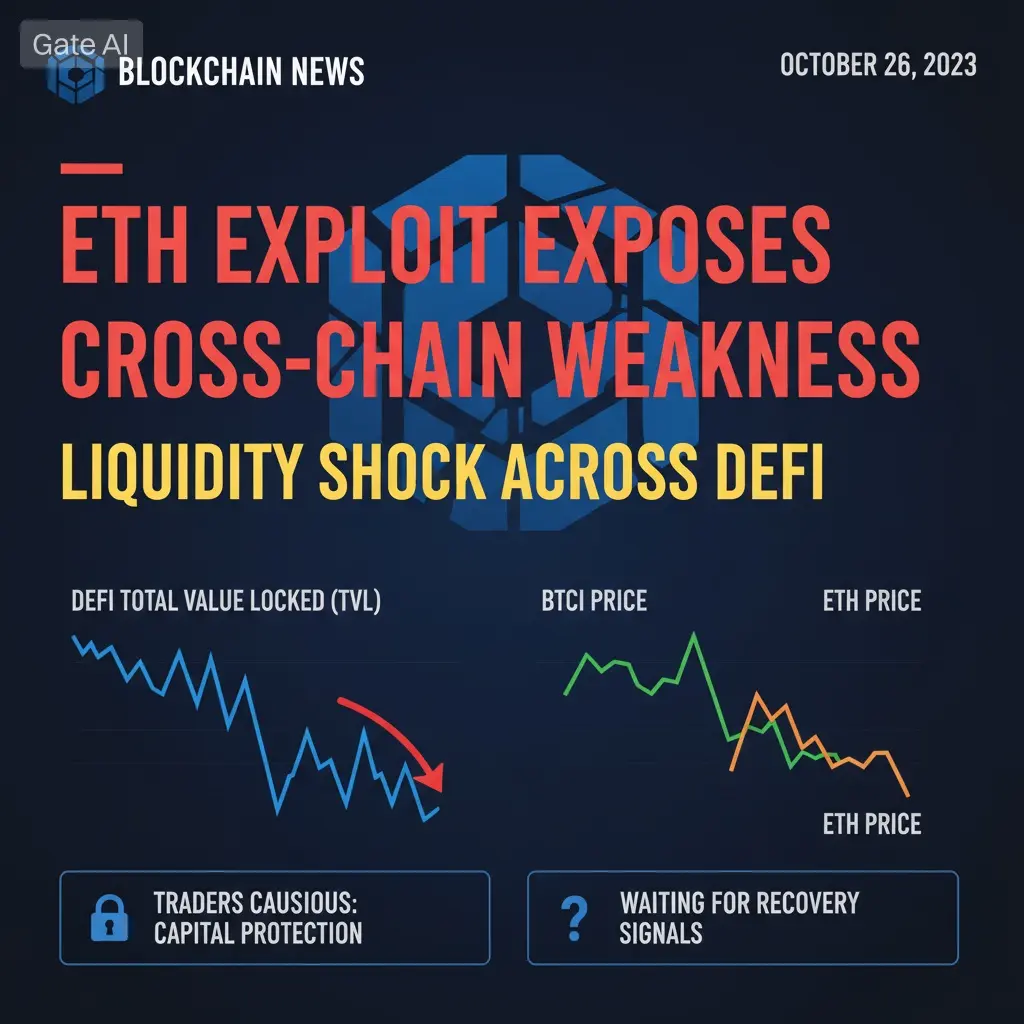
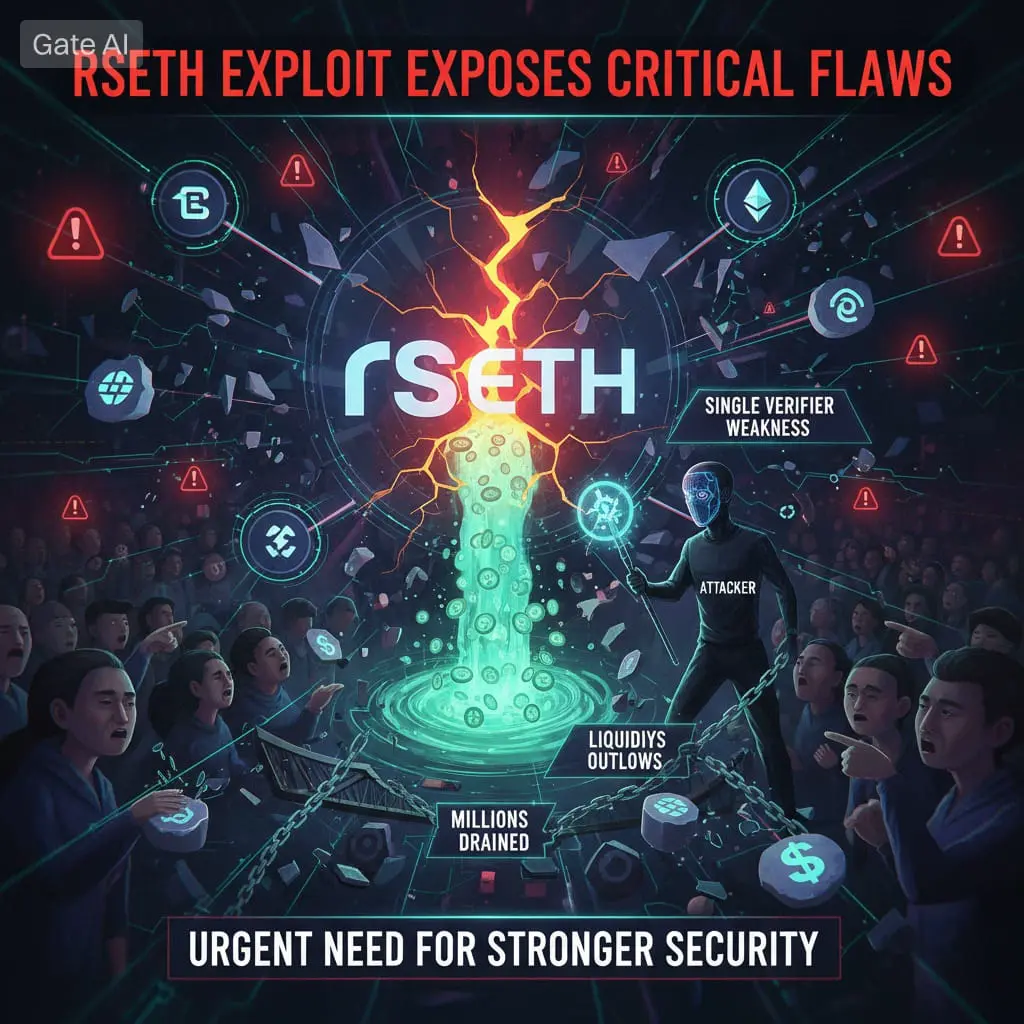
The attacker targeted LayerZero infrastructure and exploited a flaw in cross-chain message validation, allowing them to mint approximately 116,500 rsETH without depositing any real collateral. This represented nearly 36% of the supply and instantly created a synthetic liquidity shock that rippled across DeFi.
After minting, the attacker moved funds strategically, converted them into ETH, and routed them through Tornado Cash to reduce traceability, showing a high level of planning and execution.
The DeFi Contagion: Liquidity Shock Across the Market
The real crisis began when the attacker used fake rsETH as collateral on Aave and extracted around 106,000 ETH, leaving over $177 million in bad debt. This triggered a liquidity crunch where lending pools hit maximum utilization, borrowing froze, and multiple protocols had to shut down rsETH-related activity.
Within 48 hours, DeFi TVL dropped from $26 billion to nearly $20 billion, clearly showing that the impact was not isolated but systemic. Capital began exiting high-risk pools rapidly, and network congestion increased as users rushed to reposition.
Impact on the Broader Crypto Market
This event did not stay limited to DeFi, as it directly influenced the broader crypto market sentiment.
Bitcoin held relatively strong around the $76,000–$78,000 range, acting as a safe haven, while Ethereum showed mild weakness and hovered around $2,280–$2,350 due to its deeper exposure to DeFi.
Altcoins, especially those connected to DeFi narratives, experienced sharper drawdowns as traders reduced risk exposure. Liquidity shifted from speculative tokens toward majors like BTC and ETH, reflecting a classic risk-off rotation inside crypto itself.
Trader Psychology: What the Market Is Thinking
Right now, the market is not in panic mode, but it is definitely in caution mode.
Retail traders are confused and slightly fearful, questioning the safety of DeFi yields and cross-chain systems, while experienced traders are viewing this as a reset phase rather than a collapse.
Smart money is thinking in three layers:
Short-term: Protect capital and avoid unstable protocols
Mid-term: Wait for confirmation of recovery (DeFi United success)
Long-term: Accumulate quality assets at discounted levels
This difference in mindset is critical because it shows that the market is rotating, not exiting.
What Traders Are Planning Next
Professional traders are not chasing trades right now; instead, they are preparing for the next move.
Most are watching key triggers:
Recovery progress of rsETH ecosystem
Stability in lending protocols
Ethereum price holding key support
Their plans include:
Entering after confirmation, not during chaos
Focusing on BTC and ETH dominance plays
Avoiding high-risk DeFi tokens temporarily
Using lower leverage due to unpredictable volatility
In simple terms:
👉 Right now is a positioning phase, not an aggression phase.
DeFi United: A Critical Turning Point
The coordinated effort by protocols like Aave, Arbitrum, and Lido to raise over 100,000 ETH is being closely watched by the market.
If this initiative succeeds, it could restore confidence and trigger a relief rally across DeFi assets. If it struggles, it may extend uncertainty and delay recovery.
Price Outlook: Key Levels to Watch
For Ethereum:
Strong support: $2,250 – $2,300
Key resistance: $2,350 – $2,400
If ETH holds support and breaks resistance, momentum could push toward $2,500. However, if support fails, a deeper retracement toward $2,150 is possible.
For Bitcoin:
Support: $75,000
Resistance: $78,500 – $80,000
BTC strength remains a key indicator of overall market stability.
Strategy: How Smart Traders Are Navigating This
In the current environment, traders are focusing on:
Reducing exposure to complex cross-chain ecosystems
Prioritizing liquidity and capital preservation
Entering trades only after confirmation signals
Keeping cash or stablecoin reserves ready for opportunities
This is not a market for impulsive decisions; it is a market for disciplined execution.
Conclusion
The rsETH exploit has temporarily shaken confidence, but it has not broken the crypto market. Instead, it has highlighted the difference between weak and strong systems, emotional and strategic traders, and short-term panic versus long-term conviction.
In the short term, volatility and uncertainty will remain elevated, but in the long term, this event is likely to lead to stronger infrastructure, better risk management, and a more mature DeFi ecosystem.
The market is not collapsing — it is recalibrating.
And those who understand this phase will be the ones best positioned for the next major move
repost-content-media
  • Reward
  • Comment
  • Repost
  • Share
#US-IranTalksStall
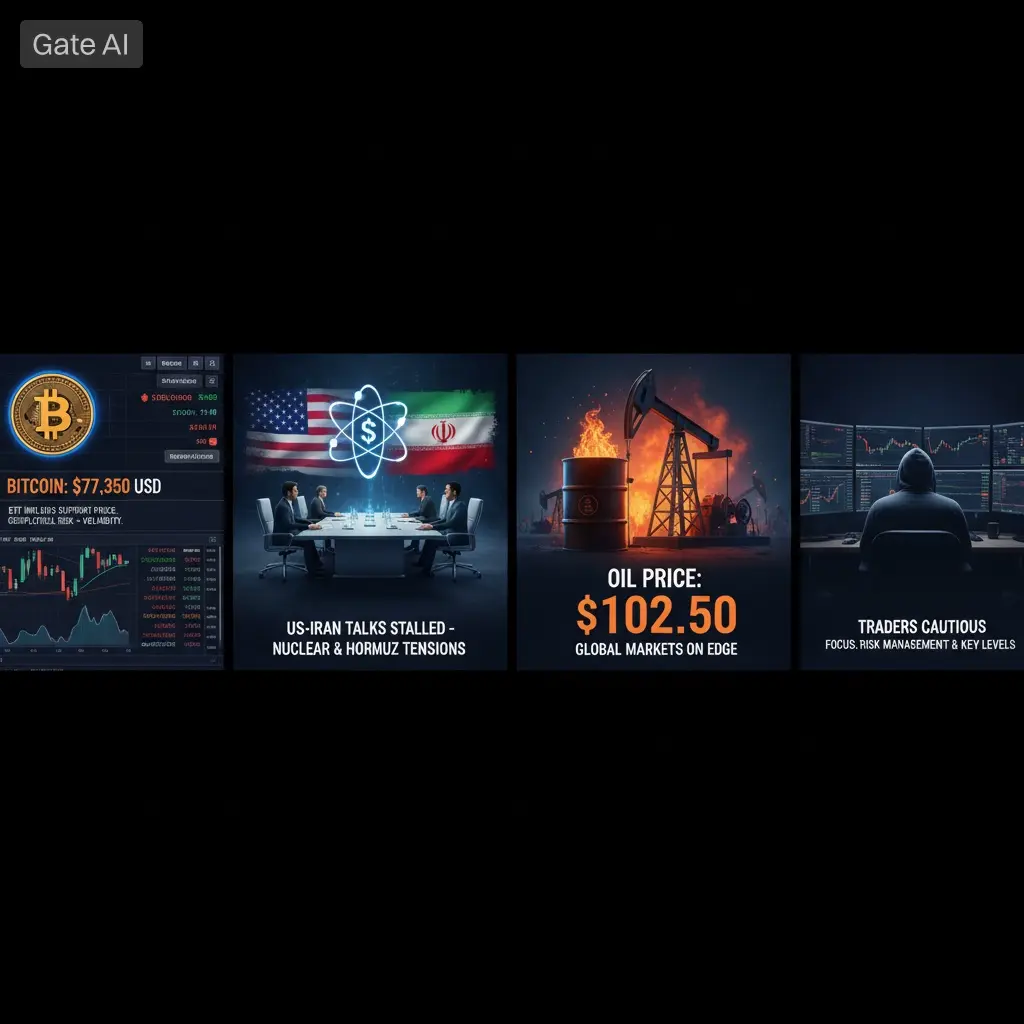
US-Iran Nuclear Talks Stall:
Why Are The Talks Stalled?
The negotiations between the United States and Iran have reached a complete deadlock due to multiple interconnected factors:
1. Fundamental Disagreement on Nuclear Enrichment
The core sticking point centers on the duration of Iran's nuclear enrichment freeze. Iran insists on maintaining its nuclear program sovereignty while the US demands comprehensive dismantling. Iranian hardliners, particularly within the IRGC (Islamic Revolutionary Guard Corps), view any negotiations under current conditions as granting the US a "
HighAmbition
#US-IranTalksStall
US-Iran Nuclear Talks Stall:
Why Are The Talks Stalled?
The negotiations between the United States and Iran have reached a complete deadlock due to multiple interconnected factors:
1. Fundamental Disagreement on Nuclear Enrichment
The core sticking point centers on the duration of Iran's nuclear enrichment freeze. Iran insists on maintaining its nuclear program sovereignty while the US demands comprehensive dismantling. Iranian hardliners, particularly within the IRGC (Islamic Revolutionary Guard Corps), view any negotiations under current conditions as granting the US a "low-cost victory" that violates Iran's declared red lines.
2. US Naval Blockade of Iranian Ports
President Trump ordered a naval blockade of Iran's ports in response to Iran's closure of the Strait of Hormuz since February 28, 2026. Iran considers this blockade a violation of the ceasefire agreement, while the US maintains it as necessary pressure. This blockade has hardened Iranian negotiating positions significantly.
3. Internal Iranian Power Struggle
There is reported infighting within Iran's leadership. Hardline elements led by figures like Vahidi oppose negotiations entirely, viewing them as having "no present value." IRGC-affiliated outlets argue that discussing the Strait of Hormuz would signal doubt over Iranian sovereignty. Meanwhile, Foreign Minister Araghchi reportedly believes participation offers little benefit and amounts to a "death sentence" for the talks under current Supreme Leader orders.
4. The "No Deal-No War" Limbo
Tehran has warned that talks may stall in a dangerous limbo where neither war nor peace prevails. The fragile two-week ceasefire expired recently, with both sides expressing readiness to resume hostilities. Pakistan-mediated talks failed to materialize after Iran pulled out of the second round.
5. Trump's Hardline Stance
President Trump cancelled a planned trip to Pakistan for negotiations, stating "we have all the cards, they have none." He has refused to lift the Hormuz blockade until a comprehensive deal is agreed, creating a chicken-and-egg situation where neither side will move first.
The Strait of Hormuz Crisis
The Strait of Hormuz represents the world's most critical oil chokepoint:
Global Significance: Approximately one-fifth of global oil supply and LNG flows through this narrow waterway
Current Status: Effectively closed due to the standoff, with tankers blocked from passage
Iran's Position: Claims full sovereignty over the strait and opposes any negotiations that would question this
US Response: Naval blockade preventing Iranian shipping, creating a counter-blockade situation
According to Baker Hughes and Dallas Fed surveys, nearly 80% of oil executives believe the strait will not reopen until August 2026 or later. This prolonged closure scenario is driving persistent risk premiums in oil markets.
Oil Market Impact and Price Forecasts
Current Oil Prices:
Brent Crude: Trading above $104-107 per barrel
WTI Crude: Around $101-102 per barrel
Price Increase: Oil has climbed roughly 12% recently, on pace for the biggest weekly gain since early March 2026
Why Oil Prices Are Surging:
1. Supply Disruption Risk: The Strait of Hormuz closure threatens nearly 20% of global oil supply
2. Shipping Cost Explosion: The Breakwave Tanker Shipping ETF has surged over 600% year-to-date as freight rates skyrocket
3. Refined Fuel Crisis: Diesel and jet fuel prices have rocketed to over $200 at times, showing demand destruction in Asian markets
4. Geopolitical Risk Premium: Markets pricing in sustained uncertainty
Price Forecasts:
Goldman Sachs: Estimates oil price increases ranging from $1-15 per barrel depending on disruption duration; warns prices can rise significantly above fair-value during high geopolitical uncertainty
EIA Forecast: Brent to fall below $90/b in Q4 2026 and average $76/b in 2027 (highly dependent on Hormuz reopening)
J.P. Morgan: Expects Brent averaging around $60/b in 2026 (bearish scenario assuming resolution)
Bloomberg Economics: For oil around $110/barrel, projects marked boost to inflation and blow to growth
ANZ: Expects Brent above $90/barrel in 2026, ending year at $88 due to supply loss
Key Risk: If Iran escalates and oil pushes toward $75-80 (currently already above $100), institutions will likely flip into full risk-off mode, triggering broader market selloffs.
Bitcoin Market Volatility Analysis
Current BTC Status:
Price: $77,517 (as of latest data)
24-hour change: +0.08%
7-day performance: +2.21%
30-day performance: +16.78%
How Geopolitical Tensions Are Affecting BTC:
1. Correlation with Oil
Bitcoin has shown a notable inverse correlation with oil price spikes. When oil started ripping higher in early 2026, BTC dropped fast from above $105K into the mid-$90Ks. The pattern is clear: oil moves first, BTC reacts second.
2. Resilience Factor
Interestingly, Bitcoin has proven more resilient than oil and equities to recent Iran-related flare-ups. The modest 1.6% pullback in BTC during the latest escalation stood against a 5.7% jump in Brent and 1.2% drop in European equity futures. Shrinking BTC sell-offs with each Iran shock suggest crypto may have largely priced in geopolitical tail risk.
3. Institutional Flows Support
US spot Bitcoin ETFs have seen 8 consecutive days of inflows exceeding $2 billion total, with weekly inflows near $1 billion - the highest since mid-January. Strategy (MicroStrategy) purchased 34,164 BTC for approximately $254 million at an average price of $74,395, bringing total holdings to 815,061 BTC. This institutional demand provides a floor.
4. Fear and Greed Index
Current reading of 33 indicates fear territory, but with 66% positive sentiment versus 17% negative, there is underlying bullish conviction.
Technical Levels to Watch:
Support: $74,000 - $73,000 range
Resistance: $78,000 (recently breached), next target $80,000
Daily SAR indicates bearish trend but 15-minute and 4-hour charts show mixed signals with MACD底背离 (bottom divergence) suggesting potential reversal
BTC Forecast:
If oil stays contained below $110, BTC can stabilize and potentially rally toward $80K-$88K. However, if oil breaks above $110-120 on full Hormuz closure, expect BTC to retest $70K-$73K support. The ETF bid has become a more reliable floor than futures-driven weekend gaps.
Trading Strategy Recommendations
For Conservative Traders:
1. Risk Management Priority
Reduce position sizes by 20-30% during high geopolitical uncertainty
Maintain 40-50% cash reserves for dip-buying opportunities
Set stop-losses at $72,000 for long BTC positions
2. Hedging Approach
Consider put options on BTC at $70K strike for protection
Allocate 10-15% to gold as traditional safe haven (currently $4,713/oz)
Dollar-cost average rather than lump sum entries
For Aggressive Traders:
1. Volatility Plays
Trade range-bound strategies between $73K-$78K
Use grid trading bots to capture oscillations
Consider longing oil proxies (energy ETFs) while shorting risk assets if tensions escalate
2. Breakout Strategies
Long BTC on confirmed break above $78,500 with target $82K
Short BTC on break below $73,000 with target $68K
Monitor oil price as leading indicator for crypto moves
Key Levels to Watch:
Oil:
Bullish above $110 (Hormuz closure extended)
Bearish below $95 (talks progress)
Bitcoin:
Critical support: $73,000-$74,000
Major resistance: $78,000-$80,000
Breakout target: $88,000 (probability currently low at 1% for April 20-26 window)
General Tips:
1. Watch Oil First: Oil prices lead, BTC follows. Monitor Brent crude as your primary geopolitical risk gauge.
2. ETF Flows Matter: Track US spot Bitcoin ETF daily flows. Sustained inflows above $200M/day support price floors.
3. Avoid Weekend Gaps: Geopolitical developments often occur weekends when crypto trades but traditional markets closed. Be cautious holding large positions over weekends.
4. Dollar Strength: Geopolitical instability drives dollar strength (DXY), which typically pressures BTC. Monitor DXY above 104 as bearish for crypto.
5. Time Horizon: If you're a long-term holder, these dips below $75K present accumulation opportunities. If trading short-term, respect the volatility and use tight stops.
6. News Sensitivity: Any headline about "Hormuz reopening" or "talks resume" will cause immediate moves. Have alerts set for major news sources.
Summary: The Complete Picture
The US-Iran talks are stalled due to irreconcilable differences on nuclear enrichment, compounded by the US naval blockade and internal Iranian power struggles. The Strait of Hormuz remains effectively closed, with 80% of industry experts expecting no reopening before August 2026. This is driving oil prices above $104-107 with forecasts ranging from $76-$110 depending on resolution timeline.
Bitcoin has shown surprising resilience, trading around $77,500 with institutional ETF inflows providing support. However, the correlation with oil means that if crude breaks significantly higher on escalation, BTC will likely face pressure toward $70K-$73K support.
Traders should prioritize risk management, maintain cash reserves for opportunities, use oil as a leading indicator, and set alerts for any breakthrough in negotiations. The current environment favors patient, defensive positioning with readiness to act quickly on any resolution news.
repost-content-media
  • Reward
  • Comment
  • Repost
  • Share
#USMilitaryMaduroBettingScandal
The US Military Maduro Betting Scandal and Its Crypto Market Shockwaves:
The so-called US Military Maduro Betting Scandal has rapidly evolved into one of the most controversial intersections of geopolitics, military intelligence, decentralized prediction markets, and cryptocurrency speculation, raising not only legal and ethical questions but also forcing the entire crypto ecosystem to confront a difficult reality: what happens when real-world classified information collides with permissionless financial systems that never sleep.
At the center of the controver
HighAmbition
#USMilitaryMaduroBettingScandal
The US Military Maduro Betting Scandal and Its Crypto Market Shockwaves:
The so-called US Military Maduro Betting Scandal has rapidly evolved into one of the most controversial intersections of geopolitics, military intelligence, decentralized prediction markets, and cryptocurrency speculation, raising not only legal and ethical questions but also forcing the entire crypto ecosystem to confront a difficult reality: what happens when real-world classified information collides with permissionless financial systems that never sleep.
At the center of the controversy lies an extraordinary allegation that a U.S. Special Forces soldier allegedly transformed approximately $33,034 in total wagers into nearly $409,881 in profit, by placing strategic bets on a crypto-based prediction platform (Polymarket) linked to geopolitical outcomes surrounding a covert military operation against Venezuelan President Nicolás Maduro.
1. The Core Event: From Classified Operation to Market Catalyst
The turning point of this entire narrative begins with Operation Absolute Resolve, a highly sensitive and coordinated U.S. military mission reportedly executed on January 3, 2026, involving elite units such as Special Forces, Delta Force, Navy SEALs, Marines, Air Force support, cyber warfare teams, and intelligence divisions, operating in a synchronized, multi-domain strike environment involving more than 150 aircraft and advanced electronic warfare systems.
The mission allegedly resulted in the swift capture and extraction of Nicolás Maduro and Cilia Flores, a development that was later publicly acknowledged at the highest political level, immediately reshaping geopolitical expectations and triggering shockwaves across both traditional financial markets and crypto-native prediction platforms.
However, the scandal does not revolve around the military operation itself, but rather what allegedly happened before the operation became public knowledge.
2. The Alleged Betting Structure and Exact Financial Exposure
According to investigative filings, Master Sergeant Gannon Ken Van Dyke allegedly accessed non-public operational intelligence and used it to place approximately 13 separate trades on prediction markets between late December 2025 and January 2026.
The financial structure of these trades is critical:
Total capital deployed: ~$33,034
Platform: Polymarket (via VPN and multiple accounts)
Strategy: concentrated “YES” positions on low-probability geopolitical outcomes
Key contracts reportedly included:
“Maduro removed by January 31, 2026”
“U.S. military presence in Venezuela confirmed”
“U.S. invasion-related probability markets”
“War Powers authorization involving Venezuela”
At the time of entry, these markets were priced with extremely low implied probabilities—some reportedly near 6% or even lower, meaning YES shares were heavily discounted and only profitable under rare or extreme geopolitical escalation.
When the operation succeeded and markets resolved accordingly, the outcome was explosive:
Total payout: ~$442,915
Net profit: ~$409,881
Return multiple: approximately 12x to 13x+ overall capital efficiency
This kind of return is rare even in crypto markets, and almost unheard of in traditional finance, which is why it immediately triggered both fascination and regulatory alarm.
3. The Core Debate: Insider Advantage or Market Inefficiency?
This is where the controversy becomes intellectually and financially complex.
One argument suggests:
If prediction markets are truly efficient, then any correct foresight—regardless of source—should be rewarded by price discovery.
However, the opposing argument is far stronger from a regulatory standpoint:
If the foresight comes from classified military intelligence, then the market is no longer reflecting public probability—it is reflecting privileged access, which destroys fairness and market integrity.
This creates a fundamental contradiction in decentralized systems:
Crypto ideology promotes open access and permissionless participation
Regulatory frameworks demand fairness and equal information distribution
When these two collide, as allegedly seen in this case, the entire structure becomes legally and ethically unstable.
4. Crypto Market Impact: Beyond Prediction Markets
While the scandal did not directly crash Bitcoin or Ethereum, it created secondary ripple effects across the crypto ecosystem, particularly in sentiment-sensitive and infrastructure-related assets.
A. Prediction Market Sector Pressure
Tokens and protocols associated with decentralized forecasting systems, including governance and dispute-resolution layers such as UMA, experienced increased volatility pressure as traders began pricing in regulatory intervention risk and potential legal restructuring of event-based markets.
Even without direct selling pressure, valuation models shifted because investors started discounting future adoption assumptions, replacing them with uncertainty premiums linked to compliance risk.
B. Ethereum Ecosystem Reaction
Since most prediction markets operate on Ethereum-based infrastructure, the broader ETH ecosystem experienced a subtle behavioral shift:
Reduced speculative flow into high-risk event trading
Temporary slowdown in aggressive on-chain betting activity
Slight reallocation of liquidity toward more stable DeFi strategies
Ethereum itself remained structurally stable, but the risk appetite layer of the ecosystem clearly contracted, showing how narrative shocks can influence capital behavior without triggering price collapse.
C. Stablecoin Flow Disruption
A less visible but highly important effect occurred in stablecoin circulation patterns, particularly USDC-based betting flows.
Reduced deposits into prediction markets
More cautious capital deployment into geopolitical contracts
Increased monitoring of transaction flows by compliance teams
This reflects a broader structural truth:
Prediction markets are not isolated gambling tools—they are liquidity sinks connected to the entire crypto settlement layer.
5. Market Psychology Shift: The Trust Shock
Perhaps the most important impact was not price-based but psychological.
Before the scandal:
Traders treated prediction markets as crowd-sourced probability engines
Risk was primarily seen as volatility-driven
After the scandal:
Traders began questioning whether probabilities are truly “crowd-derived”
Fear of hidden informational advantages increased
Confidence in fairness of geopolitical contracts weakened
This shift changes behavior permanently because crypto markets are heavily narrative-driven, and once trust assumptions break, they are difficult to restore.
6. Wider Regulatory and Structural Consequences
Regulators across multiple jurisdictions responded rapidly:
Increased scrutiny from the CFTC
Legal disputes between federal and state authorities in the U.S.
Brazil blocking 27 prediction platforms, restricting political and war-related contracts
Global push toward tighter KYC, geofencing, and contract restrictions
This suggests a future where prediction markets may evolve into:
Highly regulated forecasting tools
Or fragmented offshore speculative ecosystems
The direction depends on whether regulators prioritize innovation or risk containment.
7. Final Analytical Debate: Innovation vs Control
This scandal forces the crypto industry into a deep philosophical conflict:
On one side:
Prediction markets are powerful truth engines
They transform information into price discovery
They democratize forecasting globally
On the other side:
They are vulnerable to insider asymmetry
They can be influenced by non-public intelligence
They may unintentionally monetize classified knowledge
The Maduro betting case becomes a real-world stress test of this contradiction.
8. Conclusion
The alleged transformation of ~$33,034 into ~$409,881 profit is not just a financial anomaly—it is a symbolic event representing the collision of three systems:
Military intelligence operations
Decentralized crypto prediction markets
Global regulatory enforcement frameworks
While Bitcoin and Ethereum did not experience direct structural shocks, the broader crypto ecosystem absorbed a clear sentiment shift toward caution, compliance awareness, and reduced appetite for politically sensitive speculation.
Ultimately, this case demonstrates a critical truth about modern crypto markets:
In decentralized systems, information is no longer just power—it is liquidity, and when that information is asymmetric at a state level, even “free markets” begin to lose their definition of fairness.
repost-content-media
  • Reward
  • Comment
  • Repost
  • Share
#TopCopyTradingScout
The hashtag represents a growing movement within the cryptocurrency trading community, particularly centered around Gate.io's Copy Trading Gold Scout campaign that ran from April 22 to May 10, 2026. This initiative was designed with a substantial prize pool of 10,000 USDT to incentivize community members to identify, evaluate, and recommend top-performing lead traders on the platform. The campaign structure was thoughtfully divided into three distinct participation categories, each targeting different types of community engagement and rewarding participants accordingly.
T
HighAmbition
#TopCopyTradingScout
The hashtag represents a growing movement within the cryptocurrency trading community, particularly centered around Gate.io's Copy Trading Gold Scout campaign that ran from April 22 to May 10, 2026. This initiative was designed with a substantial prize pool of 10,000 USDT to incentivize community members to identify, evaluate, and recommend top-performing lead traders on the platform. The campaign structure was thoughtfully divided into three distinct participation categories, each targeting different types of community engagement and rewarding participants accordingly.
The first component of this program, titled Insightful Talent Scout, focused on the discovery and recommendation aspect of copy trading. Participants were required to reply with the designated hashtag, recommend specific lead traders by their nicknames, attach screenshots of the traders' homepages, and share their personal copy trading experiences. This activity alone offered 30 USDT in copy trading bonuses to 100 selected winners, demonstrating the platform's commitment to gathering authentic user feedback about successful traders. The second component, Strong Support, encouraged participants to showcase their own copy trading journey by posting screenshots of their trading records, with 120 winners receiving 50 USDT each. The third and most valuable component, Added Value, targeted social media influence by asking participants to cross-post their recommendations on X/Twitter using either #GateCopyTrading or #Copy Trading Gold Scout tags, with the top 10 social experts selected based on post view metrics receiving 100 USDT each.
Understanding the mechanics of copy trading scout programs requires delving into how modern copy trading ecosystems function. Copy trading has evolved significantly from its early days as a simple follow-the-leader feature into a sophisticated investment strategy that incorporates data analytics, risk assessment, and performance benchmarking. On platforms like Gate.io, the copy trading system operates through an objective algorithm that evaluates lead traders based on multiple performance metrics including Sharpe Ratio, yield curves, return on investment, profit and loss records, and overall trading consistency. This algorithmic approach helps copiers make informed decisions rather than relying solely on superficial metrics like recent gains or popularity.
The role of a copy trading scout extends beyond mere recommendation; it involves critical analysis of trading styles, risk management practices, and long-term sustainability of trading strategies. Professional scouts evaluate traders based on their ability to survive different market conditions, their risk management protocols, and their capacity to maintain consistency over extended periods. This analytical approach is crucial because copy trading success is fundamentally about aligning with traders who demonstrate discipline and adaptive decision-making rather than those who achieve temporary high profits through excessive risk-taking.
The Gate.io platform has further refined its copy trading ecosystem by introducing tiered lead trader levels, including the Expert Lead Trader designation. This premium level offers enhanced benefits such as a 20% profit-sharing ratio, an additional 1% bonus ratio, the ability to lead up to 1,000 copiers, and lead trading funds ranging from 100,000 to 200,000 USDT. To qualify for this elite status, traders must first achieve advanced lead trader status with full slots, join the lead trader risk control system, and apply through business development channels or the platform's copy trading Telegram group. This tiered structure ensures that top-tier traders maintain high standards while providing copiers with access to proven performers.
The copy trading landscape in 2026 has become increasingly sophisticated, with the gap between professional traders and average participants widening significantly. Modern copy trading is no longer just about convenience; it has evolved into a strategic necessity for many investors. The cryptocurrency market now operates as a high-speed, liquidity-sensitive environment where capital flows, derivatives positioning, and algorithmic execution dominate short-term price action. In such conditions, having access to professional-level execution through copy trading provides everyday traders with tools previously available only to institutional participants.
Risk management remains a critical consideration in copy trading scout activities. Successful scouts understand that evaluating a lead trader requires looking beyond surface-level profitability metrics. Key evaluation criteria include the trader's maximum drawdown history, their win rate consistency across different market cycles, their position sizing discipline, and their ability to adapt strategies when market conditions shift. The most valuable scouts are those who can identify traders capable of preserving capital during downturns while capturing upside during favorable conditions.
The community aspect of copy trading scout programs cannot be understated. These initiatives foster knowledge sharing, create feedback loops between copiers and lead traders, and build transparency within the trading ecosystem. When scouts share detailed analyses of why they recommend specific traders, they contribute to the overall education of the community. This educational component helps newer participants understand what constitutes quality trading behavior versus reckless speculation, ultimately raising the standards of the entire copy trading environment.
Looking at the broader industry context, copy trading scout programs represent a maturation of the social trading concept. While early social trading platforms focused primarily on connectivity and basic trade replication, modern iterations emphasize quality curation, risk-adjusted performance evaluation, and community-driven due diligence. The #TopCopyTradingScout movement exemplifies this evolution by incentivizing thoughtful analysis and genuine experience sharing rather than superficial engagement.
The technical infrastructure supporting copy trading has also advanced considerably. Modern platforms offer features such as automated risk controls, customizable copy ratios, stop-loss mechanisms specifically designed for copied positions, and real-time performance analytics. These tools allow scouts and copiers alike to fine-tune their exposure to lead traders based on their individual risk tolerance and investment objectives. The integration of these risk management features has made copy trading accessible to a broader range of participants who might otherwise be deterred by the complexity of direct futures or derivatives trading.
In conclusion, the #TopCopyTradingScout initiative and similar programs represent a significant development in how cryptocurrency trading communities identify, evaluate, and leverage trading talent. By combining financial incentives with educational requirements and social media engagement, these programs create a virtuous cycle where quality analysis is rewarded, community knowledge is enhanced, and platform trust is strengthened. As the cryptocurrency market continues to mature, the role of informed copy trading scouts will likely become increasingly important in helping investors navigate the complex landscape of professional trading strategies and risk management approaches.
repost-content-media
  • Reward
  • 1
  • Repost
  • Share
CryptoDiscovery:
To The Moon 🌕
#OpenAIReleasesGPT-5.5
🚨 OpenAI GPT-5.5 Launch – The Next Big Shift in AI & Its Deep Impact on Crypto Markets 🚨
OpenAI has officially introduced its most powerful AI model yet, GPT-5.5 (codename: Spud), released on April 23, 2026, marking a major technological leap that is not only reshaping artificial intelligence but also indirectly influencing global financial and cryptocurrency markets in a long-term structural way.
🧠 What Makes GPT-5.5 a Game-Changer?
GPT-5.5 is not just an upgrade — it represents a transition toward autonomous intelligence systems that can think, plan, and execute ta
FET0.42%
TAO-1.47%
BTC0.57%
HighAmbition
#OpenAIReleasesGPT-5.5
🚨 OpenAI GPT-5.5 Launch – The Next Big Shift in AI & Its Deep Impact on Crypto Markets 🚨
OpenAI has officially introduced its most powerful AI model yet, GPT-5.5 (codename: Spud), released on April 23, 2026, marking a major technological leap that is not only reshaping artificial intelligence but also indirectly influencing global financial and cryptocurrency markets in a long-term structural way.
🧠 What Makes GPT-5.5 a Game-Changer?
GPT-5.5 is not just an upgrade — it represents a transition toward autonomous intelligence systems that can think, plan, and execute tasks with minimal human input.
Key breakthroughs include:
⚡ Massive 1 million token context window for deep data analysis
🧩 Advanced reasoning for complex scientific and financial problems
🤖 Strong agentic capabilities (AI can act independently like a digital worker)
💻 Superior coding, debugging, and software development skills
🔍 Enhanced research ability across multiple domains simultaneously
This means AI is no longer just answering questions — it is becoming a decision-making engine.
⚙️ Autonomous AI Era Begins
GPT-5.5 introduces a stronger shift toward AI agents, which can:
🟢 Plan entire workflows independently
🟢 Execute tasks using digital tools
🟢 Self-correct and verify outputs
🟢 Operate in uncertain or incomplete environments
This evolution brings AI closer to real-world automation systems that can operate across industries like finance, trading, healthcare, and blockchain ecosystems.
💰 Enterprise Focus & Economic Model
Available on ChatGPT Plus, Pro, Business, and Enterprise tiers
API pricing is higher due to advanced computing power
Designed mainly for enterprise adoption and professional workflows
Despite higher cost, improved efficiency reduces overall token usage
This clearly shows AI is moving toward becoming a core business infrastructure layer rather than just a consumer tool.
📊 Performance & Competitive Landscape
GPT-5.5 is currently outperforming many existing models in:
Legal and financial reasoning benchmarks
Advanced coding and software engineering tasks
Scientific research simulations
Multi-step decision-making tests
It competes strongly with models like Gemini and Claude, pushing the AI race into a highly competitive phase.
🔗 Impact on Crypto Market – What Does It Mean?
The release of GPT-5.5 does not immediately pump crypto prices, but it strengthens a powerful long-term narrative: AI + Blockchain convergence.
🟢 Key Crypto Implications:
1. AI Token Narrative Strength Tokens like FET, RENDER, TAO may benefit from renewed attention as AI hype cycle continues.
2. Rise of AI Agents in Crypto Future AI systems may:
Manage crypto wallets
Execute trading strategies
Interact with DeFi protocols automatically
3. Demand for Decentralized Compute As AI becomes more powerful, demand grows for:
Decentralized GPU networks
Blockchain-based AI infrastructure
Tokenized compute markets
4. Blockchain Verification Layer AI-generated content, decisions, and transactions may require blockchain systems for:
Transparency
Verification
Trust minimization
📉 Short-Term Crypto Market Reaction
No immediate major pump in overall crypto market
AI tokens are consolidating near resistance zones
Market waiting for real-world adoption signals
Sentiment remains cautiously optimistic
📌 Bitcoin Market Overview
At the macro level, crypto remains strongly influenced by Bitcoin:
Bitcoin (BTC) is currently trading around: ≈ $78,000 – $80,000 range (fluctuating across major exchanges like Gate.io)
Market structure remains sensitive to macro liquidity and risk sentiment
BTC stability is acting as a base for altcoin and AI-token movement
🔮 Long-Term Market Outlook
GPT-5.5 reinforces a bigger transformation cycle where:
🟢 AI becomes autonomous economic participants
🟢 Crypto becomes settlement and coordination layer
🟢 Blockchain supports AI trust and verification systems
🟢 AI-driven trading and automation become mainstream
This creates a future where AI agents and blockchain systems work together in a shared digital economy.
🚀 Final Conclusion
GPT-5.5 is more than an AI upgrade — it is a signal of a new technological era where intelligence becomes autonomous, scalable, and deeply integrated into financial systems.
Short term: Neutral crypto reaction
Mid term: Strong narrative boost for AI-related tokens
Long term: Structural integration of AI + Blockchain ecosystems
💡 The next evolution of crypto markets will not only be driven by traders — but potentially by AI agents participating in the market itself.
repost-content-media
  • Reward
  • Comment
  • Repost
  • Share
#WCTCTradingKingPK
WCTC S8个人PK比赛的高级多时间框架动量策略
WCTC S8中的个人PK比赛要求一种在激进收益生成与纪律性风险管理之间取得平衡的交易方法。这个全面的策略指南提出了一个多时间框架的动量系统,特别针对在高压环境下的对抗交易战,其中绩效在压缩的时间段内衡量。
核心策略理念
该策略的基础在于捕捉爆炸性的价格运动,同时保持严格的资金保护协议。不同于可能持仓数天或数周的传统波段交易,PK比赛交易需要快速决策和迅速实现利润。该策略采用三层确认系统,用于过滤噪声并识别多个时间框架中的高概率动量爆发。
时间框架架构
该策略利用四个不同的时间框架协同工作。月线和周线提供主要支撑与阻力区域的结构背景。日线识别主要趋势方向和关键决策水平。四小时线作为主要执行时间框架,生成入场和出场信号。最后,一小时线提供微观结构,用于精确的入场时机和止损点设置。
这种多时间框架的方法确保交易与更广泛的市场结构保持一致,同时允许在执行中实现战术上的精准。逆势高时间框架趋势会显著降低胜率,因此策略在考虑任何仓位之前,强制执行严格的趋势对齐规则。
技术指标配置
主要的动量识别工具结合了相对强弱指数(RSI)与成交量分析。RSI在日线设置为14周期,用于识别超买和超卖状态。高于70的读数表明超买,适合做空入场;低于30的读数表明超卖,适合做多入场。然而,策略仅在这些信号与高时间框架趋
HighAmbition
#WCTCTradingKingPK
Advanced Multi-Timeframe Momentum Strategy for WCTC S8 Individual PK Competition
The Individual PK Competition in WCTC S8 demands a trading approach that balances aggressive return generation with disciplined risk management. This comprehensive strategy guide presents a multi-timeframe momentum system specifically optimized for the high-pressure environment of head-to-head trading battles where performance is measured over compressed time periods.
Core Strategy Philosophy
The foundation of this strategy rests on capturing explosive price movements while maintaining strict capital preservation protocols. Unlike traditional swing trading that might hold positions for days or weeks, PK competition trading requires rapid decision-making and quick profit realization. The strategy employs a three-layer confirmation system that filters noise and identifies high-probability momentum bursts across multiple timeframes.
Timeframe Architecture
The strategy utilizes four distinct timeframes working in concert. The monthly and weekly charts provide structural context for major support and resistance zones. The daily chart identifies the primary trend direction and key decision levels. The four-hour chart serves as the main execution timeframe where entry and exit signals are generated. Finally, the one-hour chart provides micro-structure for precise entry timing and stop-loss placement.
This multi-timeframe approach ensures that trades align with the broader market structure while allowing for tactical precision in execution. Trading against the higher timeframe trend significantly reduces win probability, so the strategy enforces strict trend alignment rules before any position is considered.
Technical Indicator Configuration
The primary momentum identification tool combines the Relative Strength Index with volume analysis. The RSI is configured with a 14-period setting on the daily chart to identify overbought and oversold conditions. Readings above 70 indicate overbought conditions suitable for short entries, while readings below 30 signal oversold conditions for long entries. However, the strategy only acts on these signals when they align with the higher timeframe trend direction.
Volume analysis uses the On-Balance Volume indicator to confirm momentum strength. Rising OBV during price advances confirms genuine buying interest, while falling OBV during price declines confirms selling pressure. Divergences between price and OBV serve as early warning signals for potential reversals.
Moving averages provide trend structure and dynamic support-resistance levels. The strategy employs the 50-period and 200-period exponential moving averages on the daily chart. Price above both averages indicates a strong uptrend, while price below both signals a strong downtrend. The 50 EMA acts as dynamic support in uptrends and resistance in downtrends.
Entry Signal Generation
Long entries trigger when three conditions align simultaneously. First, the daily RSI must read below 40, indicating the pair has pulled back from overbought conditions but maintains bullish structure. Second, price must test or slightly penetrate the 50 EMA on the daily chart, creating a high-probability support bounce scenario. Third, the four-hour chart must show a bullish engulfing candle or hammer pattern confirming buyer emergence at support.
Short entries reverse these conditions. The daily RSI must read above 60, price must test the 50 EMA from below as resistance, and the four-hour chart must display bearish engulfing or shooting star patterns confirming seller dominance at resistance.
Stop Loss Placement
Initial stop losses are placed 1.5 times the average true range below entry for long positions and above entry for short positions. This placement accounts for normal volatility while protecting against genuine trend reversals. The ATR uses a 14-period setting on the entry timeframe.
As trades move favorably, stops trail using a chandelier exit approach. The stop moves to the highest high minus three ATRs for long positions, or the lowest low plus three ATRs for short positions, calculated over the past five periods. This trailing method captures sustained trends while protecting accumulated profits.
Take Profit Strategy
The strategy employs a tiered profit-taking approach. The first 50 percent of the position closes at a 1.5 risk-reward ratio, securing base profits and reducing exposure. The remaining 50 percent continues with a trailing stop, capturing extended moves while maintaining upside participation.
For PK competition environments where rapid performance matters, an alternative aggressive approach closes 75 percent at 1.2 risk-reward and trails the final 25 percent with a tight 1 ATR stop. This method prioritizes quick wins while maintaining lottery ticket exposure to explosive moves.
Risk Management Framework
Individual trade risk is limited to 2 percent of account equity per position. This sizing allows for sustained performance even during losing streaks. The strategy expects win rates between 45 and 55 percent, making risk-reward ratios the primary profit driver.
Daily loss limits cap total account drawdown at 6 percent. Reaching this limit triggers mandatory trading cessation until the next session. This rule prevents emotional revenge trading that destroys accounts during adverse conditions.
Maximum position concentration limits exposure to any single trading pair at 25 percent of total account equity. This diversification prevents catastrophic losses from individual pair breakdowns or unexpected news events.
Market Selection Criteria
The strategy performs best on major cryptocurrency pairs with deep liquidity and tight spreads. BTC/USDT and ETH/USDT provide optimal conditions for consistent execution. These pairs exhibit clear trending behavior while maintaining sufficient volatility for meaningful profit generation.
Avoid trading during major news events or scheduled announcements. The strategy relies on technical patterns and momentum, which can be disrupted by fundamental shocks. Check economic calendars daily and reduce exposure ahead of high-impact events.
Session timing matters for execution quality. Asian session hours often provide cleaner technical setups with reduced noise. European and US sessions offer higher volatility but increased spread widening and slippage. Adapt position sizing to account for session-specific conditions.
Psychological Preparation
PK competition creates unique psychological pressures. The visible opponent and real-time performance comparison trigger competitive instincts that can override rational decision-making. Establish pre-competition routines that create mental clarity and emotional stability.
Develop specific trading plans before each session. Define which pairs you will trade, the conditions required for entry, and your maximum intended risk exposure. Having predetermined rules prevents impulsive decisions during fast-moving market conditions.
Accept that losses are part of the process. Even perfectly executed trades can fail due to random market behavior. Focus on process adherence rather than outcome obsession. Long-term profitability comes from consistent execution, not individual trade results.
Execution Checklist
Before entering any trade, verify all conditions align. Confirm higher timeframe trend direction matches your intended position. Check that RSI readings support the setup. Verify price action patterns on the execution timeframe. Calculate position size based on stop distance and risk limits. Place stop loss before entering the position. Define profit targets and exit strategy.
After entry, monitor price action without emotional attachment. Let stops and targets execute automatically. Avoid moving stops away from original placement unless following the trailing stop rules. Document each trade including entry reasoning, emotional state, and outcome for post-session review.
Competition-Specific Adaptations
PK competitions measure performance over fixed periods, creating different incentives than normal trading. Consider increasing position frequency while maintaining strict risk limits. Multiple small wins can accumulate faster than infrequent large wins in this environment.
Monitor your opponent's visible activity if the interface provides such information. Adapt your aggression level based on relative performance. If trailing significantly, consider selective size increases on high-conviction setups. If leading substantially, reduce risk to protect gains.
Time management matters in PK formats. Ensure you have adequate time remaining to execute your strategy. Avoid taking marginal setups late in competition periods when time constraints force premature exits.
Backtesting and Optimization
Validate the strategy through historical backtesting before deploying real capital. Test across multiple market conditions including trending, ranging, and volatile periods. Verify that performance remains positive across different cryptocurrency market cycles.
Optimize parameters periodically based on changing market conditions. However, avoid over-optimization that creates curve-fitted results. Focus on robust parameters that perform adequately across diverse conditions rather than perfect parameters that fail in live trading.
Paper trade the strategy for at least two weeks before PK competition participation. This practice familiarizes you with signal generation, entry timing, and emotional responses without financial risk.
Final Implementation Notes
Success in PK competition requires more than technical strategy. Physical preparation including adequate sleep, nutrition, and exercise directly impacts decision-making quality. Ensure your trading environment is free from distractions and technical issues.
Maintain detailed records of all trading activity. Review both winning and losing trades for lessons. Identify patterns in your decision-making that correlate with positive and negative outcomes. Continuous improvement separates consistent performers from occasional winners.
The WCTC S8 Individual PK Competition rewards traders who combine technical skill with emotional discipline. This strategy provides a framework for systematic decision-making, but ultimate success depends on your execution and adaptation to real-time market conditions. Trade with confidence, manage risk relentlessly, and let the results reflect your preparation.
repost-content-media
  • Reward
  • Comment
  • Repost
  • Share
#VolatileMarketTradingStrategy
4/25 – 4/26 Gate Plaza Weekend Session:
Volatile Market Trading Strategy: A Comprehensive Guide
The cryptocurrency market never sleeps, and weekends present unique challenges for traders. When traditional markets close and liquidity thins out, volatility often spikes, creating both opportunities and traps. This guide explores practical strategies for navigating weekend volatility, protecting your capital, and maintaining psychological balance during uncertain market conditions.
Where to Set Your Defense Position in Weekend Volatile Markets
Setting up a proper def
HighAmbition
#VolatileMarketTradingStrategy
4/25 – 4/26 Gate Plaza Weekend Session:
Volatile Market Trading Strategy: A Comprehensive Guide
The cryptocurrency market never sleeps, and weekends present unique challenges for traders. When traditional markets close and liquidity thins out, volatility often spikes, creating both opportunities and traps. This guide explores practical strategies for navigating weekend volatility, protecting your capital, and maintaining psychological balance during uncertain market conditions.
Where to Set Your Defense Position in Weekend Volatile Markets
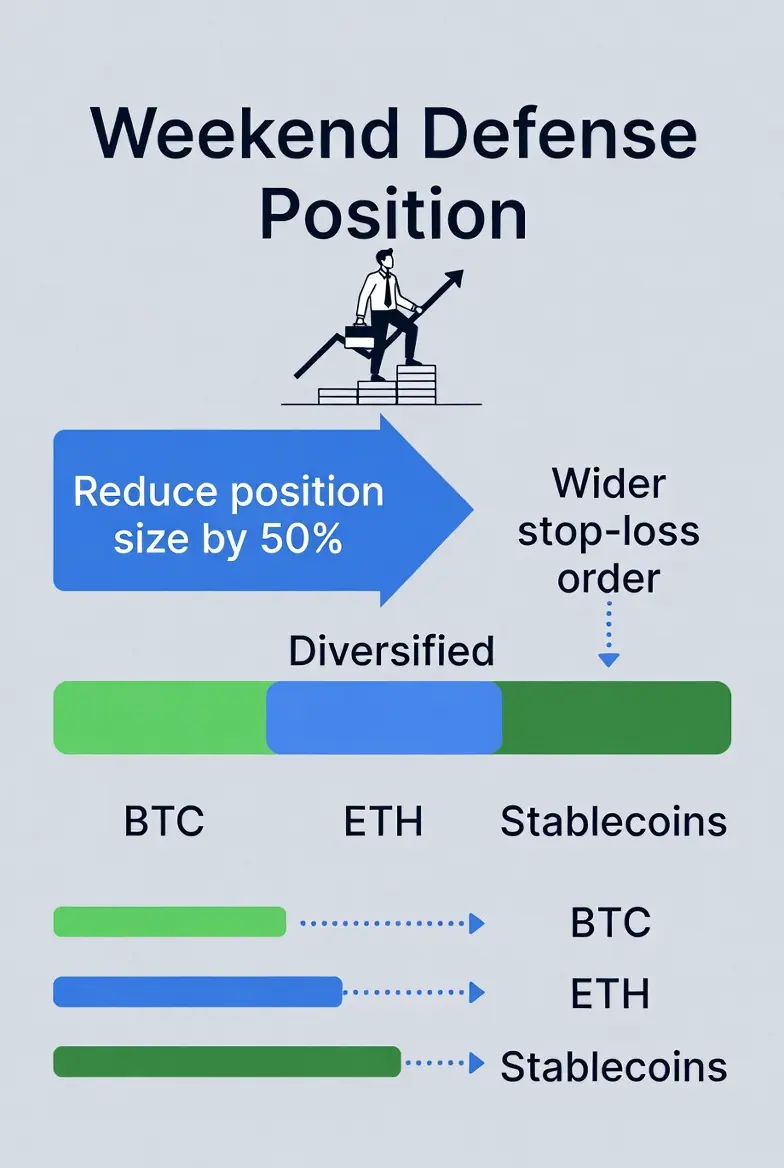
Setting up a proper defense position begins with position sizing. During weekends, reduce your overall exposure by thirty to fifty percent compared to weekday positions. This limits potential losses if the market moves against you unexpectedly and reduces emotional pressure during thin liquidity periods.
The location of your stop-loss orders requires careful consideration during weekends. Standard approaches often fail because weekend volatility can trigger stops unnecessarily. Instead of placing stops at obvious technical levels, consider using wider stops combined with smaller position sizes. This gives the market room to breathe while still protecting your account from catastrophic losses.
Diversify your weekend exposure across different timeframes and asset classes. Rather than concentrating all risk in a single high-volatility altcoin, spread positions across major cryptocurrencies like Bitcoin and Ethereum, which tend to have more stable weekend price action. Maintaining a portion of your portfolio in stablecoins provides both psychological comfort and tactical flexibility.
Timing of entries plays a crucial role. Friday evening entries should be approached with caution, as institutional traders close positions for the weekend, potentially creating artificial price movements. Sunday evening positions carry risk as markets prepare for Monday opening in traditional finance.
Establish clear rules before the weekend begins. Decide in advance what percentage of your portfolio will remain active, where stops will be placed, and under what conditions you will adjust positions. Having these decisions made prevents emotional decision-making when prices move rapidly.
Consider the layered stop-loss approach. Instead of a single stop-loss order, place multiple smaller stops at different levels. This allows you to exit portions of your position gradually rather than all at once, providing finer control over risk exposure during volatile periods.
Understanding correlation becomes important during weekend defense. Many altcoins exhibit high correlation with Bitcoin during low-liquidity periods. Avoid unintentionally doubling your risk by holding multiple positions that will likely move in the same direction.
Small Tips That Saved Me from Big Dumps and Spikes
Always check funding rates before holding positions through the weekend. Funding rates represent the cost of holding leveraged positions and can spike dramatically during volatile periods. A position that looks profitable can quickly become a loss generator if funding costs accumulate while you hold through a choppy weekend.
Set price alerts at key levels rather than staring at charts continuously. Weekend volatility creates rapid movements that trigger emotional reactions if you watch every tick. By setting alerts, you can step away from the screen and avoid the psychological toll of watching every small fluctuation.
Journal your weekend trades. After each session, spend ten minutes documenting what worked, what did not work, and how you felt. Over time, this reveals patterns in your decision-making that you might not notice in the moment.
Reduce leverage before weekends begin. If you normally trade with five times leverage, consider reducing to two or three times for weekend positions. This provides a buffer against wider price swings during low-liquidity periods.
Verify exchange maintenance schedules before the weekend. Nothing is more stressful than discovering your exchange is undergoing maintenance precisely when you need to adjust a position. Checking these schedules prevents situations where you are unable to manage your risk when needed.
Set multiple take-profit levels rather than a single target. By scaling out of positions gradually, you secure profits while maintaining exposure to further upside. This is particularly valuable during weekend spikes, where prices can move rapidly in your favor before reversing.
Monitor social media sentiment during weekends. While social media can be noisy, extreme sentiment readings often precede significant price movements. Use sentiment as a confirming factor for your technical analysis rather than trading based on social media alone.
Maintain a weekend-specific watchlist separate from your weekday trading list. Weekend markets behave differently, and certain assets that trade well during the week may become illiquid or excessively volatile. Focus on assets that maintain reasonable liquidity during weekend sessions.
Pay attention to the time of day when you make trading decisions. Many traders notice decision quality deteriorates during late-night hours. Set rules about when you will and will not make position adjustments to prevent emotionally-driven mistakes.
Pre-commit to maximum loss limits for each weekend. Decide the maximum amount you are willing to lose before the weekend begins. When you hit your limit, stop trading regardless of how convinced you are that the next trade will be a winner. This protects you from revenge trading.
Keep a portion of your capital specifically designated for weekend opportunities. This separation creates a natural limit on your weekend exposure and ensures your core trading capital remains protected.
Reducing Anxiety Without Trading When Markets Go Sideways
Sideways markets present unique psychological challenges. When prices refuse to move, the temptation to force trades becomes overwhelming. Many traders destroy their accounts not during volatile periods but during choppy, directionless markets where boredom drives poor decision-making.
Shift your focus from price action to education and research when markets are not presenting clear opportunities. Use that time to deepen your understanding of market dynamics, study new trading strategies, or research emerging projects. This transforms frustration into growth.
Physical exercise serves as an excellent anxiety management tool. The physiological stress of watching non-moving charts can be countered through physical activity. Going for a run, hitting the gym, or taking a long walk helps release tension. Many successful traders report that their best ideas come during or after physical exercise.
Practice paper trading during sideways periods to satisfy the urge to trade without risking real capital. Test new strategies or practice execution skills. This allows you to maintain your trading rhythm while protecting your account from losses that accompany forced trades in choppy conditions.
Meditation and mindfulness practices help many traders deal with sideways market anxiety. The discipline of sitting quietly and observing thoughts without judgment translates directly to trading discipline. When you can observe your desire to trade without automatically acting on it, you develop emotional control necessary to wait for genuine opportunities.
Set specific criteria that must be met before you will consider entering a trade. Write these down and commit to following them regardless of how bored or anxious you become. When the market is sideways, your criteria will naturally not be met, giving you objective permission to stay on the sidelines.
Connect with other traders during sideways periods for emotional support and perspective. Joining trading communities reminds you that you are not alone in experiencing frustration. Hearing others express similar sentiments helps normalize your feelings and prevents isolation that leads to impulsive decisions.
Review your past trades during sideways markets. This reinforces lessons from previous mistakes, reminds you of consequences of forced trades, and often reveals that your best trades came after periods of waiting. This strengthens your resolve to remain disciplined.
Set non-trading goals for sideways periods. Commit to learning a new skill for automated trading, reading books on market psychology, or developing a more sophisticated risk management system. These goals give you a sense of progress when markets are not cooperating.
Use visualization to manage sideways market anxiety. Spend time mentally rehearsing how you will handle the next major market move. Visualize yourself executing your strategy perfectly and capturing the opportunity that patient waiting has positioned you to take.
Temporarily adjust your chart timeframes during sideways periods. If you normally trade on hourly charts, switch to daily or weekly charts. Longer timeframes often reveal trends invisible on shorter scales, and reduced signal frequency naturally slows down trading activity.
Practice gratitude journaling to maintain perspective during difficult market conditions. Taking time to acknowledge positive aspects of your life outside trading creates emotional distance from market frustrations. When you recognize that your worth is not dependent on trading profits, anxiety diminishes.
Use sideways periods to improve your trading infrastructure. Organize watchlists, optimize chart layouts, test new indicators, or refine record-keeping systems. These improvements pay dividends when markets become active again.
Conclusion
Trading volatile weekend markets successfully requires technical skill, risk management discipline, and psychological resilience. By establishing clear defense positions, implementing protective practices, and developing healthy ways to manage anxiety during sideways markets, you position yourself for long-term success. The goal is not to eliminate all risk or capture every move, but to survive difficult periods with your capital and psychology intact so you can capitalize on opportunities that inevitably arise.
repost-content-media
  • Reward
  • Comment
  • Repost
  • Share
#CryptoMarketSeesVolatility
Crypto Market Volatility: A Comprehensive Analysis of Current Dynamics and Future Trajectory
The cryptocurrency market is currently experiencing significant volatility driven by a complex interplay of geopolitical tensions, macroeconomic uncertainty, and shifting institutional sentiment. Understanding these dynamics requires examining multiple interconnected factors that are reshaping the digital asset landscape.
Understanding Market Volatility: The Core Drivers
Market volatility in the crypto space stems from several fundamental sources. First, the inherent nature
HighAmbition
#CryptoMarketSeesVolatility
Crypto Market Volatility: A Comprehensive Analysis of Current Dynamics and Future Trajectory
The cryptocurrency market is currently experiencing significant volatility driven by a complex interplay of geopolitical tensions, macroeconomic uncertainty, and shifting institutional sentiment. Understanding these dynamics requires examining multiple interconnected factors that are reshaping the digital asset landscape.
Understanding Market Volatility: The Core Drivers
Market volatility in the crypto space stems from several fundamental sources. First, the inherent nature of cryptocurrency as an emerging asset class means it remains highly sensitive to sentiment shifts and liquidity flows. Unlike traditional markets with decades of established patterns, crypto markets are still discovering their equilibrium points. Second, the relatively lower market capitalization compared to traditional assets means that large institutional movements can create outsized price impacts. When major players like BlackRock or Strategy make significant moves, the entire market feels the ripple effects.
The current volatility intensification is particularly notable because it coincides with broader global uncertainty. Trade tensions between major economies, shifting monetary policies, and geopolitical conflicts are creating a perfect storm where traditional safe havens are being questioned, and crypto is caught in the crossfire of risk-on and risk-off sentiment swings.
The US-Iran Ceasefire Agreement: Latest Developments and Market Impact
The geopolitical situation surrounding the US-Iran ceasefire has become a critical factor influencing market sentiment. According to recent reports, a ceasefire between the United States and Iran was initially agreed upon on April8,2026, mediated by Pakistan, with a two-week duration. However, the situation has evolved rapidly with significant implications for global markets.
President Donald Trump announced that the ceasefire was set to expire on Wednesday evening Washington time, stating that an extension would be highly unlikely if a deal was not reached before the deadline. This hardline stance has created substantial uncertainty in global markets. The Iranian Foreign Ministry has indicated that the country does not have immediate plans to reengage with the United States, suggesting that diplomatic channels remain strained.
The situation has been further complicated by military actions in the Strait of Hormuz. Iran's Revolutionary Guard opened fire on a container ship in this critical waterway, damaging the vessel and raising stakes significantly. This attack followed US military seizures of Iranian vessels over the weekend. The Strait of Hormuz remains a crucial chokepoint for global oil shipments, and any disruption here has immediate cascading effects across energy markets and, by extension, risk assets including cryptocurrencies.
Trump has maintained that the blockade of Iranian ports will remain in place and has hinted at resuming attacks if the ceasefire expires without a comprehensive agreement. He has also claimed that Iran agreed to stop funding Hamas and Hezbollah and would hand over uranium, though Iranian officials have denied these claims. The next steps for negotiations remain unclear, with planned talks in Pakistan failing to materialize as expected.
Oil Prices and Global Demand: The Energy Market Connection
The connection between oil markets and crypto volatility cannot be overstated. Oil prices and global demand patterns serve as leading indicators for broader economic health, which directly impacts risk asset performance including cryptocurrencies.
Current oil market dynamics reveal a complex picture. According to the International Energy Agency, global oil demand growth has slowed significantly. In the third quarter of2025, demand increased by only0.8 million barrels per day, representing just0.7 percent year-on-year growth. This sluggish demand comes despite relatively lower prices, with Brent crude averaging around USD68 per barrel in August2025, marking the third consecutive month of price declines.
The World Bank has identified an oil market glut characterized by surging output and sluggish demand pressuring prices downward. This oversupply situation has created a bearish environment for energy markets. However, the Iran conflict has introduced significant supply risk premiums. Top oil traders from major firms like Gunvor Group and Trafigura have warned that demand destruction from the war could deepen substantially. Gunvor estimates that lost consumption may need to double to5 million barrels per day, roughly5 percent of world supplies, potentially triggering a global recession if the Strait of Hormuz remains closed for three months.
The energy shock is already rippling through global trade, with Morgan Stanley reporting that oil supply disruptions and shipping risks are pushing prices higher, raising costs for companies and consumers while threatening global demand and growth. This energy uncertainty creates a risk-off environment that typically pressures cryptocurrency prices as investors seek safety in traditional assets.
Bitcoin Current Status and Price Analysis
Bitcoin is currently trading at approximately77,615 USDT, showing a24-hour decline of about0.84 percent. The24-hour trading range has been between77,265 and78,480 USDT, with trading volume reaching approximately443 million USDT. Over the past seven days, Bitcoin has gained approximately5.17 percent, while the30-day performance shows a stronger uptrend of nearly16.88 percent.
Technical analysis reveals a mixed picture. On the15-minute timeframe, indicators suggest overbought conditions with CCI at108.97 and WR at negative6.96, indicating potential short-term exhaustion. The SAR indicator on the15-minute chart shows a bearish signal with the SAR point above recent average highs. However, the4-hour timeframe presents a more bullish outlook with MA7 above MA30 above MA120, forming a bullish alignment suggesting upward momentum. The daily SAR indicates bearish sentiment with the point above recent highs, suggesting caution at current levels.
Market sentiment analysis shows predominantly bullish social sentiment with68 percent positive content versus16 percent negative, resulting in a52 percent net positive differential. However, the fear and greed index currently reads31, indicating fear territory, which typically suggests caution among market participants.
Institutional activity remains a bright spot. Michael Saylor's Strategy has officially surpassed BlackRock as the largest single-entity Bitcoin holder, with Strategy holding815,061 BTC compared to BlackRock's802,823 BTC. BlackRock clients have been actively accumulating, with recent reports showing purchases of167.45 million and246.86 million USDT worth of Bitcoin on consecutive days. This institutional accumulation provides underlying support for prices even during volatile periods.
Price Forecast and Trading Strategy
Given the current market conditions, several scenarios emerge for Bitcoin's near-term trajectory. The immediate resistance level sits around83,000 USDT, which represents a critical psychological and technical barrier. Breaking above this level could open the path toward90,000 USDT and potentially retest the100,000 USDT milestone that was breached earlier this year.
However, downside risks remain significant. The77,000 USDT level is serving as immediate support, with a breakdown potentially targeting72,000 to75,000 USDT. The4-hour moving averages suggest the77,185 USDT level (MA30) provides dynamic support that bulls must defend to maintain the current uptrend structure.
For trading strategy, a range-bound approach appears most prudent given the volatility. Scalping the77,000 to79,000 USDT range with tight stops could capture short-term movements while limiting downside exposure. For swing traders, accumulating on dips toward the75,000 to77,000 USDT zone with targets at82,000 to85,000 USDT offers favorable risk-reward ratios.
Risk management is paramount in this environment. Position sizing should be reduced compared to normal conditions, with stop losses placed no wider than3 to5 percent from entry points. The high volatility environment means that moves of5 to10 percent can occur within hours, making disciplined risk management essential for capital preservation.
Future Trajectory: What Lies Ahead
The path forward for cryptocurrency markets depends heavily on several unresolved factors. First, the resolution or escalation of the US-Iran conflict will significantly impact risk sentiment. A peaceful resolution could trigger a relief rally across risk assets, while escalation would likely drive further risk-off behavior pressuring crypto prices lower.
Second, the trajectory of institutional adoption remains crucial. The continued accumulation by major players like BlackRock and Strategy provides a demand floor, but the pace of new institutional entrants will determine whether this support can translate into sustained price appreciation.
Third, regulatory developments, particularly in the United States, will shape market accessibility and sentiment. Any clarity on cryptocurrency regulation, potential strategic Bitcoin reserve initiatives, or favorable policy developments could serve as catalysts for the next major price movement.
Fourth, macroeconomic conditions including inflation trends, Federal Reserve policy, and global growth prospects will influence the broader risk asset environment within which cryptocurrencies operate.
Conclusion
The current crypto market volatility reflects a complex intersection of geopolitical uncertainty, energy market disruption, and shifting institutional sentiment. Bitcoin's current position around77,600 USDT represents a delicate balance between bullish institutional accumulation and bearish macro uncertainty. Traders should approach this environment with caution, employing strict risk management and maintaining flexibility to adapt as the geopolitical and macroeconomic landscape evolves. The coming weeks will be critical as the US-Iran situation develops and institutional flows continue to shape market dynamics.
repost-content-media
  • Reward
  • Comment
  • Repost
  • Share
#rsETHAttackUpdate
🚨 rsETH Incident 2026 – The Day DeFi Didn’t Break… But Everyone Realized It Can
There are days in crypto when nothing really changes — charts move, traders trade, noise continues — and then there are days like this, when suddenly the market goes quiet for a moment, not because nothing is happening, but because everyone is thinking at the same time, trying to process whether what just happened is a temporary disruption… or a deeper warning about the system itself.
The rsETH incident was not just another event — it was a reality check, a moment where confidence didn’t collap
ETH0.59%
HighAmbition
#rsETHAttackUpdate
🚨 rsETH Incident 2026 – The Day DeFi Didn’t Break… But Everyone Realized It Can
There are days in crypto when nothing really changes — charts move, traders trade, noise continues — and then there are days like this, when suddenly the market goes quiet for a moment, not because nothing is happening, but because everyone is thinking at the same time, trying to process whether what just happened is a temporary disruption… or a deeper warning about the system itself.
The rsETH incident was not just another event — it was a reality check, a moment where confidence didn’t collapse, but it paused, where belief didn’t disappear, but it questioned itself, and where the biggest realization wasn’t about loss… but about how easily trust can be tested in a system built on layers of assumptions.
🔥 Let’s Be Honest — This Wasn’t “Just Another Incident”
At the surface, it looks like a technical issue tied to rsETH, with an impact crossing $290 million, but if you reduce it to just numbers, you completely miss the point — because what actually happened here was something far more important:
👉 The system accepted something it shouldn’t have
👉 The ecosystem reacted after the fact
👉 And users realized how much they rely on things they never fully analyze
And that creates a very uncomfortable thought:
How many other risks exist that simply haven’t been triggered yet?
⚠️ The Part Nobody Likes To Talk About
We often celebrate DeFi for being permissionless, open, and innovative — but we rarely talk about the trade-off:
👉 More freedom = more responsibility
👉 More innovation = more unknowns
👉 More yield = more hidden complexity
And this incident exposed exactly that — not loudly, not dramatically, but quietly and effectively — by showing that sometimes the biggest risks are not in what we see… but in what we assume is safe without questioning it.
🧠 The Debate That’s Dividing The Market Right Now
Let’s address the elephant in the room — because this is where things get interesting.
🔴 Side A — “This Is A Structural Warning”
This side isn’t panicking — they’re observing carefully, and their argument is simple but powerful:
If one weak point in a system can allow invalid value to move across protocols, interact with liquidity, and influence markets, then maybe the system is not as robust as we think — maybe complexity has moved faster than security, and maybe users are operating in environments where the true risk is not visible at the surface level.
And their biggest concern is not this incident —
It’s the next one.
🟢 Side B — “This Is Exactly How Systems Improve”
The other side sees this completely differently — not as a failure, but as a necessary stress event, because no system becomes strong without being tested, and no weakness gets fixed until it is exposed.
From this perspective, what happened is not the breakdown of DeFi — it is the process of refining it, strengthening it, and forcing it to evolve beyond theoretical security into real-world resilience.
💡 So Who’s Right? Here’s The Truth…
Both sides are right — and that’s what makes this moment so important.
Because this isn’t a black-and-white situation.
👉 DeFi is not broken
👉 DeFi is not perfect
👉 DeFi is being tested
And the outcome of this test will define the next phase of the market.
📊 Now Let’s Talk About What Really Matters — PRICE
Because in the end, markets don’t lie — sentiment, fear, confidence… everything shows up in price.
💰 Ethereum Current Price: ~$2318
Now pause for a second and think about this…
After a major DeFi shock, after headlines, after uncertainty…
👉 ETH is still holding above $2300
👉 Monthly trend is still positive (~+16%)
👉 Market structure is still intact
That is not weakness.
That is controlled strength.
🔍 Expanded Price Zones (Where The Game Is Being Played)
📍 Support Levels (Where Buyers Defend):
• $2300 → Key psychological level
• $2280 → Short-term reaction zone
• $2250 → Strong support (if tested, high attention area)
📍 Resistance Levels (Where Sellers React):
• $2332 → Immediate breakout trigger
• $2360 → Supply pressure zone
• $2400 → Major psychological barrier
• $2500 → Momentum expansion target
📈 What The Chart Is Really Saying
This is not a trending market…
This is not a collapsing market…
👉 This is a decision zone
Price is compressing, volatility is tightening, and the market is preparing for a move — the only question is direction.
And here’s the key insight most traders miss:
👉 Big moves don’t start with noise
👉 They start with silence and compression
🏦 Smart Money Isn’t Loud — But It’s Active
While retail traders are reacting emotionally, smart money is doing something very different:
👉 Not rushing in
👉 Not running away
👉 Just positioning quietly
This is what rebalancing looks like — not panic, not hype, but calculated patience.
⚡ The Brutal Truth Most Traders Ignore
Let’s be real for a second —
Most people in DeFi are not losing money because of hacks…
They’re losing because they:
• Don’t understand what they’re using
• Chase returns without thinking
• Ignore risk until it hits
And this incident didn’t create that problem —
It just exposed it.
📈 Strategy Right Now — This Is Where You Win Or Lose
This is not the time to be emotional.
This is the time to be precise.
🟢 If You’re Careful:
Wait for confirmation above $2332 — don’t guess, react
🟡 If You’re Strategic:
Look at $2300 zone for controlled entries with risk defined
🔴 If You’re Aggressive:
Trade short-term, take profits fast, don’t overstay
👉 One rule above all:
Survive first. Profit second.
🚀 What Happens Next — The Bigger Picture
This moment will shape the future of DeFi, not because something went wrong, but because now:
• Builders will tighten systems
• Investors will think deeper
• Risk will be priced more accurately
• Weak structures will get exposed
👉 And that’s how systems evolve.
💬 Final Thought — Read This Carefully
The biggest danger in crypto is not volatility.
It’s not even technical failure.
👉 It’s false confidence.
repost-content-media
  • Reward
  • 1
  • Repost
  • Share
CryptoDiscovery:
To The Moon 🌕
#US-IranTalksStall
US-Iran Peace Talks Stall: A Comprehensive Analysis
The peace negotiations between the United States and Iran have reached a critical impasse, with the first face-to-face high-level talks since 1979 ending without agreement in Islamabad, Pakistan. This diplomatic failure represents a fundamental blow to hopes of finding an off-ramp to the ongoing crisis that began on February 28, 2026.
Reasons for the Talks Failure
The negotiations collapsed due to two primary sticking points that remain irreconcilable between the parties. First, the United States demanded that Iran provide
HighAmbition
#US-IranTalksStall
US-Iran Peace Talks Stall: A Comprehensive Analysis
The peace negotiations between the United States and Iran have reached a critical impasse, with the first face-to-face high-level talks since 1979 ending without agreement in Islamabad, Pakistan. This diplomatic failure represents a fundamental blow to hopes of finding an off-ramp to the ongoing crisis that began on February 28, 2026.
Reasons for the Talks Failure
The negotiations collapsed due to two primary sticking points that remain irreconcilable between the parties. First, the United States demanded that Iran provide a firm commitment not to develop nuclear weapons, which Tehran refused to offer. Vice President JD Vance, who led the American delegation, stated that Iran had chosen not to accept the US proposal, leaving Washington with what he described as a final and best offer on the table.
Second, the management of the Strait of Hormuz emerged as a major obstacle. Iran insists on maintaining sovereign control over this critical waterway, demanding military oversight and toll collection from ships passing through. This position is unacceptable to the United States, Gulf states, and most other nations who view the strait as an international passage through which approximately one-fifth of global oil and liquefied natural gas flows.
Iranian officials attributed the talks failure to what they characterized as excessive American demands. The Iranian perspective holds that Washington entered negotiations seeking a quick solution following a two-week ceasefire implementation, while Tehran typically approaches diplomacy with a long-term negotiating strategy. This fundamental mismatch in diplomatic timelines and expectations created an unbridgeable gap.
Iranian Foreign Minister's Pakistan Visit and US Delegation
In a significant development, Iranian Foreign Minister Abbas Araghchi arrived in Islamabad on Friday, April 24, 2026, leading a small delegation for what officials described as bilateral consultations with Pakistani authorities. The visit was scheduled for approximately 10 PM local time, raising hopes that negotiations might resume.
However, Iranian state media clarified that Araghchi's visit was primarily bilateral in nature, intended for discussions with Pakistani officials rather than immediate direct talks with American negotiators. The Iranian proposal would be conveyed to the United States through Pakistani intermediaries.
President Donald Trump dispatched a US delegation led by Special Envoy Steve Witkoff and Jared Kushner to Pakistan for fresh talks with Iranian leadership. This represented a shift from Vice President Vance's earlier leadership of negotiations. The American delegation's arrival was contingent upon Iran's willingness to engage, which remained uncertain throughout the week.
Will There Be Peace or Escalation
The current trajectory suggests continued tension rather than immediate resolution. President Trump announced he was indefinitely extending the ceasefire with Iran while awaiting what he termed a unified proposal from Tehran. However, he simultaneously declared it highly unlikely he would extend the two-week ceasefire if no agreement is reached, stating he would not be rushed into making a bad deal.
Iran has taken provocative actions that complicate diplomatic efforts. Iranian forces seized ships in the Strait of Hormuz and opened fire on a container vessel, tightening their grip on the strategic waterway. The US Navy maintains its blockade of Iranian ports, which Tehran considers a violation of the ceasefire agreement.
Iranian Revolutionary Guard officials have issued threatening statements warning regional neighbors that if their territories are used to attack Iran, they must say goodbye to oil production in the Middle East. This rhetoric suggests Tehran is prepared to escalate rather than compromise on core demands.
Analysts assess that Iran could run out of oil storage capacity by April 26, 2026, creating additional pressure for resolution. However, Iran appears to calculate that maintaining its chokehold on the global economy through Strait of Hormuz control provides leverage that outweighs immediate economic costs.
Oil Prices and Global Market Impact
The diplomatic stalemate has sent shockwaves through global energy markets. Brent crude oil is trading at approximately 105.33 to 105.88 dollars per barrel, having surged roughly 12 percent in recent trading sessions. West Texas Intermediate crude stands near 94.40 dollars per barrel. These elevated prices represent some of the highest levels seen since the war began.
The Energy Information Administration forecasts that Brent crude prices will peak at 115 dollars per barrel in the second quarter of 2026 before potentially moderating. JPMorgan analysts project that oil prices still have further to rise because the market has not yet forced sufficient demand destruction to offset supply losses from the Iran conflict.
The Strait of Hormuz closure affects approximately 20 percent of global oil shipments and a significant portion of liquefied natural gas trade. Traffic through the waterway remains near standstill, and analysts caution that even if the strait reopens soon, Gulf oil production will require considerable time to ramp back up to normal levels.
Bitcoin Current Price and Forecast
Bitcoin is currently trading at approximately 77,602 dollars, showing remarkable resilience despite geopolitical turmoil. The cryptocurrency experienced only a modest 1.6 percent pullback following Iran's reimposition of controls on the Strait of Hormuz, significantly outperforming both oil markets and traditional equities.
Technical analysis indicates Bitcoin trades within an intraday range of approximately 77,265 to 78,479 dollars. The four-hour moving averages show a bullish configuration with MA7 exceeding MA30 and MA120, suggesting short-term upward momentum. However, daily chart indicators present a more mixed picture with the SAR indicator positioned above recent average highs.
Institutional flows remain supportive of Bitcoin prices. US spot Bitcoin ETFs absorbed approximately 1.9 billion dollars in net inflows over the past week, representing the strongest five-day stretch since early February. BlackRock's IBIT ETF alone captured 612 million dollars in inflows, with the asset manager reportedly purchasing roughly 280 million dollars worth of Bitcoin daily during peak flow periods.
Market sentiment analysis reveals predominantly bullish positioning, with approximately 66 percent of social media discussions expressing positive sentiment versus 18 percent negative. The Crypto Fear and Greed Index registers at 31, indicating cautious but not panic-driven market conditions.
Traders' Perspective and Market Sentiment
Professional traders and institutional investors are viewing the Iran conflict volatility as another notch on the belt of market challenges they have navigated over the past fifteen months. JPMorgan strategists note that markets have successfully absorbed numerous shocks including trade wars, government shutdowns, tariff escalations, and previous military conflicts.
Bitcoin's shrinking sell-off magnitude with each Iran-related shock suggests cryptocurrency markets may have largely priced in geopolitical tail risks. The spot ETF bid has emerged as a more reliable price floor than the futures-driven weekend gaps that characterized earlier market cycles. Traders are now monitoring bond yields, dollar strength, and key technical levels around 74,000 to 73,000 dollars to confirm Bitcoin's role as a geopolitical shock absorber.
However, some analysts question Bitcoin's safe-haven narrative, noting that it continues to trade more like a high-beta risk asset than a defensive hedge in the current environment. The cryptocurrency demonstrated this characteristic when it declined 4 percent following the House of Representatives' razor-thin rejection of a resolution to curb presidential war powers regarding Iran.
Consumer sentiment has plummeted to record lows, with the University of Michigan survey registering 47.6, lower than readings observed during the Great Recession, pandemic downturn, or subsequent inflation surge. Survey respondents specifically cited the Iran conflict as responsible for unfavorable economic changes.
Conclusion
The US-Iran peace talks stall reflects fundamental disagreements over nuclear non-proliferation commitments and control of strategic waterways. While both sides maintain rhetorical openness to continued dialogue, the practical obstacles to agreement remain substantial. Iran's Foreign Minister visit to Pakistan represents a potential diplomatic opening, but the pathway to substantive negotiations remains uncertain.
Oil prices will likely remain elevated above 100 dollars per barrel until supply disruptions resolve, creating inflationary pressures globally. Bitcoin has demonstrated resilience but faces conflicting narratives as both a safe-haven asset and a risk-correlated instrument. Traders should anticipate continued volatility across all asset classes until diplomatic clarity emerges or military escalation occurs.
The coming days represent a critical window as ceasefire deadlines approach and both sides evaluate whether compromise serves their strategic interests better than continued confrontation.
repost-content-media
  • Reward
  • 1
  • Repost
  • Share
CryptoDiscovery:
To The Moon 🌕
#USMilitaryMaduroBettingScandal
🚨 The US Military Maduro Betting Scandal: A Deep Structural Analysis of Power, Information, and Crypto Markets
There are rare moments when two completely different worlds collide in a way that forces everyone — from policymakers to traders — to rethink the systems they rely on, and this scandal is exactly one of those moments, where the lines between military intelligence, financial markets, and decentralized technology did not just blur, but fully intersect in a way that exposed both the power and the vulnerability of modern financial infrastructure.
The arre
HighAmbition
#USMilitaryMaduroBettingScandal
🚨 The US Military Maduro Betting Scandal: A Deep Structural Analysis of Power, Information, and Crypto Markets
There are rare moments when two completely different worlds collide in a way that forces everyone — from policymakers to traders — to rethink the systems they rely on, and this scandal is exactly one of those moments, where the lines between military intelligence, financial markets, and decentralized technology did not just blur, but fully intersect in a way that exposed both the power and the vulnerability of modern financial infrastructure.
The arrest of Master Sergeant Gannon Ken Van Dyke is not simply a legal case, nor is it just a story about one individual making unethical decisions — it is a case study in how privileged information, when combined with emerging financial tools like blockchain-based prediction markets, can create a completely new category of risk that traditional systems were never designed to handle.
🔥 The Operation and the Bet — Where Intelligence Became Opportunity
At the center of this case lies Operation Absolute Resolve, a covert US military mission executed on January 3, 2026, targeting Venezuelan President Nicolás Maduro — an operation that, in traditional contexts, would have remained within classified channels and strategic briefings, far removed from public speculation or financial exploitation — but in this instance, something fundamentally different happened.
Van Dyke, who was not merely an observer but an active participant in planning and execution, possessed access to highly sensitive, nonpublic information, including precise timelines, operational scope, and intended outcomes — information that, under normal circumstances, would carry immense national security implications — yet instead of treating this knowledge as a responsibility, it was allegedly converted into a financial edge.
Over a period spanning late December 2025 to early January 2026, he engaged with a blockchain-based prediction platform, placing multiple positions totaling approximately 33,000 USDC, strategically targeting outcomes that were not uncertain to him, but already known — effectively transforming classified intelligence into predictable market outcomes, which ultimately generated profits exceeding 400,000 USDC within days.
And this is where the case shifts from being unusual to being historically significant — because this is not just insider trading, but insider trading executed on a decentralized, transparent, and globally accessible financial layer.
⚖️ Legal Framework — Old Laws, New Battlefield
The charges brought forward — including wire fraud, commodities fraud, and misuse of confidential information — are rooted in traditional financial law, yet they are now being applied to a completely new environment, where transactions are recorded on public ledgers, identities can be pseudonymous, and platforms operate across jurisdictions.
This creates a fascinating tension:
👉 The law is old
👉 The technology is new
👉 And enforcement is adapting in real time
What makes this case particularly powerful is that it demonstrates that decentralization does not eliminate accountability — instead, it transforms how accountability is enforced, because while blockchain systems offer pseudonymity, they also create permanent, traceable records that can be analyzed, reconstructed, and linked back to real-world identities when sufficient investigative resources are applied.
🔍 Blockchain Transparency — A Double-Edged Reality
One of the most misunderstood aspects of cryptocurrency is the belief that it guarantees anonymity, when in reality it offers something far more complex — transparency without immediate identity, which can create a temporary illusion of privacy, but not absolute invisibility.
In this case, investigators were able to track transaction flows, analyze timing patterns, correlate wallet activity with external behavior, and ultimately build a narrative that connected digital actions to a physical individual — highlighting a critical truth that many market participants overlook:
👉 Blockchain does not hide activity
👉 It records it forever
And in situations involving high-value, high-confidence trades tied to real-world events, those records become extremely powerful evidence.
🏛️ Political and Regulatory Shockwaves
The response from political leadership, including comments from Donald Trump, reflects a broader uncertainty about how to approach this emerging space, where prediction markets can serve as tools for information aggregation on one hand, while simultaneously creating opportunities for exploitation on the other.
This duality is at the heart of the regulatory challenge — because banning such platforms outright may limit innovation, but ignoring them entirely creates systemic vulnerabilities that can be exploited by individuals with privileged access to information.
As a result, regulators are now being forced into a position where they must define clear boundaries for behavior in decentralized environments, rather than relying on assumptions that existing systems will naturally regulate themselves.
🏢 Platform Evolution — From Freedom to Controlled Integrity
Platforms like Polymarket and Kalshi are now entering a new phase of development, where pure decentralization is being balanced against the need for market integrity, surveillance, and compliance mechanisms that can prevent abuse without completely undermining accessibility.
This shift represents a broader trend within crypto:
👉 Early phase: Innovation without restriction
👉 Current phase: Innovation with accountability
👉 Future phase: Innovation with structured compliance
And the Van Dyke case may accelerate this transition significantly.
📊 Implications for the Crypto Market — Structural, Not Temporary
This scandal does not just impact prediction markets — it sends signals across the entire cryptocurrency ecosystem, particularly in areas like DeFi, derivatives, and event-based contracts, where information asymmetry can create unfair advantages if left unchecked.
It reinforces several key realities:
• Markets are not just driven by data — they are driven by who has access to that data first
• Decentralization reduces barriers — but does not eliminate ethical responsibility
• Transparency increases accountability — but only if enforcement follows
For institutional players, this case acts as both a warning and a validation — a warning that compliance risks are real, and a validation that enforcement mechanisms are becoming more effective.
🌍 Broader Market Dynamics — The Hidden Pattern
What makes this case even more important is that it is unlikely to be isolated, as similar trading patterns have already been observed around geopolitical and macro events, suggesting that prediction markets may increasingly attract participants who possess informational advantages — turning these platforms into battlegrounds between public speculation and private knowledge.
This raises a deeper question:
👉 Can a market truly be fair if some participants already know the outcome?
And more importantly:
👉 How do you regulate that in a decentralized system?
🚀 Future Outlook — Regulation Meets Reality
Looking forward, the impact of this case will likely extend far beyond the individuals involved, influencing regulatory frameworks, platform design, and user behavior across the crypto space.
We can expect:
• Increased monitoring of large, high-confidence trades
• Stronger collaboration between platforms and regulators
• Clearer legal definitions around insider activity in crypto
• Greater emphasis on identity-linked participation in certain markets
And while this may reduce some of the openness that defined early crypto, it may also increase trust, stability, and long-term adoption.
💬 Final Thought — The Real Lesson Behind The Scandal
This is not just a story about misuse of information, and it is not just a case about crypto regulation — it is a reflection of a deeper truth about modern markets:
👉 Technology evolves faster than behavior
👉 Access expands faster than understanding
👉 And opportunity often appears before rules are fully defined
The real question is not whether such incidents will happen again —
because they will —
The real question is:
👉 How quickly can systems adapt to ensure that innovation does not come at the cost of integrity?
repost-content-media
  • Reward
  • 1
  • Repost
  • Share
CryptoDiscovery:
To The Moon 🌕
#WCTCTradingKingPK
WCTC S8个人PK比赛的高级多时间框架动量策略
WCTC S8中的个人PK比赛要求采用一种在激进收益生成与纪律风险管理之间取得平衡的交易方法。这个全面的策略指南提出了一个多时间框架动量系统,特别针对在高压环境下的对抗交易战,其中绩效在压缩的时间段内衡量。
核心策略理念
该策略的基础在于捕捉爆炸性价格运动,同时严格遵守资金保护协议。不同于可能持仓数天或数周的传统波段交易,PK比赛交易需要快速决策和迅速实现利润。策略采用三层确认系统,用以过滤噪声并识别多个时间框架中的高概率动量爆发。
时间框架架构
该策略利用四个不同的时间框架协同工作。月线和周线提供主要支撑与阻力区域的结构背景。日线识别主要趋势方向和关键决策水平。四小时线作为主要执行时间框架,生成入场和出场信号。最后,一小时线提供微观结构,用于精准入场时机和止损点的设置。
这种多时间框架方法确保交易符合更广泛的市场结构,同时允许在执行中实现战术精确。逆势高时间框架趋势会显著降低胜率,因此策略在考虑任何仓位之前,强制执行严格的趋势对齐规则。
技术指标配置
主要的动量识别工具结合了相对强弱指数(RSI)与成交量分析。四小时线上的RSI设为14周期,超买和超卖阈值调整为75和25,以应对加密货币市场的波动性。成交量确认要求当前蜡烛的成交量至少超过20周期平均成交量的50%,确保动量信号与真实市场参
HighAmbition
#WCTCTradingKingPK
Advanced Multi-Timeframe Momentum Strategy for WCTC S8 Individual PK Competition
The Individual PK Competition in WCTC S8 demands a trading approach that balances aggressive return generation with disciplined risk management. This comprehensive strategy guide presents a multi-timeframe momentum system specifically optimized for the high-pressure environment of head-to-head trading battles where performance is measured over compressed time periods.
Core Strategy Philosophy
The foundation of this strategy rests on capturing explosive price movements while maintaining strict capital preservation protocols. Unlike traditional swing trading that might hold positions for days or weeks, PK competition trading requires rapid decision-making and quick profit realization. The strategy employs a three-layer confirmation system that filters noise and identifies high-probability momentum bursts across multiple timeframes.
Timeframe Architecture
The strategy utilizes four distinct timeframes working in concert. The monthly and weekly charts provide structural context for major support and resistance zones. The daily chart identifies the primary trend direction and key decision levels. The four-hour chart serves as the main execution timeframe where entry and exit signals are generated. Finally, the one-hour chart provides micro-structure for precise entry timing and stop-loss placement.
This multi-timeframe approach ensures that trades align with the broader market structure while allowing for tactical precision in execution. Trading against the higher timeframe trend significantly reduces win probability, so the strategy enforces strict trend alignment rules before any position is considered.
Technical Indicator Configuration
The primary momentum identification tool combines the Relative Strength Index with volume analysis. The RSI is configured with a 14-period setting on the four-hour chart, with overbought and oversold thresholds adjusted to 75 and 25 respectively to account for cryptocurrency market volatility. Volume confirmation requires the current candle to exceed the 20-period average volume by at least fifty percent, ensuring that momentum signals coincide with genuine market participation rather than low-liquidity noise.
A secondary confirmation layer employs the Moving Average Convergence Divergence indicator with standard 12, 26, and 9 period settings. The strategy requires MACD histogram alignment with price momentum, meaning that bullish entries only trigger when both price and MACD histogram are making higher lows, while bearish entries require both to make lower highs.
The third confirmation element tracks exponential moving averages with 20, 50, and 200 period settings. The strategy mandates that price action must respect the 20-period EMA as dynamic support in uptrends and resistance in downtrends. Entries are only permitted when price pulls back to test the 20 EMA and demonstrates rejection through candlestick patterns.
Entry Protocol
Long entries trigger when four conditions align simultaneously. First, the daily chart must show a clearly defined uptrend with higher highs and higher lows. Second, the four-hour RSI must pullback from overbought territory to the 40-50 zone, indicating a healthy correction within the trend. Third, the MACD histogram must show bullish divergence or flattening before resuming upward expansion. Fourth, price must touch or slightly pierce the 20-period EMA on the four-hour chart and form a reversal candlestick pattern such as a hammer, morning star, or bullish engulfing.
Short entries follow the inverse logic with corresponding bearish requirements. The daily trend must be downward, the four-hour RSI must bounce from oversold to the 50-60 zone, MACD must show bearish characteristics, and price must reject from the 20 EMA with appropriate bearish candlestick confirmation.
Position Sizing and Risk Management
Capital allocation follows a dynamic position sizing model based on account equity and volatility conditions. The base position size starts at two percent of total trading capital per trade. This percentage increases to three percent when the Average True Range over fourteen periods falls below its 50-period average, indicating compressed volatility that often precedes explosive moves. Conversely, position size reduces to one percent when ATR exceeds its average by more than fifty percent, signaling elevated volatility and increased risk.
Stop-loss placement utilizes a dual-layer approach. The initial stop-loss sits at the swing low prior to entry for long positions or the swing high for short positions, ensuring that the trade invalidation point represents a genuine structural break rather than normal market noise. A secondary trailing stop activates once the position achieves a risk-to-reward ratio of one-to-one, locking in profits while allowing winners to run.
Profit Target Framework
The strategy employs a tiered profit-taking system designed to capture momentum while protecting gains. The first profit target sits at a one-point-five risk-to-reward ratio, where twenty-five percent of the position is closed. This initial partial exit ensures that the trade becomes risk-free while maintaining exposure to further gains. The second target at a two-point-five risk-to-reward ratio triggers closure of another fifty percent of the position. The final twenty-five percent trails with a stop-loss set at the second target level, capturing extended moves while protecting accumulated profits.
PK Competition Specific Adaptations
The Individual PK format introduces unique constraints that require strategic modifications. Competition rounds operate on fixed timeframes, typically ranging from hours to days, unlike normal trading where positions can be held indefinitely. This compressed timeline necessitates more aggressive entry criteria and faster profit realization.
The strategy adapts by reducing the confirmation period requirements. While standard implementation waits for daily candle closes, competition trading utilizes four-hour closes with one-hour micro-confirmation. This accelerates signal generation while maintaining structural validity.
Additionally, the PK environment benefits from correlation analysis across multiple trading pairs. When Bitcoin demonstrates strong momentum, altcoins often follow with amplified moves. The strategy monitors Bitcoin's four-hour structure as a leading indicator, entering altcoin positions only when Bitcoin confirms directional bias. This correlation filter significantly improves win rates by ensuring trades align with broad market sentiment.
Psychological Discipline Protocols
High-stakes competition trading amplifies emotional responses that destroy rational decision-making. The strategy incorporates specific protocols to maintain psychological equilibrium. Pre-session preparation includes reviewing trade rules, visualizing execution scenarios, and setting maximum daily loss limits at four percent of account equity. Once this limit triggers, all trading ceases regardless of market conditions or perceived opportunities.
During active trading, the strategy enforces a mandatory five-minute break after any losing trade. This cooling-off period prevents revenge trading and emotional escalation. Similarly, after three consecutive winning trades, a ten-minute break is required to prevent overconfidence and sloppy execution.
Market Condition Filters
Not all market environments support momentum trading effectively. The strategy identifies three distinct market regimes and adjusts accordingly. Trending markets with clear directional bias and healthy pullbacks represent ideal conditions where the strategy operates at full capacity. Choppy, range-bound markets with overlapping price action trigger a reduction in position size and wider stop-loss placement. Strongly trending markets with parabolic price action activate aggressive profit-taking and trailing stop protocols to protect against sudden reversals.
The Average Directional Index serves as the primary regime identification tool. Readings above thirty indicate trending conditions suitable for full strategy deployment. Readings between twenty and thirty suggest choppy conditions requiring caution. Readings below twenty signal ranging markets where the strategy remains inactive.
Execution Checklist
Every trade requires completion of a pre-entry checklist ensuring all conditions align. The checklist verifies trend alignment across timeframes, indicator confirmation, volume validation, risk-to-reward ratio minimum of one-to-two, and position size calculation. No trade proceeds without checklist completion, eliminating impulsive decisions and emotional overrides.
Post-trade analysis follows every closed position, documenting entry and exit rationale, emotional state, market conditions, and lessons learned. This continuous feedback loop drives strategy refinement and performance improvement over the competition period.
Advanced Techniques for Competitive Edge
Experienced traders can enhance the core strategy with additional techniques. Order flow analysis through volume profile identifies high-probability reaction zones where institutional participation concentrates. Market structure analysis tracks break of structure and change of character patterns that signal trend continuation or reversal. Multiple timeframe confluence zones where daily, four-hour, and one-hour support or resistance align provide exceptional risk-to-reward opportunities.
Correlation arbitrage between spot and perpetual futures markets occasionally presents risk-free profit opportunities during funding rate anomalies. While these situations are rare, monitoring funding rates every eight hours can capture additional returns without directional risk.
Performance Expectations and Reality
Successful implementation of this strategy in PK competition environments typically produces win rates between forty-five and fifty-five percent. While this appears modest, the asymmetric risk-to-reward structure ensures profitability. Average wins should exceed average losses by a factor of two to one or greater. This mathematical edge, compounded over multiple trades, generates the returns necessary for competitive performance.
Traders must abandon the pursuit of perfect trades and high win rates. Consistency, discipline, and adherence to proven mathematical edges outperform intuitive genius over time. The strategy provides the framework, but execution discipline determines ultimate success.
Final Implementation Notes
This strategy represents a complete trading system, not a collection of isolated indicators. Successful implementation requires thorough backtesting on historical data, paper trading to verify execution capability, and gradual capital deployment as proficiency develops. Modifying individual elements without understanding their systemic relationships typically degrades performance rather than improving it.
The WCTC S8 Individual PK Competition rewards traders who combine technical skill with psychological resilience. This strategy provides the technical foundation, but consistent application under pressure separates winners from participants. Master the system, trust the process, and let probability work in your favor over the competition timeline.
repost-content-media
  • Reward
  • 1
  • Repost
  • Share
CryptoDiscovery:
To The Moon 🌕
#ETHMemeCoinFLORKSurges
🧠 Understanding FLORK – The Cultural Foundation Behind the Token
FLORK is not simply another speculative meme coin appearing in the Ethereum ecosystem, but rather it is an asset that carries a deeper cultural identity that originates from the long-running “Flork of Cows” webcomic series, which has existed in internet culture for many years and has built a recognizable identity through humor, simplicity, and community-driven creativity, and because of this background FLORK enters the crypto market with something most meme tokens completely lack, which is a pre-existing
HighAmbition
#ETHMemeCoinFLORKSurges
🧠 Understanding FLORK – The Cultural Foundation Behind the Token
FLORK is not simply another speculative meme coin appearing in the Ethereum ecosystem, but rather it is an asset that carries a deeper cultural identity that originates from the long-running “Flork of Cows” webcomic series, which has existed in internet culture for many years and has built a recognizable identity through humor, simplicity, and community-driven creativity, and because of this background FLORK enters the crypto market with something most meme tokens completely lack, which is a pre-existing emotional connection between internet users and the character itself.
The token was deployed on the Ethereum blockchain in April 2023, just one day after the launch of Pepe, which places it within the early wave of Ethereum meme coins that formed the foundation of what is now known as the meme economy, and this early positioning gives FLORK a unique classification as an “OG-style meme asset” that carries both historical presence and narrative strength, especially in a market where narrative often matters more than pure fundamentals in the short term.
📊 FLORK Price Action – Full Market Movement Breakdown
The recent performance of FLORK has been extremely aggressive and has captured the attention of traders across the Ethereum ecosystem, because within a very short time frame the token experienced a surge of nearly 1,800 percent within a single 24-hour period, which is an unusual level of volatility even by meme coin standards, and during this explosive phase the market capitalization expanded rapidly to around twelve million dollars before stabilizing in a lower consolidation range between eight and ten million dollars as early profit-taking activity entered the market.
The current trading price is approximately 0.00045 dollars, with intraday highs reaching around 0.00050 dollars and lows near 0.00040 dollars, while daily trading volume remains in the range of 1.2 million dollars, which indicates that despite the cooldown from peak levels there is still active participation and liquidity in the market rather than a complete exit of interest, and this type of behavior is often seen in meme assets that transition from pure hype phases into early stabilization phases where both buyers and sellers actively reprice value.
🔥 Primary Catalysts Behind FLORK’s Rapid Expansion
The first and most important driver behind FLORK’s recent surge is the broader narrative shift occurring within the Ethereum meme ecosystem, where liquidity and attention have begun rotating back toward Ethereum-based meme assets due to stronger holder conviction, deeper liquidity pools, and a more established trading environment compared to newer chains, which has created a favorable environment for tokens with strong narrative identity such as FLORK.
Another major contributing factor is the growing visibility of meme culture within major social platforms such as X (Twitter), where algorithmic exposure, trending integrations, and community-driven virality have significantly increased awareness of tokens like FLORK, allowing them to reach audiences far beyond their initial crypto-native user base and turning them into broader internet phenomena rather than isolated trading assets.
In addition to this, community-driven momentum has played a critical role in sustaining interest, because the rise of dedicated community accounts, influencer engagement, and continuous content creation has created a self-reinforcing cycle where attention generates liquidity and liquidity generates more attention, which is a core mechanism behind most successful meme coin cycles.
📈 Technical Structure – Market Behavior and Price Dynamics
From a structural perspective, FLORK is currently transitioning from a high-volatility expansion phase into a consolidation phase, where the market is attempting to establish a new equilibrium between buyers who are entering at elevated levels and early participants who are gradually taking profits, and this type of structure is very common after sharp parabolic movements in meme-driven assets.
The key support area is currently located near 0.00040 dollars, which represents the first defensive zone where buyers have previously shown interest, while a deeper support region exists around 0.00035 dollars, which would act as a stronger accumulation area if the market experiences a further retracement, whereas on the upside the immediate resistance level is positioned around 0.00050 dollars, and a successful breakout above this level could potentially open the path toward 0.00065 dollars and even the psychological milestone near 0.001 dollars if momentum returns strongly.
⚠️ Risk Structure and Trading Behavior Considerations
It is extremely important to understand that despite the strong upside potential associated with meme coins like FLORK, these assets operate in a highly speculative environment where price movements are often driven by sentiment, liquidity shifts, and narrative cycles rather than traditional valuation metrics, which means that while rapid gains are possible, equally sharp corrections can also occur without warning when momentum slows or when early holders begin distributing positions.
For this reason, disciplined risk management becomes essential, and position sizing should always remain conservative relative to overall portfolio size, because allocating small controlled exposure allows participation in upside movements while still protecting capital from unexpected volatility events that are common in meme-driven cycles.
🏦 Ethereum Market Context – The Core Liquidity Engine
The performance of FLORK is directly tied to the broader behavior of the Ethereum ecosystem, which currently trades around 2314 dollars and shows a mixed but stable macro structure with moderate short-term gains and a longer-term corrective phase that is gradually stabilizing, and this environment is particularly important because meme coin cycles historically perform best when Ethereum is neither in extreme bearish pressure nor fully parabolic, but rather in a phase of controlled recovery and liquidity expansion.
Trading volume in Ethereum remains healthy, and institutional participation continues to show steady accumulation patterns, which suggests that while the broader market is not aggressively trending upward, underlying demand is still present, and this creates a supportive environment for speculative assets like FLORK to temporarily outperform during rotation phases.
🐋 Smart Money Behavior and Market Positioning
One of the most important signals in the current market structure is the behavior of large holders and institutional participants, because data suggests that accumulation activity in Ethereum remains active, with significant wallet-level purchases occurring during dips, which indicates that long-term participants are not exiting the market but instead gradually increasing exposure in anticipation of future upside cycles.
This type of behavior typically reflects a transition phase where the market is neither in panic nor in full bullish expansion, but rather in a strategic accumulation zone where smart capital positions itself before broader retail participation returns, and historically these phases often precede stronger directional moves once liquidity conditions improve.
🚀 Forward Outlook – FLORK and ETH Market Cycle Interaction
Looking ahead, FLORK’s potential trajectory remains heavily dependent on the continuation of the Ethereum meme cycle, because if liquidity and narrative strength remain aligned, there is potential for further expansion ranging from moderate continuation moves to significantly higher multipliers depending on market conditions, whereas Ethereum itself continues to show structural stability with potential macro targets forming in the 3000 to 4000 dollar range if broader accumulation trends persist.
However, it must also be acknowledged that both assets operate in volatile environments, and while upside opportunities exist, they are always accompanied by risk of sudden corrections, which makes timing, patience, and risk management the most important factors for any participant in this market phase.
💬 Final Perspective – The Real Market Lesson
The true lesson from the FLORK surge and the broader Ethereum ecosystem movement is not simply about price action or percentage gains, but rather about understanding how narratives, liquidity, and timing intersect to create short-term opportunities within long-term evolving systems, and how markets often move not in straight lines but in cycles of expansion, consolidation, and re-accumulation that require both discipline and awareness to navigate successfully.
repost-content-media
  • Reward
  • Comment
  • Repost
  • Share
#rsETHAttackUpdate :
The rsETH Attack: A $292M DeFi Shock That Redefined Crypto Security in 2026
The crypto market was violently shaken on April 18, 2026, when KelpDAO’s rsETH ecosystem suffered a devastating exploit worth approximately $292 million. This was not just another DeFi hack—it became a systemic stress test for the entire decentralized finance ecosystem, exposing structural weaknesses in cross-chain infrastructure, collateral design, and protocol interdependence.
What followed was not only a token collapse—but a liquidity shock, confidence crisis, and a forced global reassessment o
ETH0.59%
AAVE0.01%
ARB-0.52%
HighAmbition
#rsETHAttackUpdate :
The rsETH Attack: A $292M DeFi Shock That Redefined Crypto Security in 2026
The crypto market was violently shaken on April 18, 2026, when KelpDAO’s rsETH ecosystem suffered a devastating exploit worth approximately $292 million. This was not just another DeFi hack—it became a systemic stress test for the entire decentralized finance ecosystem, exposing structural weaknesses in cross-chain infrastructure, collateral design, and protocol interdependence.
What followed was not only a token collapse—but a liquidity shock, confidence crisis, and a forced global reassessment of DeFi risk models.
🧠 Understanding rsETH and Its Role in DeFi
rsETH is a liquid restaking token issued by KelpDAO, allowing users to stake Ethereum while keeping liquidity active across DeFi platforms.
In simple terms:
Users stake ETH → receive rsETH
rsETH is used in lending, borrowing, and yield strategies
It acts as collateral across multiple DeFi ecosystems
This makes rsETH a systemically important asset in DeFi, meaning any instability affects not just one protocol—but many interconnected markets.
⚠️ How the $292M Exploit Happened
The attack exploited a critical flaw in KelpDAO’s cross-chain verification system, specifically within a LayerZero bridge adapter.
🔴 Core vulnerability:
KelpDAO used a single-verifier DVN (Decentralized Verifier Network) configuration.
Instead of requiring multiple independent confirmations, only one verifier approval was needed to validate cross-chain messages.
That single point of trust became the entry point for attackers.
🧨 Attack Execution Flow
The exploit unfolded in a highly structured sequence:
1. Fake Cross-Chain Messages
Attackers injected forged messages into the system, pretending legitimate deposits occurred across chains.
2. Minting Unbacked rsETH
The system incorrectly minted:
~116,500 rsETH tokens
Worth approximately $292 million
With no real ETH backing
3. DeFi Collateral Abuse
The attackers used rsETH as collateral on major lending protocols (including Aave) and borrowed real assets:
~52,834 WETH (Ethereum mainnet)
~29,782 WETH + 821 wstETH (Arbitrum)
4. Extraction of Real Liquidity
This created a massive imbalance between synthetic collateral and real assets, leading to systemic exposure.
📉 Immediate Market Reaction
The impact was instant:
rsETH sharply depegged from ETH
Ethereum experienced short-term pressure
DeFi tokens (especially lending protocols) dropped significantly
Trading volumes surged due to panic repositioning
Ethereum Price Context (Current Market)
At the time of market stabilization:
ETH Price: ~$2,320–$2,380 range
Market remained in a consolidation phase between $2,100–$2,400 zones
Despite the exploit, ETH remained structurally stable because the issue was not Ethereum itself—but a layered DeFi dependency failure.
💣 Systemic Impact: The DeFi Liquidity Shock
The most dangerous outcome was not the hack itself—but the liquidity chain reaction.
Key consequences:
Massive withdrawals from DeFi lending protocols
Sudden liquidity contraction across multiple chains
Collateral reassessment across lending platforms
Risk repricing across all synthetic assets
This resembled a “digital bank-run effect”, where fear spreads faster than technical fixes.
Aave and other lending platforms faced:
Rising bad debt exposure
Emergency asset freezes
Collateral re-evaluation processes
🛡️ Emergency Protocol Responses
🔹 KelpDAO Actions:
Paused rsETH minting and transfers
Suspended cross-chain operations
Began full reserve reconciliation
🔹 Aave Actions:
Froze rsETH collateral markets
Removed borrowing power from rsETH
Initiated risk containment procedures
🔹 Ecosystem Response:
Major DeFi players created emergency liquidity support pools to stabilize rsETH backing and reduce systemic damage.
📊 Ethereum Trading Strategy (Post-Exploit Market Structure)
Despite the chaos, ETH continues to trade within a structured macro range.
🟢 Current ETH Market Zone:
Range: $2,200 – $2,450
Bias: Neutral to slightly bearish consolidation
Volatility: Moderate, event-driven spikes
📈 ETH Trading Strategy (Simplified Institutional Approach)
1. Accumulation Zone Strategy
Range: $2,100 – $2,250
Considered long-term value accumulation zone
Suitable for gradual spot entry
Ideal for DCA (Dollar Cost Averaging)
2. Breakout Strategy
Trigger: Above $2,450
Confirms bullish expansion phase
Targets: $2,600 → $2,800
Momentum continuation likely if volume supports
3. Risk/Downside Strategy
If breakdown below $2,100:
Market enters deeper correction phase
Next support: $1,950–$2,000
Defensive positioning recommended
⚖️ Market Sentiment Shift After rsETH Attack
The event has permanently shifted market psychology:
Before:
High trust in cross-chain composability
Aggressive leverage usage
Strong confidence in synthetic collateral systems
After:
Increased skepticism toward bridged assets
Lower leverage appetite
Strong preference for native collateral (ETH, BTC)
Higher demand for protocol insurance models
🔍 Key Lessons for Crypto Investors
1. Composability is powerful—but fragile
One weak link can destabilize entire systems.
2. Cross-chain bridges remain high-risk infrastructure
Even advanced protocols can fail if verification is centralized.
3. Collateral ≠ safety
Synthetic assets require deeper risk analysis than native assets.
4. DeFi is now entering “risk maturity phase”
Security will matter more than speed or innovation.
📌 Final Outlook
The rsETH exploit is more than a hack—it is a defining moment for DeFi evolution.
While the immediate damage was severe, the long-term outcome may actually strengthen the ecosystem through:
Better bridge security standards
Improved collateral frameworks
Stronger risk management systems
More realistic leverage controls
Ethereum and DeFi markets have survived this shock—but the rules of the game are changing.
🚀 Closing Insight
In crypto, innovation always moves faster than regulation or security. The rsETH incident is a reminder that:
The future of DeFi will not be defined by how fast it grows—but by how well it survives its own complexity.
repost-content-media
  • Reward
  • Comment
  • Repost
  • Share
#CryptoMarketSeesVolatility
🚨 Crypto Market Enters High Volatility Phase Amid Iran Geopolitical Crisis, Institutional Liquidity Flow, and Structural Market Compression
The global cryptocurrency market is currently experiencing a sustained high-volatility environment, where price action is being influenced by a combination of geopolitical instability, macroeconomic risk repricing, derivatives positioning, and institutional accumulation patterns, creating a complex market structure in which short-term movements appear highly reactive while the underlying long-term trend remains dependent on li
HighAmbition
#CryptoMarketSeesVolatility
🚨 Crypto Market Enters High Volatility Phase Amid Iran Geopolitical Crisis, Institutional Liquidity Flow, and Structural Market Compression
The global cryptocurrency market is currently experiencing a sustained high-volatility environment, where price action is being influenced by a combination of geopolitical instability, macroeconomic risk repricing, derivatives positioning, and institutional accumulation patterns, creating a complex market structure in which short-term movements appear highly reactive while the underlying long-term trend remains dependent on liquidity absorption and macro resolution.
At present, Bitcoin is trading around $77,700, while Ethereum is trading near $2,300–$2,320, and both assets are showing completely different short-term behavior patterns despite sharing the same macro environment, which clearly indicates that market dynamics are being driven more by asset-specific liquidity conditions and positioning structures rather than uniform directional sentiment across the entire crypto sector.
📊 Current Market Structure and Price Behavior Analysis
Bitcoin continues to trade in a relatively tight but volatile range between $76,900 and $78,600, where price repeatedly tests both support and resistance levels without establishing a sustained breakout direction, suggesting that the market is currently in a liquidity compression phase, where both buyers and sellers are actively defending key levels while larger institutional participants gradually absorb supply in the background.
Ethereum, on the other hand, is showing slightly weaker short-term momentum as it fluctuates within the range of $2,285 to $2,358, reflecting mild downside pressure of approximately -1% in the last 24 hours, however this movement does not represent structural breakdown but rather short-term repositioning within a broader accumulation structure where staking activity and long-term holding behavior continue to provide underlying price stability.
The overall market condition can therefore be described as sideways consolidation with high intraday volatility spikes, where price remains range-bound but reacts sharply to external macro triggers, which is a typical characteristic of markets transitioning between uncertainty-driven contraction and liquidity-driven expansion phases.
🌍 Geopolitical Shock: Iran–US Tension as Primary Macro Catalyst
The dominant driver behind current market volatility remains the escalating geopolitical tension between the United States and Iran, particularly following the breakdown of nuclear negotiations and increasing instability in the Strait of Hormuz, which plays a critical role in global oil transportation and energy supply chains, and any disruption in this region has historically resulted in immediate risk repricing across global financial markets including equities, commodities, and digital assets.
This situation has created a global risk-off sentiment environment, where capital temporarily shifts away from high-volatility assets such as cryptocurrencies and moves toward safer instruments, while at the same time increasing volatility due to rapid repositioning of leveraged positions, derivatives exposure adjustments, and liquidity redistribution across exchanges.
As a result, crypto markets are not reacting in isolation but are instead behaving as part of a broader macro liquidity system where geopolitical uncertainty directly influences risk appetite and capital allocation behavior.
🧠 Market Sentiment: Fear Zone but Early Accumulation Behavior Emerging
The Fear and Greed Index currently sitting at 39 (Fear Zone) indicates that market sentiment is cautious and uncertain, however historically such levels have often coincided with early accumulation phases rather than deep capitulation events, especially when supported by strong institutional inflows and declining exchange reserves.
This creates a critical divergence between retail sentiment and institutional behavior, where retail participants are primarily reacting to uncertainty by reducing exposure, while institutional investors are gradually increasing exposure during volatility, thereby creating a silent transfer of assets from weaker hands to stronger hands.
🏦 Institutional Activity: Silent but Strong Accumulation Trend
Despite short-term price fluctuations, institutional accumulation continues to remain one of the strongest underlying forces in the current market structure, as large Bitcoin wallets have accumulated approximately 270,000 BTC over the past 30 days, while exchange reserves continue to decline to multi-year lows, indicating that available liquid supply is steadily decreasing.
Additionally, spot Bitcoin ETFs have maintained consistent inflows, reflecting sustained institutional interest, and suggesting that large capital allocators are treating current volatility as an accumulation opportunity rather than a distribution phase.
This behavior strongly indicates that while price remains range-bound, structural demand is quietly increasing beneath the surface, which is a historically significant precursor to long-term bullish expansion phases.
🔵 Ethereum Market Dynamics: Mixed Short-Term Pressure but Strong Structural Foundation
Ethereum is currently displaying a mixed market structure where short-term price weakness coexists with strong underlying fundamental strength, as evidenced by increasing staking participation levels reaching approximately 32% of total supply, continued growth in network activity exceeding 200 million transactions in Q1 2026, and sustained institutional accumulation trends that suggest long-term confidence in Ethereum’s ecosystem remains intact.
However, in the short term, Ethereum is facing resistance in the $2,350–$2,400 range, while maintaining key support around $2,200–$2,250, which creates a defined trading structure where price is likely to remain range-bound until a broader macro or liquidity-driven catalyst triggers a breakout in either direction.
⚡ Why Volatility Remains Elevated Across Crypto Markets
The current high-volatility environment is not the result of a single factor but rather a combination of multiple overlapping structural forces, including geopolitical uncertainty increasing global risk premiums, derivatives market imbalances creating leveraged position unwinding, funding rate fluctuations indicating mixed long and short positioning, and technical compression across Bitcoin and Ethereum that builds energy for eventual breakout movements.
Additionally, the presence of both negative and neutral funding rates suggests that short positioning remains structurally active, which increases the probability of short squeeze scenarios if upward momentum begins to build unexpectedly, thereby amplifying volatility in both directions.
📉 Market Psychology: A Silent Battle Between Fear and Accumulation
The current market psychology reflects a clear divergence between retail and institutional behavior, where retail traders remain cautious due to geopolitical uncertainty and short-term price instability, while institutional participants continue to accumulate strategically during volatility phases, creating a silent but powerful redistribution cycle within the market structure.
This environment is typically characterized by low conviction breakouts, frequent fake moves, and sharp liquidity-driven reversals, all of which serve to eliminate weak leveraged positions before a more sustainable trend direction emerges.
📊 Trading Structure and Liquidity-Based Market View
From a structural perspective, the market can currently be divided into three phases: the first phase being fear-driven volatility expansion where uncertainty dominates price action, the second phase being the current accumulation zone where price remains range-bound while liquidity is absorbed, and the third phase being the eventual expansion phase where breakout momentum develops once liquidity imbalance reaches a critical threshold.
Bitcoin’s current trading behavior between $76,900 and $78,600, combined with Ethereum’s range between $2,285 and $2,358, strongly supports the interpretation that the market is in a controlled compression phase rather than a directional breakdown or full bullish breakout phase.
🔮 Forward-Looking Market Outlook
Looking ahead, the direction of the cryptocurrency market will remain heavily dependent on geopolitical developments related to Iran–US negotiations, global energy stability, and broader macroeconomic liquidity conditions, while simultaneously being supported by structural tailwinds such as continued Bitcoin ETF inflows, declining exchange reserves, and post-halving supply dynamics that historically contribute to long-term bullish cycles.
If geopolitical tensions begin to stabilize, the market is likely to transition into a strong liquidity-driven expansion phase where Bitcoin could break above $80,000, Ethereum could move toward $2,600+, and altcoins could follow with delayed but amplified momentum, whereas continued escalation may result in prolonged sideways volatility with periodic downside liquidity tests before structural recovery resumes.
🚀 Final Conclusion
The current cryptocurrency market should not be interpreted as a simple bullish or bearish environment, but rather as a liquidity-driven equilibrium phase under macro uncertainty, where price is temporarily compressed while institutional capital continues to accumulate beneath the surface, and where volatility is not a sign of weakness but rather a reflection of active capital redistribution within a structurally evolving financial system.
Ultimately, the key takeaway is that in crypto markets, fear does not destroy value but instead redistributes it, and the current phase represents a critical accumulation window where smart capital positions itself before the next major directional expansion begins.
💡 Key Insight
In modern crypto markets, price is only the visible layer, while liquidity flow, institutional positioning, and macro uncertainty determine the real direction, and the current environment clearly shows that while volatility is high, structural accumulation is even stronger beneath the surface.
repost-content-media
  • Reward
  • Comment
  • Repost
  • Share
#US-IranTalksStall
The recent breakdown in negotiations between the United States and Iran represents one of the most significant geopolitical developments affecting global markets in 2026. The talks, which were held in Islamabad, Pakistan, collapsed after marathon 21-hour negotiations failed to produce a truce deal, with both sides trading accusations and escalating tensions.
Reasons Behind the Talks Stall
The primary sticking points that led to the collapse of negotiations are multifaceted. First and foremost, Iran's refusal to commit to abandoning its nuclear ambitions remains the central
BTC0.57%
HighAmbition
#US-IranTalksStall
The recent breakdown in negotiations between the United States and Iran represents one of the most significant geopolitical developments affecting global markets in 2026. The talks, which were held in Islamabad, Pakistan, collapsed after marathon 21-hour negotiations failed to produce a truce deal, with both sides trading accusations and escalating tensions.
Reasons Behind the Talks Stall
The primary sticking points that led to the collapse of negotiations are multifaceted. First and foremost, Iran's refusal to commit to abandoning its nuclear ambitions remains the central obstacle. US Vice President JD Vance explicitly stated that Tehran would not accept Washington's terms regarding nuclear weapons development. The US demands an affirmative commitment that Iran will not seek nuclear weapons or the tools to quickly achieve them.
The Strait of Hormuz has emerged as another critical flashpoint. Iran continues to essentially control this vital waterway through which approximately 20 percent of global oil shipments pass. President Trump announced that the US would impose a naval blockade on Iranian ports in response to Iran's closure of the strait since the beginning of hostilities on February 28, 2026. This blockade has sent oil prices spiraling worldwide and created significant economic pressure on Iran.
Iran has expressed frustration over Trump's decision to maintain the naval blockade even after Tehran announced it would reopen the strait following a 10-day ceasefire between Israel and Lebanon. Iranian officials have threatened to forgo negotiations entirely after the US military seized an Iranian-flagged vessel attempting to defy the blockade over the weekend.
The scope of Iran's nuclear enrichment program has also been contentious. The proposed enrichment program was based on what analysts describe as an overly ambitious 10-year reactor plan, including enriching uranium up to 20 percent with advanced centrifuges. The International Atomic Energy Agency has tracked Iran's nuclear fuel and documented that Iran had 45.5 kilograms of uranium enriched to 20 percent, representing roughly a seven-to-eight-year supply for the reactor.
Why Iran is Stalling the Talks
Iran's negotiating position appears driven by several factors. The regime is seeking to maintain leverage by controlling the Strait of Hormuz, which gives them significant geopolitical power. Additionally, Iran views the US blockade as a violation of the ceasefire agreement, creating a Catch-22 situation where neither side is willing to make the first concession.
The Iranian leadership, under Supreme Leader Mojtaba Khamenei, faces domestic pressure to appear strong against American demands. The country's economy has been devastated by sanctions, and any deal that appears to capitulate to US demands could undermine the regime's legitimacy. Furthermore, Iran's strategic alliances with regional actors and its position within the Axis of Resistance create additional constraints on its negotiating flexibility.
Impact on Crypto Markets
The breakdown in US-Iran talks has created significant ripples throughout cryptocurrency markets. Bitcoin, which had touched the 79,000 USDT level, has retreated to approximately 77,700 USDT, reflecting the risk-off sentiment that typically accompanies geopolitical uncertainty.
The correlation between geopolitical tensions and crypto market volatility has become increasingly pronounced. When traditional safe-haven assets like gold and the US dollar strengthen during times of crisis, cryptocurrencies often experience sell pressure as investors seek liquidity and stability. The current situation is no exception, with Bitcoin struggling to maintain momentum above key resistance levels.
The Strait of Hormuz crisis has particular implications for crypto markets because it affects global energy prices. Higher oil prices typically lead to inflationary pressures, which can influence Federal Reserve policy decisions. Any indication that the Fed might maintain higher interest rates for longer due to inflation concerns tends to weigh on risk assets, including cryptocurrencies.
BTC Current Price Analysis and Forecast
Bitcoin is currently trading around 77,700 USDT, having retreated from the 79,000 USDT resistance level. Technical analysis reveals a mixed picture. On the 4-hour timeframe, moving averages show a bullish alignment with MA7 above MA30 above MA120, indicating an overall upward trend. However, there are concerning signals as well.
The 4-hour chart displays a MACD top divergence pattern, where price made a new high while the MACD histogram decreased, suggesting potential pullback risk. Daily indicators show overbought conditions with CCI at 114.97 and WR at negative 19.51, indicating the market may be due for a correction.
Short-term indicators on the 15-minute timeframe show oversold conditions with CCI at negative 153.55 and WR at negative 87.26, suggesting potential for a bounce. However, the price has fallen below the 20-period moving average, indicating short-term weakness.
Volume analysis shows significant participation with 24-hour trading volume exceeding 522 million USDT, suggesting strong market interest at current levels. The fear and greed index sits at 39, indicating a neutral to slightly fearful sentiment among market participants.
Trading Strategy and Price Targets
Given the current geopolitical uncertainty and technical setup, a cautious approach is warranted. The immediate support level to watch is around 76,900 USDT, which represents the recent low. If this level holds, Bitcoin could attempt another push toward the 79,000 USDT resistance.
However, if the US-Iran situation deteriorates further and oil prices spike, Bitcoin could face additional downside pressure. In a risk-off scenario, support levels at 75,000 USDT and 72,000 USDT come into play. The 200-day moving average around 73,000 USDT represents a critical long-term support zone.
For upside targets, a break above 79,000 USDT could open the door to 82,000 USDT and potentially 85,000 USDT. However, given the overbought daily conditions and geopolitical risks, the probability of immediate new highs appears limited.
Strategic Recommendations
Traders should consider reducing position sizes during periods of heightened geopolitical uncertainty. Setting stop-losses below the 76,000 USDT level would help protect against a deeper correction. For those looking to accumulate, dollar-cost averaging on dips toward the 75,000-76,000 USDT zone may be prudent.
The correlation between traditional markets and crypto has been increasing, so monitoring developments in oil prices, the US dollar index, and equity markets will provide valuable context for crypto trading decisions. Any resolution to the US-Iran tensions could spark a relief rally, while escalation could trigger a broader risk-off move affecting all asset classes.
In conclusion, the US-Iran talks stall represents a significant geopolitical risk factor for crypto markets in the near term. While Bitcoin's long-term fundamentals remain intact, short-term volatility is likely to persist until there is clarity on the diplomatic front. Traders should remain vigilant, manage risk appropriately, and be prepared for rapid shifts in market sentiment as the situation evolves.
repost-content-media
  • Reward
  • Comment
  • Repost
  • Share
  • Pin