NFT storage does not involve placing full files directly on the blockchain. Instead, smart contracts record ownership, while metadata and media files are stored either on-chain or in off-chain systems. Most NFTs use a hybrid “on-chain + off-chain” model, where the blockchain records token IDs and ownership, and media files are stored in decentralized networks such as IPFS and Arweave or on centralized servers. The security of NFT storage depends on a combination of data structure design, storage location, and access methods, such as cold storage or hot wallets.
2026-04-09 11:08:11
An NFT transfer refers to the process of sending a non-fungible token from one wallet address to another through a blockchain network. At its core, this is a change in ownership recorded within a smart contract. The process typically involves selecting the NFT, entering the recipient’s address, confirming the transaction, and paying network fees. The cost of transferring an NFT depends on blockchain gas fees, while security relies on address verification, private key management, and platform reliability. As cross-chain technology and user experience continue to improve, NFT transfers are becoming more efficient and accessible.
2026-04-09 11:07:22
Keeta operates around three core pillars: transaction execution, compliance validation, and integration with external systems. A typical transaction in Keeta goes through stages such as signature construction, rule validation, network propagation, consensus ordering, and state execution. Through anchors, it can also interact with fiat systems, identity systems, and other blockchains. This design allows Keeta to maintain high performance while directly connecting on-chain activity with traditional financial systems.
2026-04-08 08:19:56
With the launch of ETF, the explosion of BRC-20 ecosystem and the added narrative of halving, the market's focus is once again on the Bitcoin ecosystem. CKB seems to have always adhered to its original intention, insisted on being isomorphic with Bitcoin, and further bridged the gap.
2026-04-07 22:13:40
Starknet supports native-level AA account abstraction, allowing highly customizable transaction processing solutions, and implements multiple countermeasures to ensure security. These features create necessary conditions for Starknet to support functions like storage layering and garbage contract detection, despite some functionalities not yet implemented, providing an important foundation for the AA ecosystem.
2026-04-07 22:01:15
As L2 fees decrease, more unique applications will choose to build on L2. The Cancun upgrade is an important milestone in Ethereum’s scalability journey, heralding a new era of increased activity on the L2 chain.
2026-04-07 21:17:44
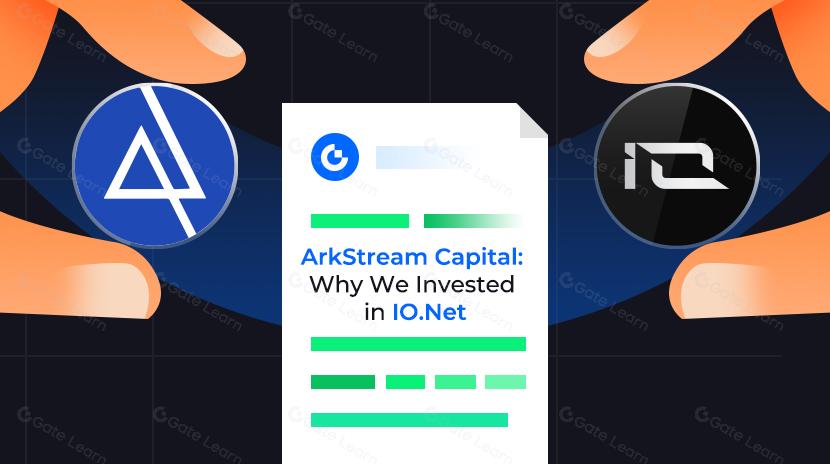
ArkStream Capital announces its Series A investment in IO.Net, marking a significant move in the AI and decentralized infrastructure sectors. IO.Net presents innovative solutions, harnessing encryption technology to coordinate global human computing power, positioning itself as the “new oil” of GPU computing capabilities and demonstrating its potential in the AI era.
2026-04-07 20:46:38
B^2 Network is a decentralized Data Availability (DA) and storage platform that addresses data compression and verification issues using an off-chain DA network. It aims to reduce dependence on the Bitcoin main network. The B^2 Hub functions as a DA layer and off-chain verification layer, similar to Celestia, to prevent data withholding and other malicious activities. In the future, B^2 Network plans to incorporate Bitcoin Layer2 to establish a universal DA layer and data storage layer within the Bitcoin ecosystem. The B^2 Hub node validates transaction batches, while storage nodes compete for block production rights to earn incentives. The workflow of B^2 Network involves the sequencer creating new blocks, the aggregator sending them to the Prover for ZK proof generation, and the B^2 Hub node verifying and transmitting the data hash to the Bitcoin chain. As a universal DA and verification layer, B^2 Hub has the potential to enhance other Bitcoin second-layer solutions.
2026-04-07 20:40:09
Having development capabilities or even just basic development knowledge is a better path to increasing the chances of receiving airdrops or, more accurately, becoming a true builder on the blockchain. This article will detail the basic development knowledge needed for a user who likes to experience chain operations.
2026-04-07 20:29:53
The current situation where the security of tokens depends entirely on the project's self-awareness. To address this, we may need to improve token mechanisms or introduce effective token supply monitoring schemes to ensure transparency in token quantity changes. We need to be vigilant, as while people's awareness of fraud is increasing, attackers' anti-fraud techniques are also constantly evolving. This is an ongoing game, and we need to continue learning and thinking to protect our interests.
2026-04-07 20:07:36
The RGB++ asset protocol proposed by the CKB team uses CKB and other UTXO-type blockchains as a function expansion layer to achieve isomorphic binding. Users do not need to verify transaction data and can leave the verification work to the UTXO chain. The protocol supports users to switch verification modes and operate assets on the CKB chain through Bitcoin accounts. In addition to CKB, Cardano and Fuel can also support isomorphic binding, but CKB is more suitable as a function expansion layer for the Bitcoin asset protocol. Isomorphic binding utilizes UTXOs on CKB and Cardano chains as “containers” to add programmability and complex scenarios to assets.
2026-04-07 19:54:17
This article provides a detailed introduction to the cross-chain project Zetachain and how it addresses the issue of full-chain interoperability.
2026-04-07 19:20:54
Explore the key differences between zero-knowledge proofs and transparent blockchains, and understand how each plays a role in protecting privacy and enhancing transparency. Discover the strengths, weaknesses, and future trends of these two technologies, and how they together shape trust and innovation in the digital world.
2026-04-07 17:54:44
Decentralized Science (DeSci) has emerged. This is a new concept in the world of Web3. The main goal of DeSci is to achieve fair and equitable funding, creation, review, storage, and dissemination of scientific knowledge through establishing public infrastructure and using Web3 tools (including NFTs, smart contracts, DAOs, etc.). Finally, the article points out that although DeSci offers a new research model, its development still faces many challenges, such as the quality of research projects and how to improve the governance system of DAOs, which can be solved based on further effort and innovation.
2026-04-07 17:50:41
Including transactions in a purely first-come-first-served fashion encourages spam and may block high-value transactions from ordinary users. This article tackle this problem by propose a new fee mechanism on Solana.
2026-04-07 15:41:31