In on-chain prediction markets and real-world data assetization systems, tokens are not merely a medium of exchange, but also coordination tools that enable the system to function. As information increasingly becomes a priced asset, how to distribute value among different participants has emerged as a central challenge in designing data markets.
Opinion Labs has built an infrastructure centered on real-world data and prediction markets, with the OPN token serving as the core mechanism for incentives and value distribution. It is not only used to encourage market participation and settlement, but also connects the entire process of data production, verification, and trading through its underlying design.
In this context, the significance of OPN lies in its ability to standardize “data participation” into quantifiable economic incentives, thereby supporting the sustainable operation of the entire data financialization system.
What Is OPN? Its Role in the Opinion Ecosystem
As the native token of the Opinion Labs ecosystem, OPN has a total supply of 1 billion tokens. It functions as the core utility token, enabling access to platform services, participation in governance, and the capture of network value.
Within the system architecture, OPN is more than just a payment tool. It acts as a value bridge between data inputs and market outputs. It rewards participants who provide real-world data, while also incentivizing liquidity providers and traders within prediction markets.
In terms of functionality, OPN serves three roles simultaneously: an incentive mechanism, a unit of value settlement, and a governance tool. Together, these roles allow the data market to operate without centralized coordination.
Why Prediction Markets Need Token Incentives
Prediction markets fundamentally rely on the combination of distributed information and capital expression. The quality of information directly determines market efficiency. Without incentive mechanisms, participants would lack motivation to contribute high-quality data and accurate predictions.
Within the Opinion Labs framework, token incentives address three key challenges: insufficient data supply, low prediction accuracy, and lack of liquidity.
By leveraging OPN incentives, the system attracts more data contributors and traders, enhancing price discovery and aligning market outcomes more closely with real-world probability distributions.
Core Use Cases of OPN
OPN’s use cases span the entire lifecycle of the data market.
At the data layer, OPN rewards data providers and Oracle validation nodes. At the market layer, it is used for transaction fee payments and liquidity incentives. At the governance layer, OPN may be used to adjust protocol parameters and update market rules.
Together, these use cases form a closed-loop system, ensuring that the token plays an active role across data production, validation, and trading.
How OPN Incentivizes Different Participants
OPN coordinates the behavior of multiple roles through differentiated incentive mechanisms.
Data providers earn rewards by submitting high-quality, verifiable data. Predictors generate returns by accurately forecasting market outcomes. Validation nodes receive incentives for participating in Oracle consensus.
The design of Opinion Labs fosters both competition and collaboration among these roles, improving overall information efficiency within the system.
OPN Supply and Demand Structure and Token Distribution
OPN’s supply and demand dynamics are typically driven by three core sources: market trading demand, incentive emissions, and protocol allocations.
| Allocation Category |
Percentage |
Amount |
Release Mechanism |
| Airdrop |
23.50% |
235 million |
3.5% at TGE, 7-month vesting |
| Investors |
23% |
230 million |
12-month lock, 24-month release |
| Team & Advisors |
19.50% |
195 million |
Same as above |
| Foundation |
12% |
120 million |
1% at TGE |
| Ecosystem & Incentives |
11.10% |
111 million |
5.65% at TGE |
| Marketing |
8.90% |
89 million |
7.7% at TGE |
| Liquidity |
2% |
20 million |
2% at TGE |
In terms of allocation, the OPN airdrop accounts for 23.5% or 235 million tokens, with 3.5% released at TGE and the remainder vested over seven months. Investors hold 23% or 230 million tokens, while the team and advisors account for 19.5% or 195 million tokens, both subject to a 12-month lockup followed by a 24-month linear release.
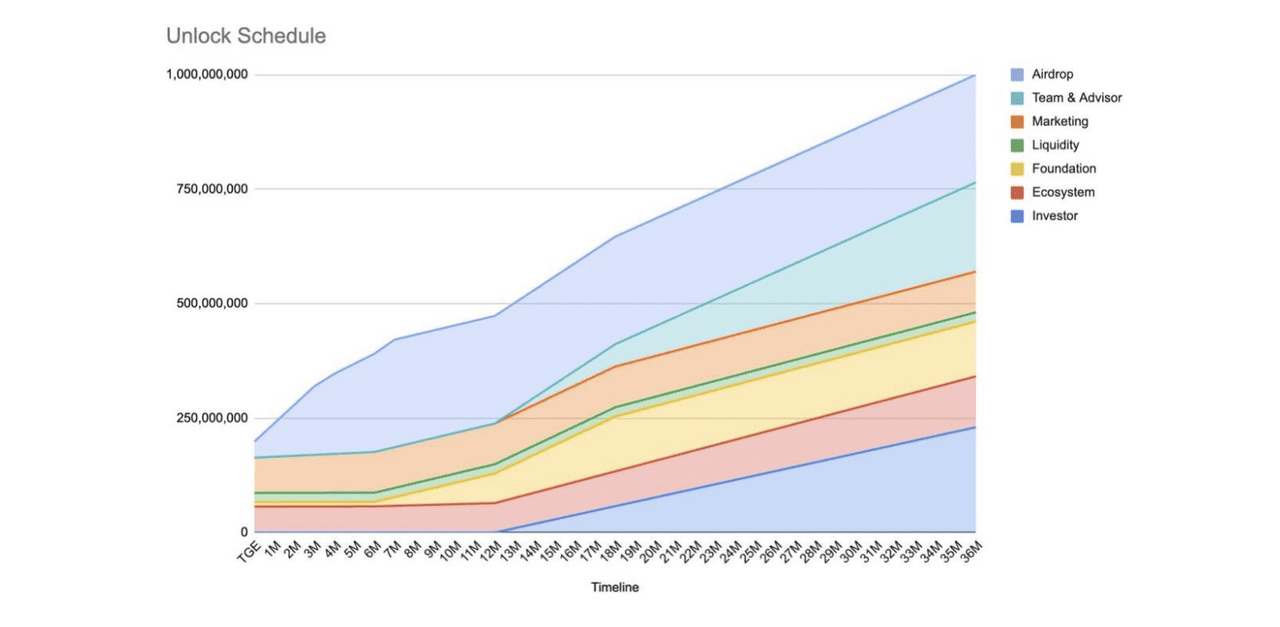
On the demand side, usage is primarily driven by prediction market trading and fee payments, while supply comes from system rewards and ecosystem incentive emissions. The token distribution mechanism is designed to balance short-term incentives with long-term ecosystem growth.
The key objective of this structure is to avoid inflationary pressure from a single incentive source while maintaining strong participation across the market.
OPN Value Capture Mechanism
OPN captures value primarily through prediction market activity and the process of data assetization.
As trading volume increases, a portion of fees and system revenue may flow back into the token ecosystem, forming a closed value loop. At the same time, as data becomes increasingly financialized, demand for OPN as a coordination tool is likely to grow.
Within the Opinion Labs framework, this value capture mechanism effectively transforms the flow of information into economic value.
Core Design Logic of the OPN Economic Model
The central logic of the OPN economic model is to enhance information quality through incentives while maintaining system stability through structured token distribution.
This design typically relies on a three-layer framework: short-term incentives such as trading rewards, medium-term balance through liquidity and market depth, and long-term value capture driven by network effects and data asset growth.
Through this layered approach, OPN sustains participant engagement and ensures stable system operation in a dynamic market environment.
Challenges and Risks Facing the Opinion Ecosystem
Despite its structured design advantages, Opinion Labs still faces several challenges.
These include issues related to data source reliability, Oracle attack risks, market manipulation, and incentive misalignment. Poorly designed incentives could lead to short-term speculation outweighing long-term contributions to data quality.
In addition, prediction markets themselves may be affected by low liquidity or extreme events, which can undermine price discovery efficiency.
Summary
OPN serves as the core incentive and value coordination mechanism within the Opinion Labs ecosystem. By linking data production, prediction trading, and result verification through token-based mechanisms, its economic model enhances data quality and enables value capture. This allows prediction markets to evolve from simple information tools into foundational infrastructure for data finance.
FAQs
What is the core function of OPN?
OPN coordinates incentives and value distribution across data provision, prediction trading, and validation processes.
How does OPN improve data quality?
It rewards high-quality data contributors through incentive mechanisms, thereby increasing overall data reliability.
Where does OPN’s value come from?
It primarily derives from prediction market trading activity and system revenue generated through data assetization.
What is the relationship between OPN and prediction markets?
OPN functions as the incentive and coordination layer of prediction markets, improving both efficiency and liquidity.
What is the core goal of the OPN economic model?
To enhance information quality and market efficiency while maintaining system stability.