As DeFi protocols have evolved, the role of tokenomics has been steadily shifting. Early projects often relied heavily on token incentives to quickly attract liquidity. However, as the industry matures, more protocols are focusing on governance structures and the distribution of control, using tokens to enable sustainable decentralization over the long term.
Within this broader trend, Morpho takes a relatively restrained approach. MORPHO does not emphasize revenue sharing or short-term incentives. Instead, it centers on governance, with the core objective of gradually transferring protocol control to the community, supporting a more stable and sustainable growth path.
MORPHO Token Overview
MORPHO is the native governance token of the Morpho protocol, with a total supply of 1 billion tokens. Its primary function is to support decentralized governance.
According to official documentation, MORPHO is not designed to capture protocol revenue. Rather, it acts as a “governance credential,” allowing holders to participate in key decisions. These include protocol upgrades, parameter adjustments, and the evolution of governance structures.
In this sense, MORPHO is better understood as a tool for protocol control, rather than a traditional yield-generating token.
Core Use Cases of MORPHO
MORPHO’s utility is concentrated almost entirely at the governance layer, centered around control of the protocol. Token holders can vote on governance proposals that shape critical decisions, such as market parameter settings, risk management rules, and the introduction of new modules.
To improve governance efficiency, Morpho also supports delegation. Users can delegate their voting power to more active or experienced participants, creating a more representative governance structure. This approach helps maintain decentralization while improving both decision quality and efficiency.
Notably, MORPHO is not used to pay interest or fees, nor can it be used as collateral in lending. This distinguishes it from many other DeFi tokens and is also one of the most commonly misunderstood aspects of its design.
MORPHO Token Distribution and Vesting
MORPHO’s token distribution is designed around a key objective: gradually transferring control to the community. The allocation typically includes community users, core contributors, early investors, and the protocol treasury, balancing interests across stakeholders over the long term.
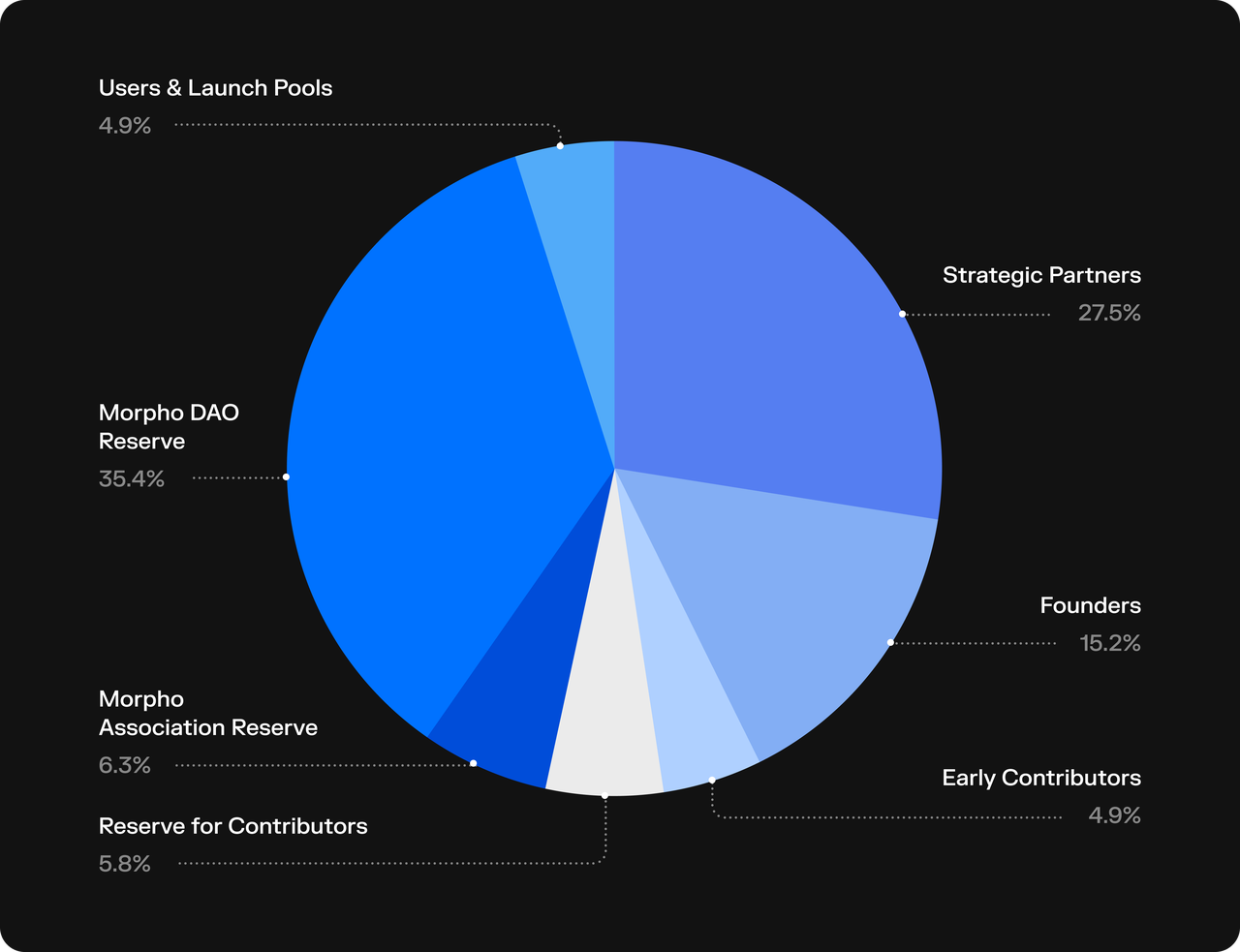
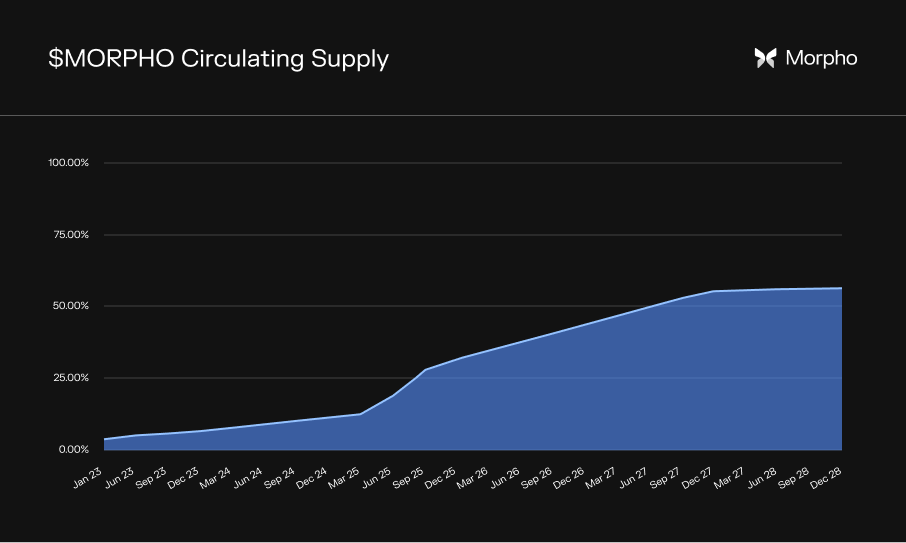
In terms of vesting, tokens are generally released in phases. Allocations for contributors and investors often come with longer lock-up periods to prevent large amounts from entering circulation too quickly. Meanwhile, the community allocation is distributed progressively through incentives, supporting protocol growth and user participation.
Incentive Model Design of MORPHO
Unlike many early DeFi projects that relied on aggressive token subsidies, Morpho’s incentive model prioritizes efficiency and sustainability. Its goal is not to attract short-term liquidity through token rewards, but to improve the product itself so that capital flows in naturally.
Under this framework, MORPHO plays a supporting role in incentives. For example, it may be used selectively during specific phases or within certain markets to guide user behavior, but the protocol does not depend on continuous token emissions to sustain activity.
This reflects a “product-first” philosophy, where competitiveness comes from the lending mechanism itself, such as peer-to-peer matching, rather than token-based yield.
MORPHO and Value Capture
Under its current design, MORPHO does not directly participate in protocol revenue distribution. Holding the token does not entitle users to interest or fee income, making its value model fundamentally different from cash flow-based tokens.
Instead, MORPHO derives its value primarily from governance power. Holders can influence the protocol’s direction through voting, which becomes increasingly meaningful as the protocol grows.
As the ecosystem expands, MORPHO may also play a larger role in coordinating different modules and markets, further strengthening its importance within the system.
MORPHO and Morpho Blue Relationship
As Morpho evolves toward modular lending architecture, the governance role of MORPHO becomes even more significant. Within the Morpho Blue framework, lending markets can be created independently, with more flexible risk parameters and a more open overall structure.
In this setup, the protocol layer and market layer are increasingly separated. MORPHO’s role is concentrated at the protocol layer, where it governs core rules, drives upgrades, and coordinates overall development.
This shift means MORPHO is no longer limited to a single function. Instead, it becomes a key governance tool connecting different modules across the ecosystem.
Potential Risks and Controversies of MORPHO
Despite its thoughtful design, MORPHO still faces several common challenges. Because it is not directly tied to protocol revenue, its value depends largely on governance demand, which may limit its ability to capture value.
Additionally, if token holders are not actively engaged in governance, decision-making power could become concentrated among a small group of participants, potentially weakening decentralization.
Finally, without strong mandatory use cases, demand for the token may fluctuate depending on the pace of ecosystem growth.
Conclusion
MORPHO is a governance-focused token, designed not for short-term yield but for the decentralized distribution of protocol control. By emphasizing governance over revenue linkage, Morpho has built a token model oriented toward long-term sustainability.
As modular lending architecture continues to develop, MORPHO’s role is evolving from a simple governance tool into a broader coordination mechanism across the ecosystem. Its importance is likely to grow alongside the protocol itself.
FAQs
Can MORPHO generate yield or dividends?
Currently, MORPHO follows a pure governance model and does not directly share protocol fees or interest. This design helps minimize risk and keeps the protocol streamlined. Any potential value for holders comes from the scarcity of governance power and increased influence as the protocol grows.
What is the core use case of MORPHO?
It is primarily used for governance and the distribution of protocol control.
Can MORPHO be used for lending or collateral?
No, it is not designed for payment or collateral purposes.
Where does MORPHO derive its value?
Mainly from governance rights and the ability to influence protocol development.
Will MORPHO become more important with Morpho Blue?
As protocol architecture evolves, its governance role is likely to become even more significant.







