When choosing a Layer 2 solution or evaluating its technical roadmap, users need to understand how various networks handle transaction execution, data storage, and final settlement. For instance, their approaches to fee models, scalability, and system upgrades differ significantly.
These questions typically center on three aspects: architecture design, execution mechanisms, and data processing. Together, these factors shape the system performance of Mantle and Optimism.
What Is Mantle
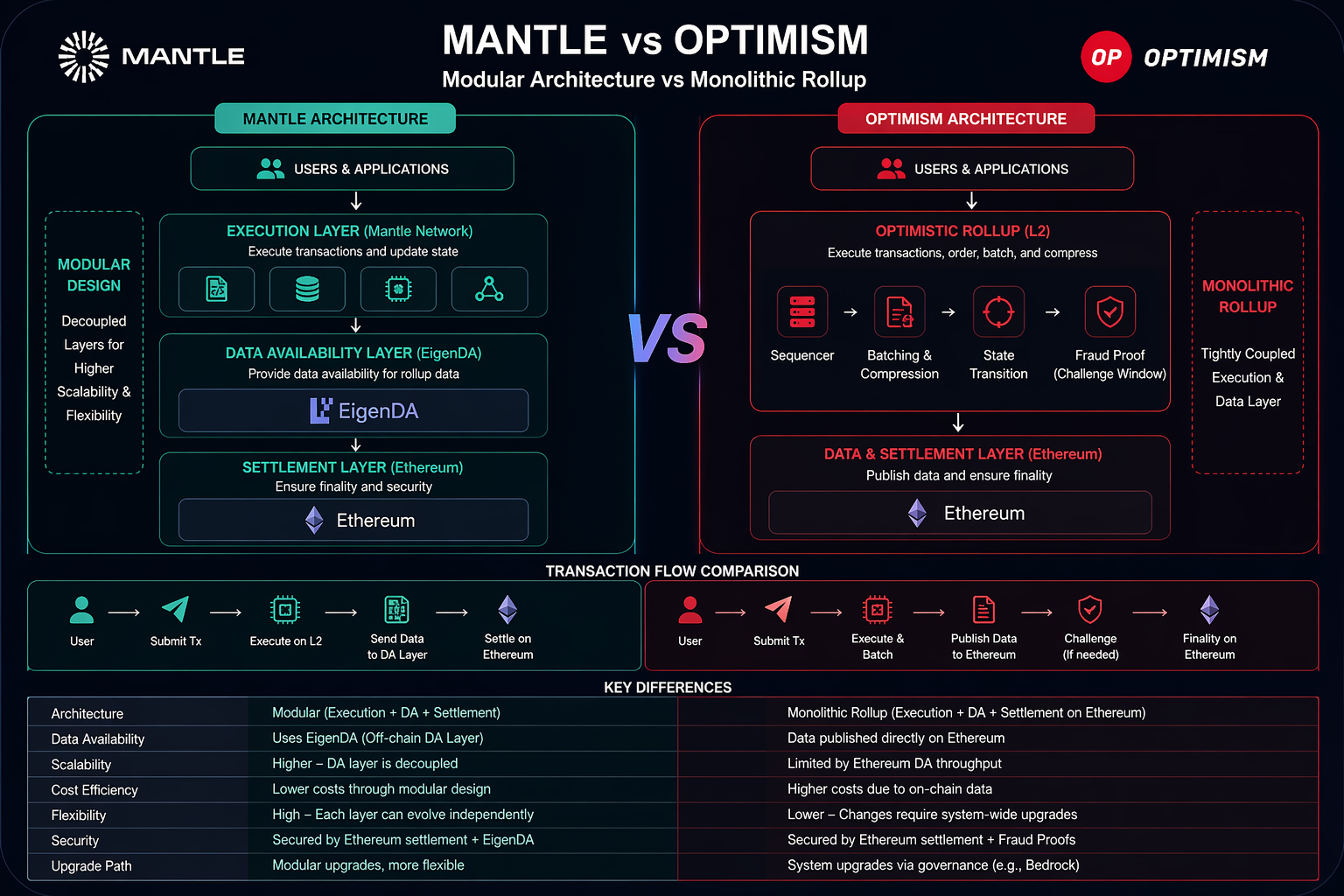
Mantle is a Layer 2 network built on a modular architecture, separating execution, data availability, and settlement layers as its core design principle.
In practice, Mantle processes transactions on Layer 2 via its execution layer, computes results, and stores transaction data on a dedicated data availability layer, with final settlement handled by Ethereum. This layered approach allows each module to be optimized independently.
Structurally, Mantle leverages external data availability solutions, decoupling data storage from execution logic, which reduces costs and increases scalability.
This design transforms blockchain from a monolithic system into a composable framework, offering greater flexibility for performance optimization.
What Is Optimism
Optimism is a Layer 2 network based on the Optimistic Rollup model, focused on batching transactions and submitting results to Ethereum.
Optimism executes transactions on Layer 2, periodically aggregates and posts data to Ethereum, and ensures correctness using a fraud-proof system. Transactions are presumed valid by default and are only challenged if disputes arise.
Structurally, Optimism tightly couples execution and data publication on Ethereum, relying on the mainnet for both data storage and security assurances.
This design streamlines validation logic for higher efficiency while maintaining close compatibility with Ethereum’s native environment.
Architectural Differences: Mantle vs. Optimism
Their architectural strategies define their overall operations.
Mantle adopts a modular architecture, separating the execution and data availability layers. Optimism uses a monolithic Rollup structure, integrating execution and data publication.
This difference directly influences system component coupling and upgrade mechanisms.
| Dimension |
Mantle |
Optimism |
| Architecture Type |
Modular |
Monolithic Rollup |
| Data Layer |
Independent DA |
Ethereum-based |
| Component Coupling |
Low |
High |
| Upgrade Model |
Modular Upgrades |
Full-System Upgrades |
| Flexibility |
High |
Relatively Limited |
Mantle’s architecture enables greater flexibility, while Optimism prioritizes system consistency.
Execution Mechanism Differences
Execution mechanisms define transaction processing flows.
Mantle’s execution layer operates independently on Layer 2, collaborating with other modules post-computation. Optimism batch-processes transactions using the Rollup model and submits results directly to Ethereum.
Mantle separates execution from data storage, whereas Optimism tightly integrates execution with data publication.
As a result, Mantle offers higher scalability in high-traffic scenarios, while Optimism’s execution is more closely aligned with Ethereum’s native logic.
Incentive Mechanism Design
Incentive models shape network participation and resource allocation.
Mantle’s incentive structure is built around its modular setup: its token is used for fees, governance, and ecosystem incentives. Optimism relies on the OP token to drive governance and fund public goods, with network operations sustained by transaction fees.
Mantle distributes incentives across multiple modules, while Optimism concentrates rewards on governance and ecosystem development.
| Dimension |
Mantle |
Optimism |
| Token Utility |
Fees + Governance + Incentives |
Governance + Ecosystem |
| Incentive Recipients |
Multi-module Nodes |
Users & Projects |
| Governance Model |
DAO |
DAO |
| Revenue Source |
Transaction Fees |
Transaction Fees |
This distinction highlights their different approaches to ecosystem growth.
Data Availability: Mantle vs. Optimism
Data handling is one of the most critical distinctions.
Mantle employs an independent data availability layer for transaction data storage, while Optimism publishes all data directly to Ethereum.
Mantle reduces costs by outsourcing data availability; Optimism enhances security and transparency via on-chain storage.
The result: Mantle achieves lower fees; Optimism delivers more direct, robust data security.
Ecosystem and Development Path Differences
Technical choices ultimately define ecosystem direction.
Mantle focuses on building financial and asset infrastructure on-chain, leveraging its modular design to support complex applications. Optimism puts a premium on Ethereum compatibility, driving general-purpose app development.
Mantle emphasizes integrated financial use cases; Optimism focuses on broad, general expansion.
These strategies lead to distinctly different ecosystem trajectories.
Summary
Mantle and Optimism represent two distinct Layer 2 models: modular and monolithic Rollup. Their architectural, execution, and data processing differences drive their unique performance profiles and ecosystem directions.
FAQ
What is the biggest difference between Mantle and Optimism?
Mantle uses a modular architecture; Optimism relies on a monolithic Rollup structure.
Why are Mantle’s fees lower?
Mantle’s independent data availability layer minimizes reliance on Ethereum, reducing costs.
How does Optimism ensure security?
By publishing data to Ethereum and leveraging fraud-proof mechanisms for validation.
Are both suitable for the same applications?
Their strengths differ—applicability depends on cost, scalability, and compatibility needs.
Is modular architecture superior?
It depends on requirements. Modular design offers flexibility but introduces added complexity.