As blockchain scalability solutions continue to advance, projects are taking varied approaches in execution layer design: some boost composability by integrating multiple execution environments, while others focus on optimizing a single execution path for maximum performance. When developers select foundational infrastructure, they must often balance flexibility against performance.
This challenge typically spans three dimensions—architecture design, execution mechanisms, and resource allocation—which together shape the technical direction and ecosystem trajectory of each network.
What Is Fluent?
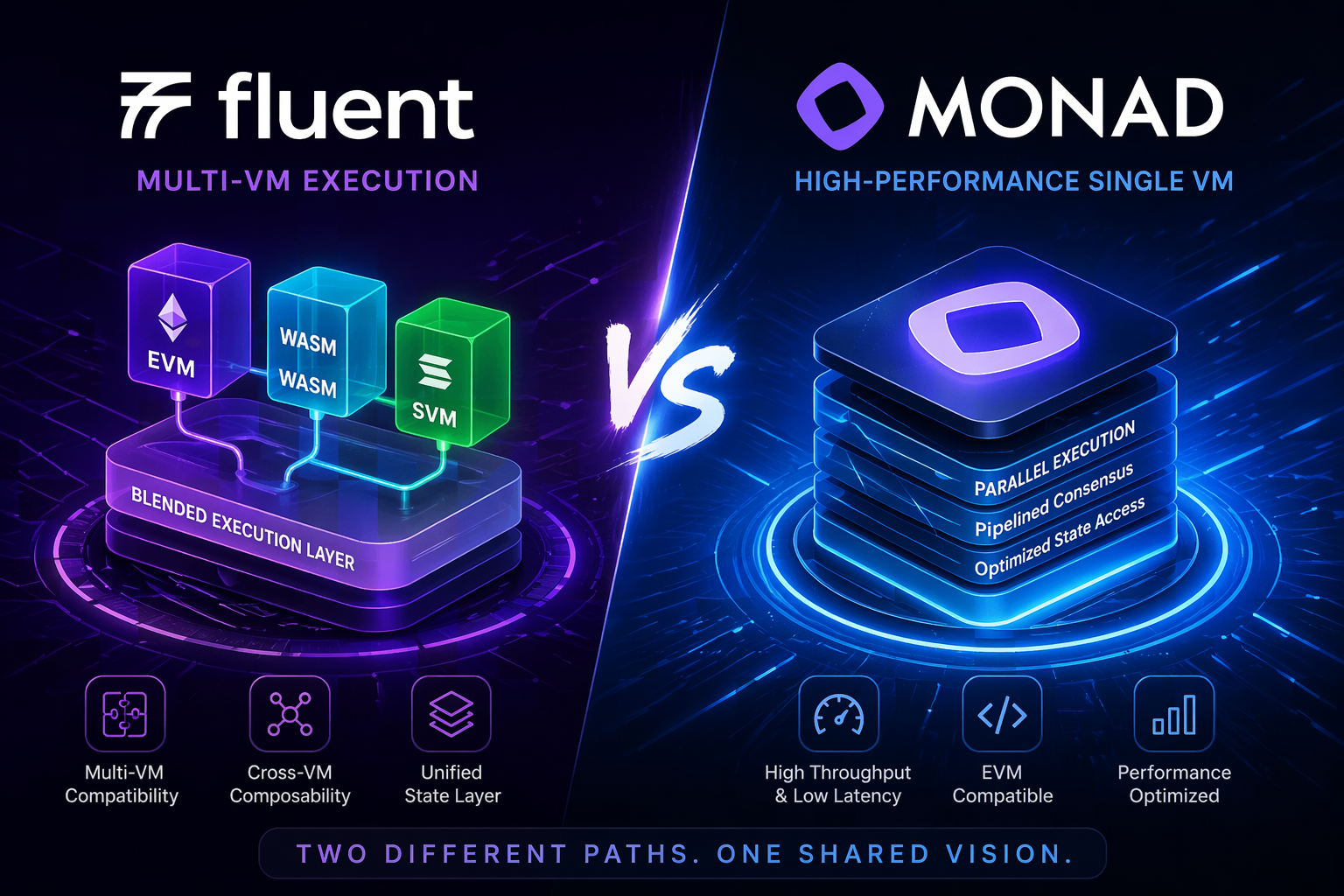
Fluent is a network designed to support collaborative execution across multiple virtual machines, centering on the integration of diverse computing environments through a unified execution layer.
Mechanically, Fluent enables different virtual machines—such as the EVM and Wasm—to operate within a single system. It facilitates cross-VM calls, allowing applications to share state and logic across various execution environments.
Structurally, Fluent leverages an abstract execution layer that encapsulates multiple VMs behind a unified interface, making cross-environment interaction seamless. This architecture empowers developers to build complex, multi-path execution applications within one cohesive system.
The core value of this model lies in its enhanced composability, enabling tools and logic from different ecosystems to integrate within a single execution framework.
What Is Monad?
Monad is a blockchain that prioritizes high-performance execution within a single virtual machine, optimizing the execution path for high throughput and low latency.
Mechanically, Monad builds upon the EVM and leverages parallel execution, pipelining, and state optimization to maximize transaction processing efficiency within a single VM.
Structurally, Monad’s design is centered around a single-VM architecture, pushing performance through deep execution flow optimizations rather than introducing multiple execution environments. This leads to a more streamlined system.
The key benefit of Monad’s approach is its significant performance gains, all while maintaining a familiar environment for developers.
Architectural Differences Between Fluent and Monad
The primary architectural difference is in how each organizes its execution environment.
Mechanically, Fluent achieves cross-environment execution by fusing multiple VMs, whereas Monad boosts execution efficiency through aggressive single-VM optimization. These represent fundamentally different scalability strategies.
Structurally, Fluent requires an additional abstraction layer to coordinate calls and state sharing between VMs, while Monad maintains a unified execution environment and drives performance via execution engine optimizations.
| Dimension |
Fluent |
Monad |
| Execution Model |
Multi-VM Integration |
Single VM |
| Architecture Path |
Abstract Integration |
Deep Optimization |
| System Complexity |
High |
Low |
| Composability |
High |
Moderate |
| Performance Improvement |
Architectural Integration |
Execution Layer Optimization |
This distinction underscores the fundamental design philosophies: Fluent is built for extensibility, whereas Monad is engineered for execution efficiency.
How Do Execution Mechanisms Differ Between Fluent and Monad?
Execution mechanisms determine how transactions are processed.
Mechanically, Fluent supports cross-VM execution, processing transactions in stages across multiple environments. Monad, in contrast, handles all execution within a single VM, boosting throughput via parallelization.
Structurally, Fluent’s execution flow is more complex, requiring careful coordination of calls between VMs. Monad’s process is more streamlined, leveraging optimized scheduling for greater efficiency.
In practice, Fluent suits complex logic applications, while Monad excels in high-frequency, performance-sensitive scenarios.
How Are Incentive Mechanisms Designed in Fluent and Monad?
Incentive mechanisms dictate resource allocation.
Mechanically, Fluent’s incentive system must cover multiple participant types—including execution and validation nodes—to support collaborative multi-VM execution. Monad, however, focuses its incentives within a single execution framework.
Structurally, Fluent’s incentive model is more intricate, distributing rewards across diverse execution roles. Monad’s model is more centralized and straightforward.
This means Fluent supports complex system operations via multi-layered incentives, while Monad enhances efficiency through a focused incentive structure.
How Are State Management and Control Distributed?
State management establishes system consistency.
Mechanically, Fluent employs a unified state layer to manage execution outcomes from multiple VMs, allowing environments to share state. Monad maintains state entirely within a single VM, avoiding the challenges of cross-environment synchronization.
Structurally, Fluent must resolve cross-VM consistency, adding complexity, while Monad’s approach is direct and simplified.
In effect, Fluent offers greater flexibility but requires sophisticated coordination, whereas Monad’s advantage lies in architectural simplicity.
Differences in Application Scenarios and Ecosystem Evolution
Application scenarios reflect the real-world impact of design choices.
Mechanically, Fluent is ideal for use cases needing cross-environment execution—like multi-language smart contracts and complex compositional logic. Monad is better suited for high-throughput environments such as high-frequency trading and large-scale applications.
Structurally, Fluent’s ecosystem leans toward diversity and cross-system integration, whereas Monad’s ecosystem is focused on performance-driven solutions.
Ultimately, Fluent and Monad steer their ecosystems in different directions: one toward diversity, the other toward efficiency.
Summary
Fluent and Monad represent two distinct scalability paths in blockchain: multi-VM integration and single-VM optimization. Their differences span architecture, execution mechanisms, and ecosystem priorities.
FAQ
What is the core difference between Fluent and Monad?
Fluent is designed for collaborative execution across multiple virtual machines, while Monad is focused on optimizing performance within a single VM.
Is Fluent more flexible than Monad?
Fluent generally offers greater flexibility in execution environments and composability.
What are Monad’s main advantages?
Monad delivers high throughput and low-latency execution performance.
Do their application scenarios overlap?
There is some overlap, but Fluent is better for complex applications, while Monad excels in performance-driven contexts.
Which architecture is more scalable?
It depends on your needs: multi-VM architectures are better for expanding functionality, while single-VM architectures offer more direct performance scaling.







