In traditional finance, borrowing rates are typically set by banks or financial institutions based on market conditions and risk assessments. This centralized model relies on institutions to manage the cost of capital and manually adjust lending rates. In contrast, decentralized lending protocols use automated mechanisms for rate setting, with no intermediaries involved in determining interest rates.
A core objective of DeFi lending protocols is to enable the market to set the price of capital transparently and automatically. Compound accomplishes this with an algorithmic interest rate model, allowing borrowing rates to adjust in real time based on supply and demand. This ensures the lending pool’s liquidity and market equilibrium—without any manual intervention.
Why Is Compound’s Interest Rate Model Important?
Compound’s interest rate model directly impacts two key aspects of the marketplace: the borrowing costs for borrowers and the returns for depositors. If rates are too low, excessive borrowing can drain liquidity and discourage deposits. If rates are too high, borrowing demand may drop, reducing overall market activity.
In essence, Compound’s interest rate model not only determines the cost of capital in the lending market but also plays a crucial role in balancing supply and demand. By automatically adjusting rates, Compound facilitates the efficient flow of funds between borrowers and lenders, maintaining protocol stability across varying market conditions. This mechanism is a foundational reason why Compound is a core piece of on-chain money market infrastructure.
What Is Compound’s Interest Rate Model?
Compound’s interest rate model is an algorithmic system that automatically sets borrowing rates based on the utilization rate of funds. The protocol calculates the borrowing rate for each asset by evaluating the proportion of that asset currently borrowed from the pool, and then derives the deposit rate accordingly.
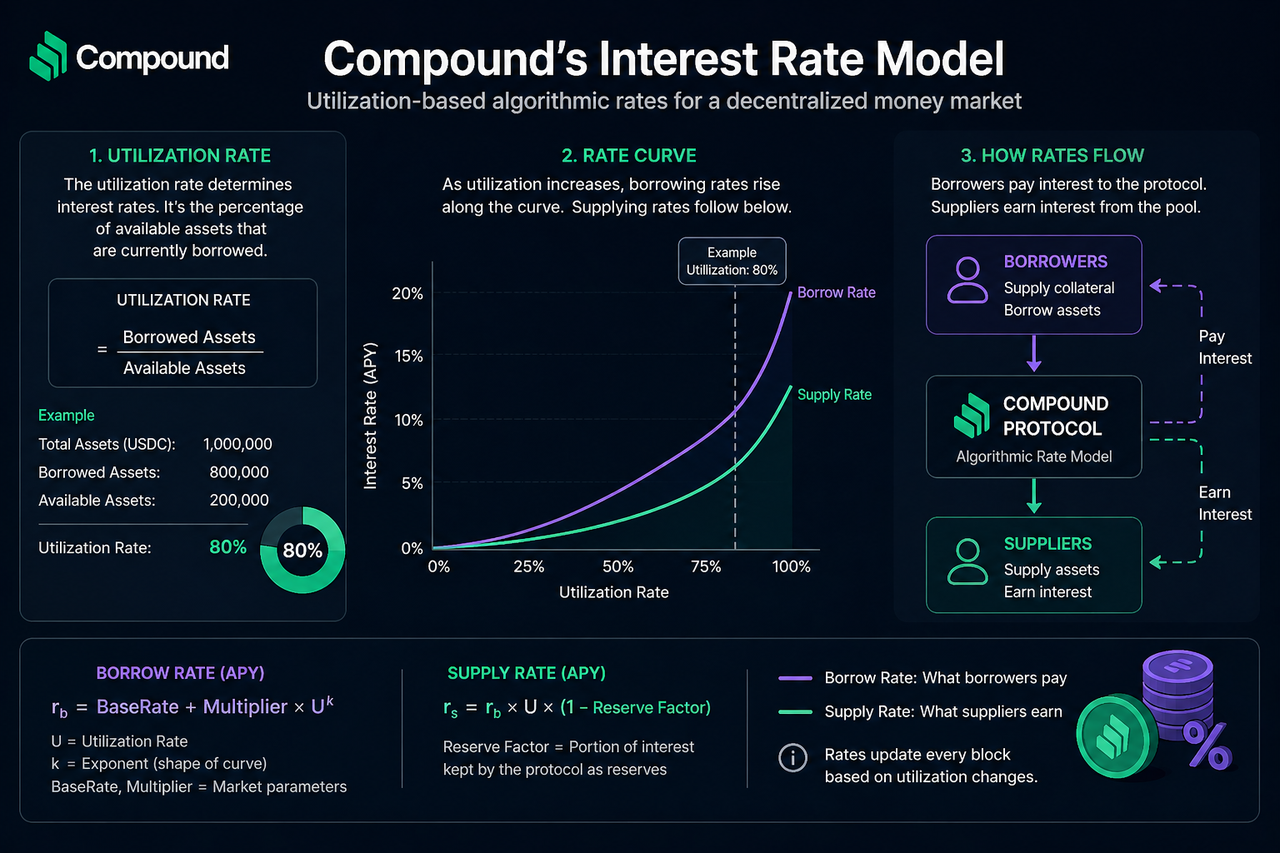
At its core, the model works as follows: when borrowing demand increases, the borrowing rate rises to curb demand, while higher deposit returns attract more liquidity. Conversely, when borrowing demand drops, rates are lowered to stimulate lending activity. This dynamic adjustment allows Compound to achieve automated, market-driven fund pricing within a decentralized framework.
What Is Utilization Rate?
The utilization rate is a central parameter in Compound’s interest rate model, representing the percentage of a pool’s funds that have been borrowed. It is calculated as:
Utilization Rate = Total Borrowed Assets ÷ (Total Pool Assets - Reserves)
For example, if a pool holds 1,000 USDC and 800 USDC are borrowed, the utilization rate is 80%.
A higher utilization rate means less available liquidity, so borrowing rates rise; a lower utilization rate results in lower borrowing rates. This metric guides the direction of rate changes within Compound and underpins the protocol’s dynamic market adjustments.
How Is the Borrowing Rate Calculated?
Compound’s borrowing rate is determined by a predefined rate curve, with the utilization rate identifying the current rate tier for users. As utilization increases, borrowing rates rise incrementally.
This curve design supports low borrowing costs when liquidity is ample but raises costs quickly as liquidity tightens, mitigating the risk of over-leveraging the pool. This way, Compound can automatically increase funding costs during periods of high demand, protecting pool liquidity.
How Is the Deposit Rate Calculated?
The deposit rate is not set independently; it is derived from the borrowing rate and utilization rate. The basic principle is that a portion of the interest paid by borrowers is distributed to depositors as their return.
In simplified terms:
Deposit Rate ≈ Borrowing Rate × Utilization Rate
This means that even with a high borrowing rate, the deposit rate will remain low if utilization is low. When lending demand is robust and utilization is high, deposit rates rise significantly. This mechanism ensures that deposit returns are closely linked to market lending activity.
Why Do Interest Rates Fluctuate with Market Conditions?
Compound’s interest rates are fundamentally driven by market supply and demand. When borrowing demand rises, available pool liquidity falls, utilization increases, and the protocol automatically raises borrowing rates to reduce demand and attract more deposits.
Conversely, when deposits increase or borrowing decreases, utilization drops, and the protocol lowers rates to stimulate lending. This automated adjustment enables Compound to maintain market balance without manual intervention.
This real-time, market-driven rate adjustment is a key difference between Compound’s model and traditional fixed-rate lending, greatly enhancing capital allocation efficiency.
How Does Compound’s Interest Rate Model Improve Capital Efficiency?
Traditional lending markets depend on manual rate adjustments, which can be slow to react. Compound’s algorithmic interest rate model instantly updates borrowing costs based on utilization, allowing the market to immediately reflect changes in supply and demand.
This mechanism maximizes capital efficiency by ensuring that the cost of funds always aligns with current market needs. When demand is high, higher rates prevent liquidity shortages; when demand is low, lower rates encourage lending. Through dynamic rates, Compound delivers an automated capital adjustment system for the on-chain lending market.
Summary
Compound’s interest rate model automatically calculates borrowing and deposit rates based on utilization, forming the core of the protocol’s lending mechanism. As borrowing demand and utilization rise, both borrowing and deposit rates increase, drawing more liquidity into the market.
This dynamic rate system enables Compound to balance supply and demand without manual intervention, optimizing capital allocation. As a foundational element of decentralized lending markets, Compound’s algorithmic rate model provides an automated pricing paradigm for DeFi protocols.
FAQs
Is Compound’s lending rate fixed?
No. Compound’s lending rate adjusts dynamically based on the utilization rate and is not fixed.
What is utilization rate?
Utilization rate refers to the proportion of funds borrowed from the pool relative to total available funds. It is the core parameter of Compound’s rate model.
Why does the borrowing rate increase?
When borrowing demand rises and utilization increases, the protocol automatically raises the borrowing rate to balance supply and demand.
How are deposit and borrowing rates related?
The deposit rate is funded by the interest paid by borrowers, and is typically determined by both the borrowing rate and utilization rate.
What is the function of Compound’s interest rate model?
It balances market supply and demand through dynamic rate adjustments, improves capital efficiency, and ensures pool liquidity.







