

Trade
Basic
Futures
Futures
Hundreds of contracts settled in USDT or BTC
TradFi
Gold
Trade global traditional assets with USDT in one place
Options
Hot
Trade European-style vanilla options
Unified Account
Maximize your capital efficiency
Demo Trading
Futures Kickoff
Get prepared for your futures trading
Futures Events
Participate in events to win generous rewards
Demo Trading
Use virtual funds to experience risk-free trading
Earn
Launch
CandyDrop
Collect candies to earn airdrops
Launchpool
Quick staking, earn potential new tokens
HODLer Airdrop
Hold GT and get massive airdrops for free
Launchpad
Be early to the next big token project
Alpha Points
Trade on-chain assets and enjoy airdrop rewards!
Futures Points
Earn futures points and claim airdrop rewards
Investment
Simple Earn
Earn interests with idle tokens
Auto-Invest
Auto-invest on a regular basis
Dual Investment
Buy low and sell high to take profits from price fluctuations
Soft Staking
Earn rewards with flexible staking
Crypto Loan
0 Fees
Pledge one crypto to borrow another
Lending Center
One-stop lending hub
VIP Wealth Hub
Customized wealth management empowers your assets growth
Private Wealth Management
Customized asset management to grow your digital assets
Quant Fund
Top asset management team helps you profit without hassle
Staking
Stake cryptos to earn in PoS products
Smart Leverage
New
No forced liquidation before maturity, worry-free leveraged gains
GUSD Minting
Use USDT/USDC to mint GUSD for treasury-level yields

More





Structure Selection During Consolidation: Bitcoin Range Trading and HYPE Wave Opportunities | Special Analysis
Hello, I am your old friend, Odaily’s exclusive market analyst Cody. Today is the seventh day of the Lunar New Year, and the Spring Festival holiday is basically coming to an end.
From the market performance, this week’s trend is similar to the analysis in our previous article—a slow pace, mainly oscillating, with no clear directional volatility.
Bitcoin has mainly traded within the $65,500–$70,000 range over the past week. The overall price structure remains in consolidation, neither effectively breaking through the upper resistance nor showing signs of further volume weakening downward.
In this context, it’s more appropriate this week not to rush to judge the trend direction but to observe the structural changes within the oscillation range.
During this phase of “mainstream assets slowing down,” we can extend our view to some relatively independent targets.
Therefore, this week’s article will introduce a new coin analysis—HYPE, combined with recent short-term practical results, analyzing its current position and potential trading opportunities from daily and wave perspectives.
Weekly Trading Summary:
• Short-term strategy execution (effectiveness verification): Due to Bitcoin not reaching the predicted pressure zone, we did not execute short-term trades last week based on strategy discipline.
• Mid-term strategy execution (effectiveness verification): Bitcoin followed the established mid-term strategy last week, holding a short position built at $89,000 (1x leverage). As of last week’s close, profit was approximately 24.01%, with a maximum profit of about 32.58% during the period.
• Core short-term view verification: Last week, Bitcoin oscillated between $65,500 and $70,000. The current trend aligns with our previous forecast of a range-bound market.
**• HYPE: **Analysis of structure and short-term trading opportunities. (See detailed explanation in Chart 1)
Below, we will review the market forecast, strategy execution, and specific trading process in detail.
1. HYPE Structure Analysis and Short-term Trading Review:
HYPE Daily K-line Chart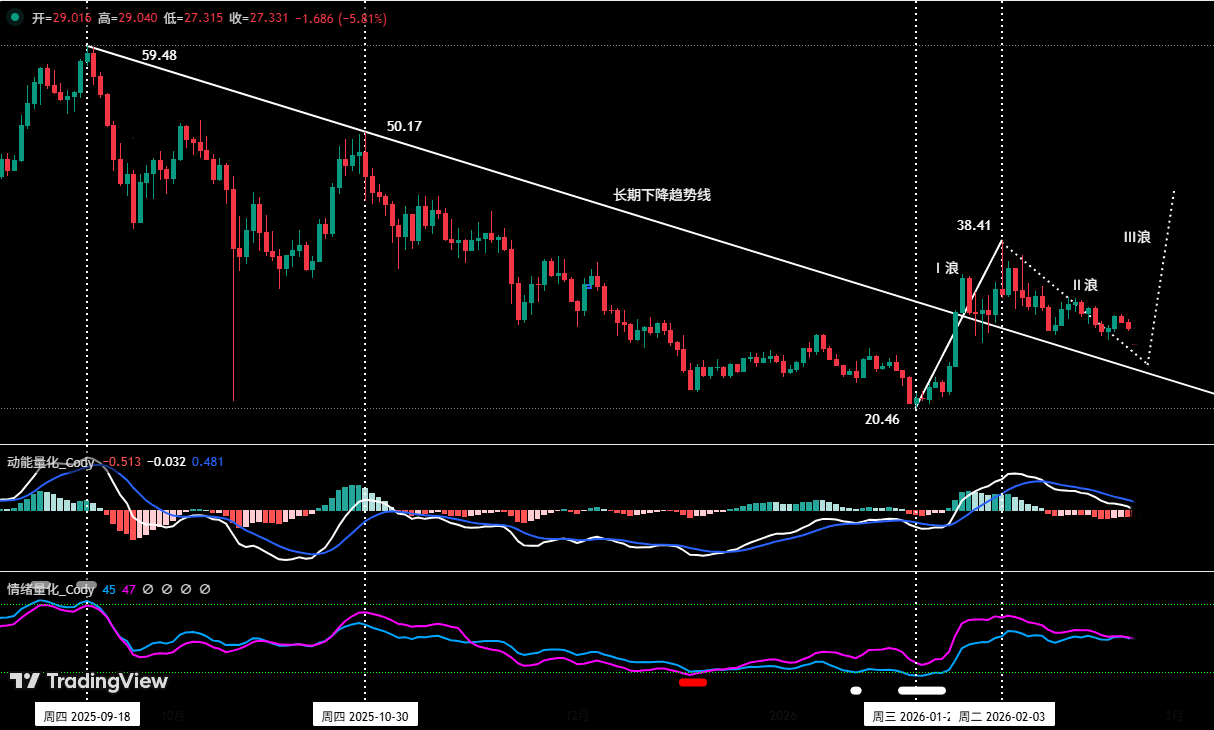
Chart 1
1. Daily Chart Structural Framework (see Chart 1)
Since stabilizing around $20.46 on January 21, 2026, HYPE has begun an independent oscillating upward trend. Currently, the price has confirmed a breakout of the long-term downtrend connecting the highs of September 2025 (~$59.48) and October 2025 (~$50.17), indicating a possible shift from the previous bearish structure.
The daily trend structure can be preliminarily divided as follows (based on price action after January 21):
• Wave I (Driving Wave): From January 21 ($20.46) to February 3 ($38.41), completing an upward wave.
Wave I bottom signal: Quantitative models built independently show that at the end of Wave I (around January 21), the following signals appeared simultaneously:
• Momentum Quantitative Model: Divergence signals.
• Sentiment Quantitative Model: Bottom warning signal triggered (white horizontal bar in the chart).
The overlap of these signals reinforces the forecast that Wave I formed an important low at $20.46 on January 21.
• Wave II (Correction Wave): From February 3 ($38.41) to now, representing a correction of Wave I.
• Key confirmation conditions for Wave III:
• Confirmation of Wave III start:
• Confirmation of Wave III end:
2. Short-term HYPE Trading (Long position with 1x leverage)
• Entry decision: Based on the correction after the first upward trend on the 1-hour chart, and after the momentum line in the Momentum Quantitative Model breaks above zero and pulls back for the first time, with the price above key support.
• Exit decision: Close position near the short-term technical resistance of $30.97.
• Trading summary: This operation successfully captured a rebound wave on the hourly level, earning approximately 4.71% profit.
2. Bitcoin Range-bound Market Continues: (02.16–02.22)
Since Bitcoin did not reach last week’s key resistance zone, and our independently built momentum and spread trading models did not trigger top signals, we strictly followed the established short-term strategy and did not open new positions last week.
Mid-term: Continue holding 60% short positions built around $89,000. As of last week’s close, profit was 24.01%.
Resistance zone: $72,000–$74,500
Support zone: around $65,000
3. Bitcoin Technical Indicator Analysis: Multi-model and Multi-dimensional Comprehensive Assessment
Combining market operation, I rely on independently developed trading systems to analyze multiple technical indicators from multi-model and multi-dimensional perspectives.
Bitcoin Weekly K-line (Momentum + Sentiment Models)
Chart 2
• Momentum Quantitative Model: Technical indicators show the momentum line is moving downward in sync, with negative energy bars expanding over 4 weeks, with no divergence signals.
The momentum model indicates: the price decline index is high.
• Sentiment Quantitative Model: Blue sentiment line at 27, with zero strength; purple sentiment line at 10, also zero strength, with peak at 0. This suggests the market’s oversold panic has not yet appeared.
The sentiment model indicates: the price support index is neutral.
• Digital Monitoring Model: No bottom signals detected.
No digital bottom signals; last week’s candle closed with a small downtrend of about 1.73%. The chart shows a pattern of “higher lows and lower highs” over three weeks, forming a converging structure.
These data suggest: Bitcoin weekly trend is bearish, with narrowing declines. It’s likely a consolidation within a downtrend.
Bitcoin Daily K-line (Momentum + Sentiment Models)
Chart 3
• Momentum Model: Last week’s market showed a “narrow sideways oscillation.” The momentum line, after forming a “golden cross” below zero, moved upward, with positive energy bars gradually enlarging.
The momentum model indicates: bullish rebound momentum is releasing, watch for energy changes.
• Sentiment Model: After triggering a bottom warning signal (white dot), the sentiment lines turned upward. Currently, blue sentiment at 20, zero strength; purple at 22, zero strength. The two lines are close together, moving out of oversold territory.
The sentiment model indicates: sentiment lines are turning upward, confirming the bottom warning signal; but the close alignment suggests mid- and short-term buying activity is weak, and rebound strength is limited.
These data imply: Daily trend remains bearish, but a short-term oversold rebound is ongoing.
4. Market Forecast for This Week: (02.23–03.01)
Bitcoin 4-hour chart
Chart 4
Using the 4-hour chart as the trading cycle:
• Central zone determination: The current structure suggests a high probability of forming an “upward central zone”. Resistance at about $72,300, support at about $65,100.
• Main scenarios and trading plans:
• Scenario 1 (failure to break): If subsequent rebound fails to break above the upper boundary (~$72,300), the market remains in consolidation. Strategy: consider reducing long positions on rallies.
• Scenario 2 (success to break): If the rebound successfully breaks above the central zone, the breakout is confirmed. Strategy: the uptrend may continue; hold longs, wait for clear exit signals.
• Scenario 3: If the correction breaks below the lower boundary (~$65,100), the price will test the support of the February 6 low again.
Core view this week: Focus on the battle between bulls and bears near the upper and lower boundaries of the central zone. The strategy should adhere to “reduce on rallies (longs), control risk”.
Key resistance levels:
• First resistance: $72,300–$74,500 (near April 2025 low)
• Second resistance: $79,500–$80,600 (near B wave initiation point)
• First support: $65,000 (previous low point)
• Second support: $60,000–$62,500 (near February 6 low)
• Third support: $57,400 (around 210-week moving average)
5. Trading Strategy for This Week (excluding unexpected news): (02.23–03.01)
Mid-term: Maintain 60% short positions. If a rebound effectively breaks $74,500, reduce to 40%.
Short-term: Use 30% position with stop-loss, based on support and resistance levels, to seek spread trading opportunities (using 30-minute/60-minute cycles).
Since the mid-term market trend is bearish, short-term trading should follow the principle of “trend-following, shorting on rallies.” To adapt dynamically to market changes and based on signals from our proprietary trading models, we propose two plans:
• Plan A: If the price rebounds to near the upper boundary (~$72,300):
• Entry: Triggered by resistance signals at this level, combined with model top signals, establish a 15% short position.
• Risk control: initial stop-loss above $75,500.
• Exit: When approaching key support levels and model signals, gradually close positions for profit.
• Plan B: If the price rebounds near $74,500:
• Add to position: When resistance is met and model signals confirm, increase short position by 15%.
• Risk control: stop-loss above $75,500.
• Exit: When the price drops to support levels, close for profit.
6. Special Reminder:
1. When opening a position: immediately set an initial stop-loss.
2. When profit reaches 1%: move stop-loss to break-even (entry price).
3. When profit reaches 2%: move stop-loss to 1% profit level.
4. Continuous tracking: for every additional 1% profit, move stop-loss up by 1% to protect gains and lock in profits.
The markets are highly volatile; all analysis and trading strategies should be dynamically adjusted. All viewpoints, models, and strategies discussed are based on personal technical analysis and are for personal reference only, not investment advice. Market risks are inherent; please trade cautiously and do not base decisions solely on this information.