Bitcoin falls below $97,000 to $95,500. Two major bearish signals: Initial jobless claims at 198,000 far below expectations, rate hike delayed until June; Trump states Iran “stopping killing,” risk aversion cools down. Funding rate only 4% (neutral 8%-12%), Google searches at 27, retail investors weaken, shifting to silver. VDD at 0.53 indicates long-term holders are not selling, double bottom pattern with $86,300 support remains solid.
Effect of delayed rate hike on initial jobless claims at 198,000
The first reason why Bitcoin dropped today points to macro turning points driven by US employment data exceeding expectations. The US Labor Department reported Thursday that for the week ending January 10, seasonally adjusted initial unemployment claims decreased by 9,000 to 198,000, significantly below the market forecast of 215,000, highlighting the resilience of the US labor market again. This data is a typical “bearish” signal for Bitcoin.
Why does good employment data negatively impact Bitcoin? The logical chain is: strong employment → no recession risk → Fed doesn’t need to cut rates → high interest rates persist longer → risk assets under pressure. DRW Trading strategist Lou Brien notes that current initial claims are at the lower end of recent ranges, prompting market participants to “moderately adjust positions,” which strengthens the dollar. A stronger dollar further suppresses Bitcoin priced in USD.
Amid ongoing strong employment data and sticky inflation, Fed rate hike expectations have been pushed back to June. The market generally expects the Fed to keep rates unchanged at the January 27-28 policy meeting, despite Trump repeatedly calling for rate cuts. Last Friday’s December non-farm payrolls showed unemployment unexpectedly falling to 4.4%, exceeding economists’ expectations, reinforcing the view of “holding steady in the short term.”
Triple impact of delayed rate hike on Bitcoin
High financing costs: Elevated interest rates make leveraged trading and staking loans expensive
Dollar strength suppression: Interest rate differentials attract funds into USD assets, reducing Bitcoin’s relative appeal
Risk appetite cooling: No rate cut expectations lead investors to reduce high-risk asset allocations
Meanwhile, inside the Fed, more cautious voices are emerging. Chicago Fed President Goolsbee said Thursday that with sufficient evidence of stable employment, the Fed should focus on pushing inflation back to 2%. He emphasized the labor market remains strong, “a rate cut may happen this year,” but only if there is “convincing evidence” that inflation is returning to 2%. Atlanta Fed President Bostic believes continued relatively tight policy is necessary given inflation remains high.
Additionally, market concern over “Fed personnel uncertainty” has eased temporarily. Trump told Reuters on Wednesday he has no plans to fire Powell, stating “I have no plans to do that.” He also emphasized that the current period is “observation,” and the Justice Department’s investigation into the Fed’s remodeling project is “too early” to determine if it constitutes grounds for removal. This ambiguous stance temporarily alleviates political interference fears but uncertainty remains.
Trump’s softening stance on Iran reduces risk aversion
The second reason for Bitcoin’s decline today stems from a sudden easing of geopolitical risks. The main clue comes from the latest White House statement. According to Bloomberg, President Trump told reporters in the Oval Office Wednesday that after receiving assurances from “a very important source” in the opposing camp, he might delay military action against Iran. He said: “We are told that Iran’s killing is stopping — it has stopped.”
Bloomberg notes that this marks a clear “tone shift” from the previous day. Trump had earlier called for continued protests in Iran and threatened “appropriate action” after reports of violent suppression, even posting on social media “help is on the way.” The 180-degree turn from “imminent military intervention” to “delaying action” caused risk-averse capital to quickly withdraw from Bitcoin.
US-Iran conflict risk was a key driver for Bitcoin rebounding from $91,000 to $97,900 earlier this week. When evacuation orders were issued, US military withdrew from Middle Eastern bases, and European officials hinted “action within 24 hours,” market panic peaked. Safe-haven funds flooded into gold, Bitcoin, and other non-seizable assets. But when Trump suddenly announced “killing has stopped” and military action was postponed, this risk aversion logic collapsed instantly.
Iran controls critical global oil shipping choke points, producing over 3 million barrels per day. If conflict erupts, supply disruptions could push oil prices higher, fueling inflation and increasing recession risks globally. In such extreme scenarios, Bitcoin’s role as “digital gold” hedge would be validated. But as geopolitical risks subside, this hedge demand naturally diminishes. Investors reassess: if geopolitics stabilizes, the economy avoids recession, and the Fed does not cut rates, what reasons remain for Bitcoin to rise?
Earlier, the US launched military action on January 3 to detain then-Venezuelan President Nicolás Maduro, increasing uncertainty. But Trump’s softened stance toward Iran suggests Middle East strategy may be more about pressure than actual war. This “bluff” pattern makes market pricing of geopolitical risks very difficult and weakens Bitcoin’s reliability as a safe haven.
Funding rate at 4% and retail exit indicated by Google searches at 27
(Source: Laevitas)
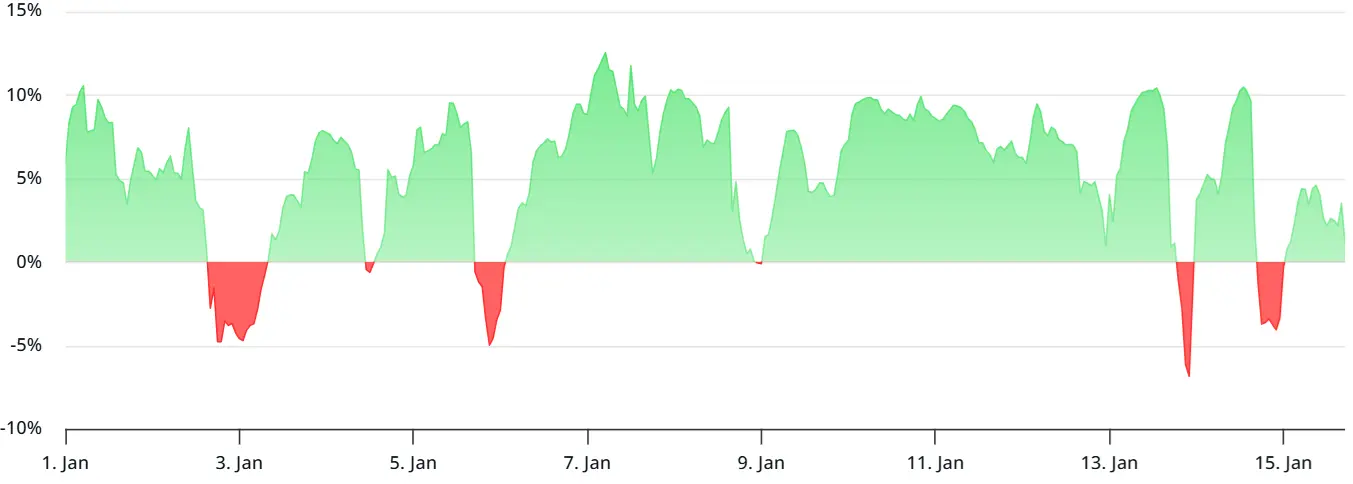
Thursday’s funding rate for Bitcoin perpetual futures is 4%, indicating limited demand for long positions. Under neutral market conditions, this indicator typically fluctuates between 8% and 12% to cover funding costs. These derivatives are favored by retail traders because their prices closely track spot markets. A 4% rate suggests very few longs, and the market lacks bullish momentum.
The logic of funding rates: when longs exceed shorts, longs pay funding to shorts, and the rate rises; when shorts exceed longs, shorts pay longs, and the rate falls or turns negative. The current low 4% rate indicates a “wait-and-see” stance—neither strong bullish nor panic-selling. This “apathetic” sentiment often signals sideways or slow downward price movement.
Google Trends data shows global searches for “cryptocurrency” at 27 (out of 100), close to the 12-month low of 22. Retail traders tend to chase recent winners, especially as silver prices surged 28% in two weeks. Bitcoin has long been viewed as a competitor to precious metals, but crypto traders often focus on short-term performance. When silver skyrockets and Bitcoin consolidates, capital naturally flows into silver.
Four signs of retail investor fatigue
Google searches only 27: far below the 80-100 peak during bull markets, extremely low interest
Funding rate only 4%: below neutral 8%-12%, weak retail bullishness
Shift to silver: 28% rise in two weeks absorbs speculative capital, reducing short-term appeal of Bitcoin
Futures liquidations decrease: $465 million in liquidations, relatively moderate, indicating cautious leverage use
Lack of retail interest does not mean Bitcoin market is ending, as the spot ETF industry alone holds over $120 billion in assets. Companies continue to follow MicroStrategy’s lead, holding over $105 billion in Bitcoin. Institutional demand is expected to grow until 2025 and may ultimately be the key driver pushing Bitcoin toward $100,000. Institutional buying offsets retail investor fatigue.
Thursday’s tech-heavy Nasdaq is only 1.6% below its all-time high, driven by TSMC’s 35% quarterly profit growth boosting trader confidence. However, despite recent gains, Bitcoin’s current price of $95,500 remains 25% below its all-time high of $126,219. This divergence from tech stocks shows Bitcoin is still not viewed as a “tech asset” by mainstream investors, but more as a “speculative asset.”
VDD at 0.53 and double bottom rebound prospects
(Source: CryptoQuant)
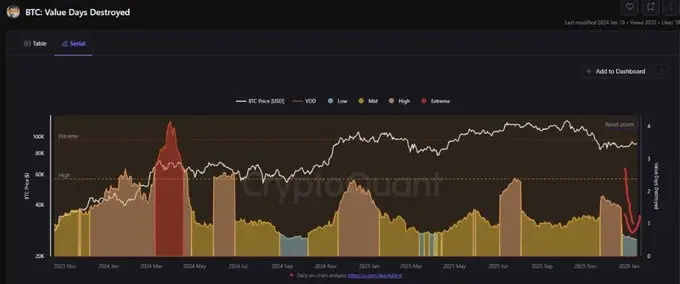
Despite short-term bearish signals, long-term indicators remain optimistic. According to on-chain insights shared by CryptoQuant-certified analyst Carmelo Alemán, the Bitcoin Value-Destroyed Days (VDD) indicator suggests room for further upside. VDD measures the number of days Bitcoin remains inactive before transfer, weighted by transfer amounts.
Currently, VDD is around 0.53 in January 2026, at a historic low, indicating recent transfers involve relatively new coins, and older coins remain unaffected. This implies long-term holders are not selling as prices rise. “This behavior enhances the quality of the bull market because price increases are not accompanied by selling from the most experienced capital,” Alemán explains.
Historically, when Bitcoin prices rise and VDD stays low, the market is in a healthy expansion phase, with demand absorbing available supply and no structural sell pressure. “In this scenario, breaking resistance levels and sustained upward momentum are strongly supported by long-term holders’ inaction, reinforcing the view that the current rally is driven by genuine market strength rather than a fragile short-term rebound fueled by speculative trading,” the analyst adds. Continued VDD growth indicates long-term holders are diversifying, which could challenge the final resistance at $100,000.
CryptoNews analysts recently suggested Bitcoin could surge well beyond $100,000, consistent with weekly chart technicals. The weekly Bitcoin chart shows stabilization after a sharp correction, with recent volatility but overall bullish structure.
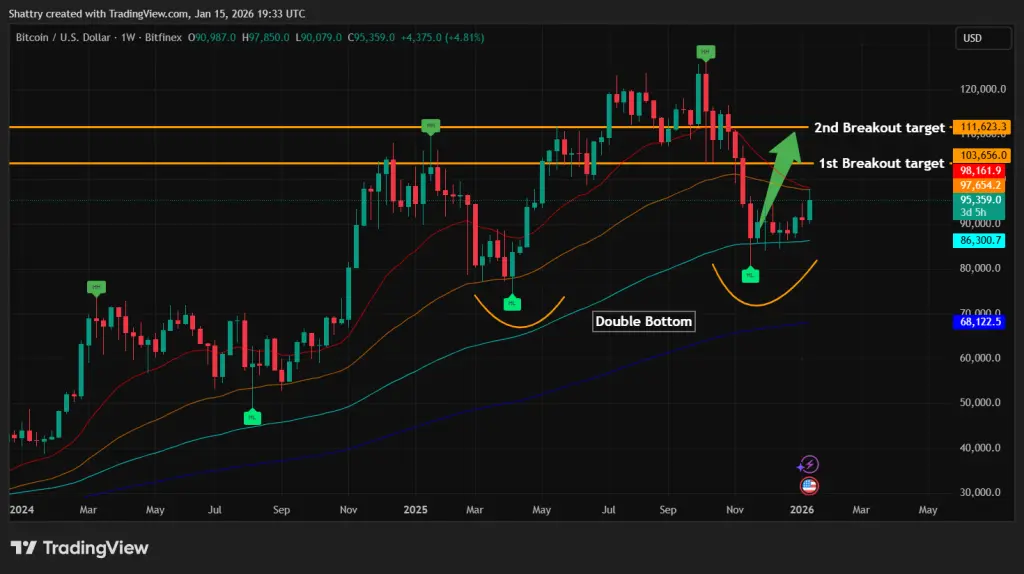
Bitcoin price around $95,000 has rebounded from the $86,300 zone, very close to the 100-week moving average, marking a key higher low. The clear double bottom pattern around this zone indicates strong demand absorption and supports the view that long-term buyers are re-entering rather than capitulating.
From a trend perspective, Bitcoin remains above the 200-week moving average (around $68,000), maintaining a macro bull structure. However, current prices are below the 20-week and 50-week moving averages, which cluster around $97,600 to $98,200. This zone currently acts as direct dynamic resistance. A decisive weekly close above this area would preliminarily confirm bullish momentum returning.
Key technical levels for Bitcoin
(Source: TradingView)
Support at $86,300: key low of double bottom, near 100-week MA, breaking below would undermine bull structure
Short-term resistance $97,600-$98,200: zone where 20-week and 50-week MAs converge, breaking confirms momentum
Medium-term target $103,650: previous sell-off and rebound zone, breaking opens upside channel
Long-term target $111,600: potential acceleration target, only 12% below all-time high, key resistance
Levels at $103,650 and $111,600 represent the most critical upside targets. These zones previously served as major sell and bounce areas; if momentum accelerates, they will become reasonable breakout targets. Breaking above $98,000 could shift market sentiment to bullish, opening the path toward $103,000, and with increased volume and momentum, even reaching $111,000.
Institutional accumulation and long-term TradFi rescue logic
Despite clear short-term catalysts (employment data + Trump softening), medium-term view shows institutional accumulation quietly underway. Retail disinterest does not mean Bitcoin market is ending, as the spot ETF industry alone exceeds $120 billion in assets. Companies continue to follow MicroStrategy’s example, holding over $105 billion in Bitcoin.
This “retail exit, institutional entry” shift may be an inevitable stage of market maturation. Retail-driven markets are prone to speculation and emotional swings, while institutional-led markets tend to be more rational and stable. Although short-term institutional buying cannot fully offset retail withdrawal, long-term institutional demand will provide a solid foundation. Demand from institutions is expected to grow until 2025 and may ultimately be the key factor driving Bitcoin toward $100,000.
Bitcoin has yet to prove itself as a reliable hedge during economic turmoil; thus, even as stocks and gold rise, retail traders worry that cryptocurrencies could suffer the biggest losses during a recession. This skepticism about Bitcoin’s hedging role has been amplified after the 2022 bear market and recent geopolitical risk easing. Investors are beginning to see Bitcoin more as a high-beta tech stock rather than a true safe haven.


