As demand for AI training and inference accelerates, traditional cloud computing faces mounting challenges: concentrated compute power, high costs, and inefficient resource utilization. In response, Aethir leverages a decentralized network to connect idle GPUs worldwide, enabling global support for AI workloads and real-time rendering.
This topic typically covers compute network architecture, node roles, tokenomics, resource scheduling, application scenarios, and differentiation from other DePIN projects. Together, these components define Aethir’s operational logic.
What Is Aethir
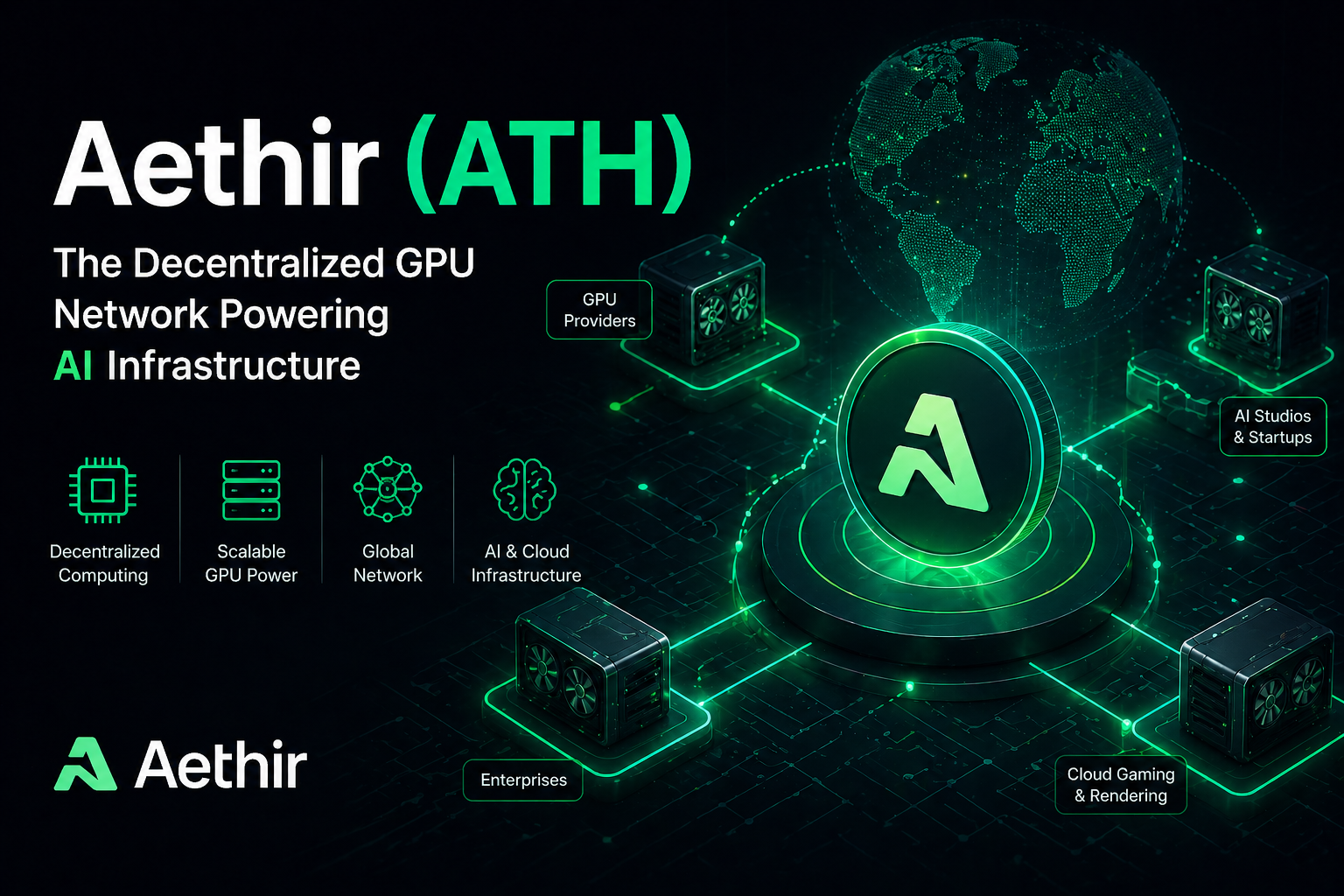
Aethir is a decentralized compute network designed for AI and cloud computing, with the goal of providing scalable GPU resource services.
Aethir serves as a platform that aggregates distributed GPU compute power into a unified service. Users access on-demand resources, while compute node operators earn rewards. Unlike legacy cloud providers reliant on centralized data centers, Aethir connects multiple compute providers via a distributed network.
Aethir uses blockchain to transparently record resource allocation and task execution. When a user submits a compute request, the system matches it with suitable nodes across the network.
This architecture shifts compute power from centralized infrastructure to a tradable, flexible resource, making AI workloads more adaptable.
Aethir: Technical Architecture & Operations
Aethir’s architecture is built on distributed node collaboration, modularizing compute supply, task scheduling, and result verification.
Compute providers connect GPU resources to the network. End users submit task requests, and the system matches them based on available resources. After assignment, execution nodes process computations, while a verification mechanism ensures result integrity.
Core components include:
| Module |
Function |
Purpose |
| Compute Nodes |
Supply GPU resources |
Power computational tasks |
| Scheduling System |
Match tasks to resources |
Maximize efficiency |
| Verification Mechanism |
Validate computation results |
Ensure reliability |
| Blockchain Layer |
Record transactions and settlements |
Guarantee transparency |
This modular design reduces single-point dependencies and enables dynamic scaling.
Aethir supports high-performance computing requirements while maximizing resource utilization.
ATH Token: Network Roles & Utility
ATH Token is the core economic instrument of Aethir, linking compute supply, demand, and incentives.
ATH serves as payment for compute services, staking, and node rewards. Users pay for GPU resources with ATH, while node operators earn tokens for providing compute power.
ATH plays multiple roles: it enables payments for compute transactions, requires nodes to stake tokens to participate—boosting network security—and incentivizes node participation through rewards.
This structure makes ATH vital to both transaction flow and ecosystem stability.
GPU Compute Scheduling in Aethir
Aethir’s scheduling system dynamically allocates GPU resources, matching supply and demand in real time.
Users submit compute tasks, the system analyzes requirements, and locates suitable nodes. Tasks are assigned, executed, verified, and results returned to users.
The scheduler optimizes performance, latency, and resource availability—essential in a distributed network.
This mechanism allows decentralized GPU resources to function as a unified cloud service, greatly enhancing computing efficiency.
Key Application Scenarios & Usage
Aethir is primarily used in AI computing and real-time rendering.
For AI training, organizations access large-scale GPU resources for model development. For AI inference, the network supports low-latency computations. In cloud gaming and real-time rendering, Aethir delivers high-performance graphics processing.
Users access compute services via API or platform, while developers can integrate Aethir into their applications. Compute usage is transparently settled and recorded on-chain.
This positions Aethir as a vital bridge between AI workloads and blockchain infrastructure.
Aethir vs Render: Decentralized Compute Network Differences
Aethir and Render represent different approaches: Aethir focuses on general GPU compute; Render specializes in GPU-powered rendering.
Aethir’s core is AI compute and cloud infrastructure, offering schedulable GPU resources. Render targets 3D rendering for digital content production and visual computing.
Structurally, Aethir uses compute scheduling to match resources with workloads, reflecting a cloud computing paradigm. Render distributes rendering tasks by segmenting jobs across nodes.
| Comparison |
Aethir |
Render |
| Resource Type |
General GPU compute |
Rendering GPU compute |
| Core Use |
AI, cloud services |
3D rendering |
| Architecture |
Compute scheduling |
Task distribution |
| Application |
AI infrastructure |
Content creation |
Aethir is closer to compute infrastructure, while Render serves as a content production tool. This distinction shapes their ecosystem focus and user base.
Ecosystem Participants & Value Flow
Aethir’s ecosystem comprises compute providers, demand-side users, and the network system.
Providers connect GPU resources and earn rewards. Users pay tokens for compute services. The network orchestrates scheduling and settlement. Tokens circulate, fueling the economic cycle.
Value flow is driven by supply-demand dynamics: higher demand increases resource utilization and node rewards.
This structure enables market-based resource allocation.
Advantages & Potential Limitations
Aethir’s strengths lie in efficient resource utilization and cost structure.
By aggregating distributed GPUs, Aethir lowers barriers to compute access and improves utilization. Its decentralized design reduces reliance on single service providers.
Limitations include dependence on node quality and scheduling efficiency for network performance. Distributed environments may also introduce latency and stability concerns.
These factors collectively impact Aethir’s real-world effectiveness.
Summary
Aethir integrates distributed GPU compute resources into a flexible, schedulable infrastructure. Its core architecture includes compute supply, task scheduling, tokenomics, and application scenarios, with value flow among participants forming an ecosystem loop. This design gives Aethir a unique position in AI computing and cloud rendering.
FAQ
What Is Aethir
Aethir is a decentralized GPU compute network for AI and cloud rendering services.
What Is The ATH Token Used For
ATH is used to pay for compute resources, participate in staking, and incentivize network nodes.
How Does Aethir Provide Compute Power
It connects distributed GPU nodes, schedules resources, and executes compute tasks.
How Does Aethir Differ From Other DePIN Projects
Aethir focuses on GPU compute, while other DePIN projects may prioritize storage or bandwidth.
What Are Aethir’s Key Use Cases
Primarily AI training, inference, cloud gaming, and real-time rendering.







