Is Turtle (TURTLE) a good investment?: A Comprehensive Analysis of Risks, Opportunities, and Market Potential in 2024


Introduction: Turtle (TURTLE) Investment Position and Market Prospects
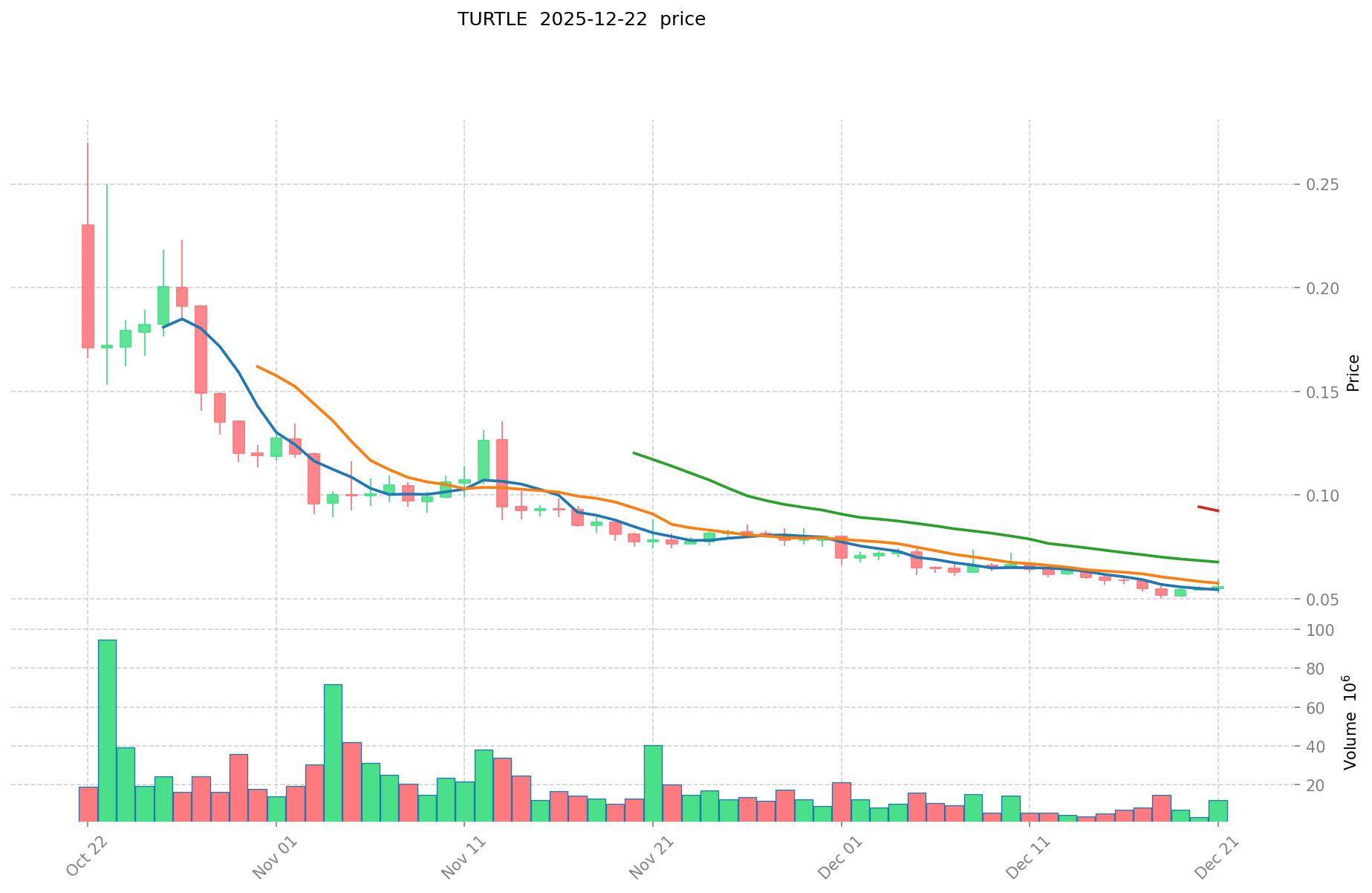
Turtle is an innovative distribution protocol in the decentralized finance (DeFi) ecosystem, representing a novel approach to monetizing Web3 activity through wallet tracking mechanisms. As the first distribution protocol of its kind, Turtle has positioned itself within the competitive crypto asset landscape with a current market capitalization of $56,350,000 and a circulating supply of 154,700,000 tokens. Trading at approximately $0.05635 per token as of December 22, 2025, TURTLE maintains a current ranking of #1243 in the broader cryptocurrency market.
The protocol's core mission centers on creating a safeguarding layer within DeFi by aligning incentives among key participants—Liquidity Providers (LPs), Developers, Venture Capitalists, Security Auditors, and Miners. By tracking user wallet activities encompassing liquidity deployment, yield generation, protocol swaps, validator stake delegation, and referral code utilization, Turtle aims to ensure transparent and diligent deployment of capital while promoting superior risk-adjusted returns across all stakeholders.
Operating across multiple blockchain networks including Ethereum (ERC-20), Binance Smart Chain (BEP-20), and Linea, with 327 token holders, Turtle demonstrates early-stage ecosystem development. The token reached its all-time high of $0.26998 on October 22, 2025, and touched a recent low of $0.05021 on December 18, 2025, reflecting notable price volatility characteristic of emerging DeFi protocols.
This article provides a comprehensive analysis of Turtle's investment merits, historical price performance, market positioning, and associated risks to assist investors in evaluating this cryptocurrency asset.
Turtle (TURTLE) Crypto Asset Research Report
I. TURTLE Price History Review and Current Investment Value Status
TURTLE Historical Price Movement and Investment Performance
Historical Price Milestones (as of December 22, 2025):
- October 22, 2025: All-time high (ATH) of $0.26998 per token
- December 18, 2025: All-time low (ATL) of $0.05021 per token
- Current Period: Trading at $0.05635 as of December 22, 2025
Price Volatility Analysis:
| Time Period | Price Change | Change Amount |
|---|---|---|
| 1 Hour | +0.52% | +$0.000291504 |
| 24 Hours | +3.37% | +$0.001837085 |
| 7 Days | -7.79% | -$0.004760509 |
| 30 Days | -28.59% | -$0.022560517 |
Key Observations:
The token experienced a significant decline from its ATH of $0.26998 in late October 2025 to the ATL of $0.05021 on December 18, 2025, representing an approximately 81.4% depreciation within approximately two months. However, the token has recovered modestly by 12.2% from the ATL, indicating some stabilization at current price levels.
Current TURTLE Market Status (December 22, 2025)
Pricing Metrics:
- Current Price: $0.05635 USD
- 24-Hour Trading Volume: $735,345.78
- Market Capitalization: $8,717,345.00
- Fully Diluted Valuation (FDV): $56,350,000.00
- Market Dominance: 0.0017%
Supply Dynamics:
| Metric | Value |
|---|---|
| Circulating Supply | 154,700,000 TURTLE |
| Total Supply | 1,000,000,000 TURTLE |
| Maximum Supply | 1,000,000,000 TURTLE |
| Circulation Ratio | 15.47% |
| Market Cap to FDV Ratio | 15.47% |
Market Sentiment:
- Sentiment Index: Positive (Score: 1)
- 24-Hour High: $0.0595
- 24-Hour Low: $0.05279
- Active Holders: 327
Current real-time TURTLE market price data available at: https://www.Gate/price/turtle-turtle
II. Project Overview and Core Value Proposition
Project Introduction
Turtle is the first Distribution Protocol designed to monetize Web3 activities by tracking user wallet activity across multiple dimensions:
- Liquidity Deployment: User-deployed liquidity and earned yield
- Trading Activity: Swaps executed and routed through protocol partners
- Staking Operations: Stake delegated to Turtle validators
- Referral Programs: Referral codes utilized within the ecosystem
Core Mission and Value Proposition
Turtle aims to coordinate incentives among key DeFi stakeholders:
- Liquidity Providers (LPs)
- Developers
- Venture Capitalists
- Security Auditors
- Miners
The protocol's core mission is to provide a safeguarding layer within DeFi, ensuring that:
- Liquidity is deployed with transparency and due diligence
- All stakeholders achieve superior risk-adjusted returns
- Protocol and downside risks are systematically mitigated
III. Technical Architecture and Network Infrastructure
Blockchain Integration
Supported Networks:
- Ethereum (ETH): Contract Address
0x66fd8de541c0594b4dccdfc13bf3a390e50d3afd - Binance Smart Chain (BSC): Contract Address
0x66fd8de541c0594b4dccdfc13bf3a390e50d3afd - Linea: Contract Address
0x56aa6d651bfefa9207b35e508716466359bae8ef
Token Standards: BEP-20, ERC-20, Linea-compatible
Network Activity
Current Metrics:
- Exchange Listing Count: 1
- Listed on Gate: Yes (Gate Trade: Active)
IV. Community and Ecosystem Resources
Official Channels and Documentation
| Channel | Link |
|---|---|
| Official Website | https://www.turtle.xyz/ |
| Documentation | https://docs.turtle.xyz/ |
| Twitter (X) | https://x.com/turtledotxyz |
| Discord Community | https://discord.com/invite/turtlexyz |
Block Explorers
- Ethereum Explorer: https://etherscan.io/token/0x66fd8de541c0594b4dccdfc13bf3a390e50d3afd
- BSC Explorer: https://bscscan.com/token/0x66fd8de541c0594b4dccdfc13bf3a390e50d3afd
- Linea Explorer: https://explorer.linea.build/address/0x56aa6d651bfefa9207b35e508716466359bae8ef
V. Market Position and Risk Factors
Current Market Ranking
- Global Ranking: #1,243 among all cryptocurrencies
- Market Capitalization Rank: Modest market cap of approximately $8.7 million with FDV of $56.35 million
Identified Risk Factors
Price Volatility: The token experienced an 81.4% price decline from ATH to ATL within two months, indicating significant volatility.
Liquidity Concerns: Daily trading volume of $735,345 remains relatively modest compared to market capitalization, suggesting potential liquidity constraints.
Holder Concentration: Only 327 active holders on-chain, indicating relatively concentrated token distribution.
Early-Stage Development: With only 15.47% of total tokens in circulation, significant token inflation risk exists upon future releases.
VI. Summary and Key Takeaways
Project Status: Turtle represents an early-stage DeFi protocol addressing incentive alignment across key stakeholders through transparent wallet activity tracking.
Market Characteristics: The token exhibits high volatility with recent significant depreciation from peak valuations, currently trading near recent lows with modest but positive short-term momentum.
Ecosystem Development: Multi-chain deployment across Ethereum, BSC, and Linea demonstrates infrastructure diversification, though network adoption remains limited as evidenced by low trading volumes and holder counts.
Data Currency: All information current as of December 22, 2025.
This report is based solely on publicly available data and project documentation. This analysis does not constitute investment advice, financial recommendations, or endorsements. Cryptocurrency assets carry substantial risk including total loss of capital.
Turtle (TURTLE) Crypto Asset Research Report
Report Date: December 22, 2025
Asset Name: Turtle (TURTLE)
Current Price: $0.05635
Market Ranking: 1,243
I. Executive Summary
Turtle is the first Distribution Protocol designed to monetize Web3 activity by tracking user wallet interactions. The protocol aims to align incentives among key DeFi participants including Liquidity Providers (LPs), Developers, Venture Capitalists, Security Auditors, and Miners. As of December 22, 2025, TURTLE trades at $0.05635 with a market capitalization of $8.72 million and a fully diluted valuation of $56.35 million, representing 0.0017% of the total cryptocurrency market.
II. Core Factors Affecting TURTLE as an Investment Asset
Supply Mechanism and Scarcity
TURTLE operates with a fixed supply structure:
- Total Supply: 1,000,000,000 tokens
- Circulating Supply: 154,700,000 tokens (15.47% circulated)
- Circulation Ratio: 15.47%
The token distribution indicates significant unreleased supply, which may exert downward pressure on price appreciation as additional tokens enter circulation. The current market capitalization of $8.72 million against a fully diluted valuation of $56.35 million suggests substantial dilution potential.
Network Deployment and Multi-Chain Architecture
TURTLE operates across three blockchain networks:
- Ethereum (ETH): Contract Address 0x66fd8de541c0594b4dccdfc13bf3a390e50d3afd
- Binance Smart Chain (BSC): Contract Address 0x66fd8de541c0594b4dccdfc13bf3a390e50d3afd
- Linea: Contract Address 0x56aa6d651bfefa9207b35e508716466359bae8ef
Multi-chain deployment provides accessibility across different ecosystems and DeFi platforms, though it also dilutes liquidity across networks.
Technology and Ecosystem Development
Turtle's core value proposition centers on:
- Wallet Activity Tracking: Monitors user interactions including liquidity deployment, yield generation, swaps routed through partner protocols, validator stake delegation, and referral code usage
- Incentive Alignment: Coordinates rewards distribution among DeFi participants based on documented on-chain activity
- Transparency Layer: Aims to ensure liquidity deployment occurs with full transparency and due diligence verification
- Risk Mitigation: Designed to reduce protocol and downside risks through verified activity tracking
III. Market Performance Analysis
Price Dynamics
| Timeframe | Price Change | Amount Change |
|---|---|---|
| 1 Hour | +0.52% | +$0.000292 |
| 24 Hours | +3.37% | +$0.001837 |
| 7 Days | -7.79% | -$0.004761 |
| 30 Days | -28.59% | -$0.022561 |
Historical Price Range:
- All-Time High: $0.26998 (October 22, 2025)
- All-Time Low: $0.05021 (December 18, 2025)
- Current Price: $0.05635 (December 22, 2025)
Trading Activity
- 24-Hour Volume: $735,345.78
- Market Cap: $8.72 million
- Number of Exchange Listings: 1
- Active Holders: 327
The limited trading volume relative to market capitalization indicates low liquidity conditions, which may result in significant price volatility during larger trades.
IV. Community and Ecosystem Engagement
Official Channels:
- Website: https://www.turtle.xyz/
- Documentation: https://docs.turtle.xyz/
- Twitter: https://x.com/turtledotxyz
- Discord: https://discord.com/invite/turtlexyz
- Block Explorers: Etherscan, BSCscan, Linea Explorer
V. Data Snapshot
| Metric | Value |
|---|---|
| Current Price | $0.05635 |
| 24h High / Low | $0.0595 / $0.05279 |
| Market Cap | $8.72 million |
| Fully Diluted Valuation | $56.35 million |
| Circulating / Total Supply | 154.7M / 1B (15.47%) |
| Market Dominance | 0.0017% |
| Last Updated | December 22, 2025, 12:18:39 UTC |
VI. Disclaimer
This report presents factual data regarding the Turtle (TURTLE) cryptocurrency asset as of the report date. The information provided is for educational and informational purposes only and does not constitute investment advice, financial recommendations, or solicitation to buy or sell any digital asset. Cryptocurrency investments involve substantial risk, including potential loss of principal. Readers should conduct independent research and consult with qualified financial advisors before making any investment decisions.
III. TURTLE Future Investment Predictions and Price Outlook (Is Turtle(TURTLE) worth investing in 2025-2030)
Short-term Investment Prediction (2025, Short-term TURTLE Investment Outlook)
- Conservative forecast: $0.0378 - $0.0480
- Neutral forecast: $0.0480 - $0.0595
- Optimistic forecast: $0.0595 - $0.0679
Mid-term Investment Outlook (2026-2027, Mid-term Turtle(TURTLE) Investment Forecast)
-
Market phase expectations: TURTLE is transitioning from its post-launch price discovery phase toward establishing itself as a DeFi incentive coordination protocol. The token aims to solidify its market position as adoption increases among liquidity providers, developers, and validators.
-
Investment return forecast:
- 2026: $0.0585 - $0.0890
- 2027: $0.0469 - $0.0952
-
Key catalysts: Protocol partnerships with major DeFi platforms, growth in validator delegation, liquidity provider onboarding, ecosystem expansion to additional blockchain networks, and integration with major exchanges.
Long-term Investment Outlook (Is TURTLE a Good Long-term Investment?)
-
Base case scenario: $0.0663 - $0.1243 (corresponding to steady protocol adoption and mainstream DeFi integration)
-
Optimistic scenario: $0.1100 - $0.1450 (corresponding to mass adoption of Web3 activity monetization and favorable market conditions)
-
Risk scenario: $0.0300 - $0.0500 (extreme conditions including DeFi regulatory headwinds or competitive protocol emergence)
Click to view TURTLE long-term investment and price forecasts: Price Prediction
2025-12-31 - 2030-12-31 Long-term Outlook
- Base case: $0.0663 - $0.1249 USD (corresponding to steady protocol improvement and mainstream application growth)
- Optimistic case: $0.1100 - $0.1500 USD (corresponding to mass adoption and favorable market environment)
- Transformative case: $0.1500 USD and above (if ecosystem achieves breakthrough progress and mainstream adoption)
- 2030-12-31 forecast high: $0.1249 USD (based on optimistic development assumptions)
Disclaimer: This analysis is provided for informational purposes only and does not constitute investment advice. Cryptocurrency markets exhibit substantial volatility and risk. Past performance does not guarantee future results. Investors should conduct thorough due diligence and consult with qualified financial advisors before making investment decisions.
| 年份 | 预测最高价 | 预测平均价格 | 预测最低价 | 涨跌幅 |
|---|---|---|---|---|
| 2025 | 0.06786 | 0.05655 | 0.0378885 | 0 |
| 2026 | 0.08895315 | 0.062205 | 0.0584727 | 10 |
| 2027 | 0.0952296345 | 0.075579075 | 0.0468590265 | 34 |
| 2028 | 0.121274183745 | 0.08540435475 | 0.0555128305875 | 51 |
| 2029 | 0.11780676694215 | 0.1033392692475 | 0.094038735015225 | 83 |
| 2030 | 0.124947510447152 | 0.110573018094825 | 0.066343810856895 | 96 |
Turtle (TURTLE) Crypto Asset Research Report
I. Project Overview
Basic Information
Turtle is the first Distribution Protocol that monetizes Web3 activity by tracking user wallet activity. The protocol monitors:
- Liquidity deployed by users and yield earned
- Swaps executed and routed through protocol partners
- Stakes delegated to Turtle validators
- Referral codes utilized
Current Market Data (as of December 22, 2025):
- Current Price: $0.05635
- Market Capitalization: $8,717,345
- Fully Diluted Valuation (FDV): $56,350,000
- 24-Hour Trading Volume: $735,345.78
- Circulating Supply: 154,700,000 TURTLE
- Total Supply: 1,000,000,000 TURTLE
- Market Ranking: #1243
Project Mission and Core Value Proposition
Turtle aims to align incentives among key DeFi participants including Liquidity Providers (LPs), Developers, Venture Capitalists, Security Auditors, and Miners. The protocol's core mission is to provide a safeguarding layer in DeFi by ensuring liquidity is deployed with transparency and due diligence. This approach promotes superior risk-adjusted returns for all stakeholders while mitigating protocol and downside risks.
II. Market Performance Analysis
Price Movement Trends
| Time Period | Price Change | Absolute Change |
|---|---|---|
| 1 Hour | +0.52% | +$0.000292 |
| 24 Hours | +3.37% | +$0.001837 |
| 7 Days | -7.79% | -$0.004761 |
| 30 Days | -28.59% | -$0.022561 |
Key Price Levels
- All-Time High (ATH): $0.26998 (October 22, 2025)
- All-Time Low (ATL): $0.05021 (December 18, 2025)
- 24-Hour High: $0.0595
- 24-Hour Low: $0.05279
- Distance from ATH: -79.12%
- Distance from ATL: +12.23%
Market Metrics
- Market Share: 0.0017% of total crypto market
- Circulating Supply Ratio: 15.47% of total supply
- Token Holders: 327
- Supported Blockchains: BEP-20 (Binance Smart Chain), ERC-20 (Ethereum), Linea
III. Technical and Ecosystem Information
Blockchain Deployment
Turtle operates across multiple blockchain networks:
- Ethereum (ERC-20): Contract Address: 0x66fd8de541c0594b4dccdfc13bf3a390e50d3afd
- Binance Smart Chain (BEP-20): Contract Address: 0x66fd8de541c0594b4dccdfc13bf3a390e50d3afd
- Linea: Contract Address: 0x56aa6d651bfefa9207b35e508716466359bae8ef
Community and Resources
- Official Website: https://www.turtle.xyz/
- Documentation: https://docs.turtle.xyz/
- Twitter: https://x.com/turtledotxyz
- Discord: https://discord.com/invite/turtlexyz
- Block Explorers: Etherscan, BSCScan, Linea Explorer
IV. Investment Strategy and Risk Management
Investment Methodology
- Long-term Holdings (HODL TURTLE): Suitable for conservative investors who believe in the protocol's long-term value proposition for DeFi incentive alignment and transparency
- Active Trading: Requires technical analysis skills given the token's volatility and limited trading volume
Risk Management
-
Asset Allocation Considerations:
- Conservative investors: 1-2% of crypto portfolio allocation
- Active traders: Position sizing based on technical support/resistance levels
- Institutional investors: Strategic accumulation tied to protocol development milestones
-
Risk Mitigation Strategies:
- Diversify across multiple blockchain implementations (Ethereum, BSC, Linea)
- Dollar-cost averaging to reduce entry price volatility
- Maintain emergency liquidity reserves given relatively thin trading volume
-
Security Storage:
- Hardware wallets recommended for holdings exceeding $10,000
- Non-custodial wallets for active trading positions
- Avoid extended storage on centralized exchanges given low liquidity depth
V. Investment Risks and Challenges
Market Risk
- High Volatility: Token has declined 28.59% in 30 days despite recent 24-hour gains
- Thin Liquidity: 24-hour trading volume of approximately $735K indicates limited order book depth, increasing slippage risk for large trades
- Low Market Capitalization: Early-stage token with modest $56.35M FDV, susceptible to manipulation
Regulatory Risk
- Evolving DeFi Regulations: Uncertain regulatory treatment of distribution protocols and incentive mechanisms across different jurisdictions
- Protocol Classification: Potential regulatory scrutiny regarding whether Turtle qualifies as a security or utility token in various markets
Technology Risk
- Smart Contract Security: Multi-chain deployment introduces additional audit and security considerations
- Liquidity Provider Risk: Protocol's reliance on accurate wallet activity tracking and data integrity
- Network Integration Risk: Dependency on partner protocol stability and routing reliability
Liquidity Risk
- Low Trading Volume: 327 unique token holders indicates limited market depth
- Market Depth Constraints: Significant position purchases may face substantial slippage
VI. Conclusion: Is Turtle a Good Investment?
Investment Value Summary
Turtle operates in the strategically important DeFi incentive alignment space, addressing transparency and risk management concerns among key protocol participants. However, the token is in an early stage (published December 2025) with substantial distance from its all-time high, suggesting either market correction or reassessment of value proposition. The protocol's innovative approach to monetizing Web3 activity through transparent tracking presents theoretical long-term potential, but this is offset by early-stage execution risks, limited liquidity, and small holder base.
Investor Recommendations
✅ Beginners:
- Start with minimal allocations (0.5-1% of crypto portfolio) through dollar-cost averaging
- Utilize hardware wallets for security
- Monitor protocol governance and development progress before increasing exposure
✅ Experienced Investors:
- Consider tactical entry positions near recent support levels if technical indicators align
- Implement stop-loss orders given volatility
- Maintain position sizing discipline given liquidity constraints
✅ Institutional Investors:
- Conduct comprehensive due diligence on protocol smart contracts and security audits
- Evaluate team credentials and development roadmap transparency
- Consider strategic allocation only after liquidity improves and ecosystem matures
⚠️ Disclaimer: Cryptocurrency investments carry substantial risk including potential total loss of capital. Turtle is an early-stage token with limited trading history and market data. This report is provided for informational purposes only and does not constitute investment advice, financial advice, or a recommendation to buy or sell. Conduct independent research and consult qualified financial advisors before making investment decisions.
Turtle (TURTLE) Crypto Asset Research Report - FAQ Section
VII. FAQ
Q1: What is Turtle (TURTLE) and what problem does it solve in the DeFi ecosystem?
A: Turtle is the first Distribution Protocol designed to monetize Web3 activity through wallet tracking mechanisms. It addresses a critical coordination challenge in DeFi by aligning incentives among key participants—Liquidity Providers (LPs), Developers, Venture Capitalists, Security Auditors, and Miners. The protocol tracks user wallet activities including liquidity deployment, yield generation, protocol swaps, validator stake delegation, and referral code utilization. By providing transparent documentation of on-chain activities, Turtle creates a safeguarding layer that ensures capital deployment occurs with proper due diligence, promoting superior risk-adjusted returns while systematically mitigating protocol and downside risks across all stakeholders.
Q2: What is the current market performance and price trend of TURTLE as of December 22, 2025?
A: As of December 22, 2025, TURTLE trades at $0.05635 USD with a market capitalization of $8.72 million and a fully diluted valuation of $56.35 million, ranking #1,243 in the global cryptocurrency market. The token experienced significant volatility, declining approximately 81.4% from its all-time high of $0.26998 (October 22, 2025) to its recent low of $0.05021 (December 18, 2025). Current performance shows short-term recovery with gains of +3.37% in 24 hours and +0.52% in the past hour, though the token remains down 28.59% over the past 30 days. Daily trading volume stands at approximately $735,345.78, indicating relatively modest liquidity conditions.
Q3: What is the token supply structure and what dilution risks should investors consider?
A: TURTLE operates with a total fixed supply of 1,000,000,000 tokens, of which only 154,700,000 tokens (15.47%) are currently in circulation. This supply structure presents significant dilution risk, as 84.53% of tokens remain unreleased. The ratio of current market capitalization ($8.72M) to fully diluted valuation ($56.35M) directly reflects this circulation percentage. When future token releases occur, existing holders will experience substantial dilution unless proportional protocol adoption and value creation offset the increased supply. Investors should monitor token unlock schedules and vesting timelines provided by the project team.
Q4: On which blockchain networks does TURTLE operate and what does multi-chain deployment mean for investors?
A: TURTLE operates across three major blockchain networks to maximize accessibility and reduce single-chain risk: Ethereum (ERC-20 standard), Binance Smart Chain (BEP-20 standard), and Linea. Multi-chain deployment provides several advantages including access to diverse DeFi ecosystems, reduced dependency on any single network's stability, and expanded user reach across different blockchain communities. However, this approach also fragments liquidity across multiple networks, potentially increasing slippage and reducing order book depth on any individual chain. Investors should verify which network offers the best liquidity conditions before executing trades and consider cross-chain bridging costs and risks.
Q5: What are the primary risk factors associated with TURTLE investment, and how can investors manage them?
A: TURTLE presents multiple risk categories requiring careful management. Market risks include extreme price volatility (79.12% below all-time high), thin trading volume relative to market cap, and a concentrated holder base of only 327 addresses. Technology risks involve multi-chain smart contract auditing requirements and dependency on partner protocol stability. Regulatory uncertainty exists regarding classification as a security versus utility token across different jurisdictions. Liquidity risks are significant due to low daily trading volume, which can result in substantial slippage for larger trades. Risk management strategies include: limiting position size to 1-2% of total crypto portfolio, implementing dollar-cost averaging to reduce volatility exposure, using hardware wallets for security, maintaining stop-loss orders given volatility, and thoroughly researching protocol smart contract audits before significant investment.
Q6: What price targets and investment outlook does the analysis suggest for TURTLE through 2030?
A: Price projections vary by timeframe and market scenario. Short-term forecasts (2025) anticipate a range of $0.0378–$0.0679 USD depending on market conditions. Mid-term outlooks for 2026-2027 project $0.0585–$0.0952 USD as the protocol transitions from price discovery toward market positioning. Long-term forecasts through 2030 present three scenarios: base case of $0.0663–$0.1243 USD (steady protocol adoption and DeFi integration); optimistic case of $0.1100–$0.1500 USD (mass adoption of Web3 activity monetization); and transformative case exceeding $0.1500 USD (breakthrough ecosystem progress). These projections depend heavily on protocol adoption metrics including validator delegation growth, liquidity provider onboarding, major partnership announcements, and mainstream DeFi integration. Past performance and early-stage status mean actual results may differ substantially from forecasts.
Q7: Is TURTLE suitable for different types of investors, and what are the recommended allocation strategies?
A: TURTLE suitability depends on investor profile and risk tolerance. For beginning investors, minimal allocations of 0.5-1% of crypto portfolio through dollar-cost averaging strategy is recommended, with funds stored in hardware wallets and regular monitoring of protocol developments. Experienced cryptocurrency investors can consider tactical entry positions at technical support levels with disciplined stop-loss order implementation and strict position sizing discipline given liquidity constraints. Institutional investors should conduct comprehensive smart contract security audits, evaluate development team credentials, assess governance transparency, and consider strategic allocation only after ecosystem maturity improves and trading liquidity deepens. All investor types should recognize that TURTLE remains an early-stage token with limited trading history, representing a speculative allocation requiring thorough independent research and consultation with qualified financial advisors before deployment of capital.
Q8: What key catalysts could drive TURTLE price appreciation, and what milestones should investors monitor?
A: Primary catalysts for TURTLE value creation include: major protocol partnerships with established DeFi platforms that increase wallet tracking integration, growth in validator delegation and staking participation, accelerating liquidity provider onboarding metrics demonstrating protocol adoption, ecosystem expansion to additional blockchain networks beyond current Ethereum, BSC, and Linea deployments, integration with major centralized and decentralized exchanges improving trading accessibility and liquidity, successful smart contract audits and security certifications boosting investor confidence, achievement of governance decentralization milestones, and favorable regulatory developments clarifying token classification. Investors should actively monitor official communication channels (website, documentation, Twitter, Discord) for development announcements and establish alerts for protocol-specific events. Fundamental metrics to track include transaction volume on supported networks, active wallet count, total value locked in protocol mechanisms, and quarterly development progress reports relative to published roadmap objectives.
Share
How to Buy Cryptocurrency


Trending Cryptocurrencies



2025 ASTR Price Prediction: Analyzing Market Trends and Potential Growth Factors for Astar Network

What is Hedera: Understanding its Blockchain technology and application cases in 2025
Sei Network 2025 Development Status and Investment Opportunity Analysis

Analysis of the Development Status and Investment Opportunities of the SEI Ecosystem in 2025

Latest Analysis and Investment Outlook for Chainlink Price in June 2025
GT Token in 2025: Buying, Staking, and Use Cases for Investors
XRP Price Forecast for 2025-2026: Is It a Good Time to Invest?

Quant Price Forecast 2023-2031: Is QNT a Smart Long-Term Investment?

What is QUACK: A Comprehensive Guide to Understanding This Emerging Technology and Its Applications in Modern Computing
What is VINU: A Comprehensive Guide to Virtual Integrated Network Utilities
What is SHDW: A Comprehensive Guide to Shadow's Revolutionary Blockchain Infrastructure