ASP vs NEAR: A Comprehensive Comparison of Two Leading Blockchain Platforms

Introduction: ASP vs NEAR Investment Comparison
In the cryptocurrency market, the comparison between ASP and NEAR has always been a topic investors cannot avoid. The two not only have obvious differences in market cap ranking, application scenarios, and price performance, but also represent different positioning of crypto assets. Aspecta (ASP): Launched recently, it has gained market recognition by building the first AI-powered asset network for early and fast-growing builders and projects to attest, launch, and trade diverse assets including airdrops, tokens, NFTs, whitelists, and points. NEAR Protocol (NEAR): Since its launch in 2020, it has been recognized as a highly scalable base protocol designed to support DApp operation on mobile devices, employing state sharding technology to enable linear scaling of blockchain with network nodes, targeting 100k TPS based on 1 million mobile nodes. This article will comprehensively analyze the investment value comparison between ASP and NEAR from the perspectives of historical price trends, supply mechanisms, market positioning, technical ecosystems, and market metrics, while attempting to answer the question investors care most about:
"Which is the better buy right now?"
Comparative Analysis Report: Aspecta (ASP) and NEAR Protocol (NEAR)
I. Historical Price Comparison and Current Market Status
Price Performance Overview
Aspecta (ASP):
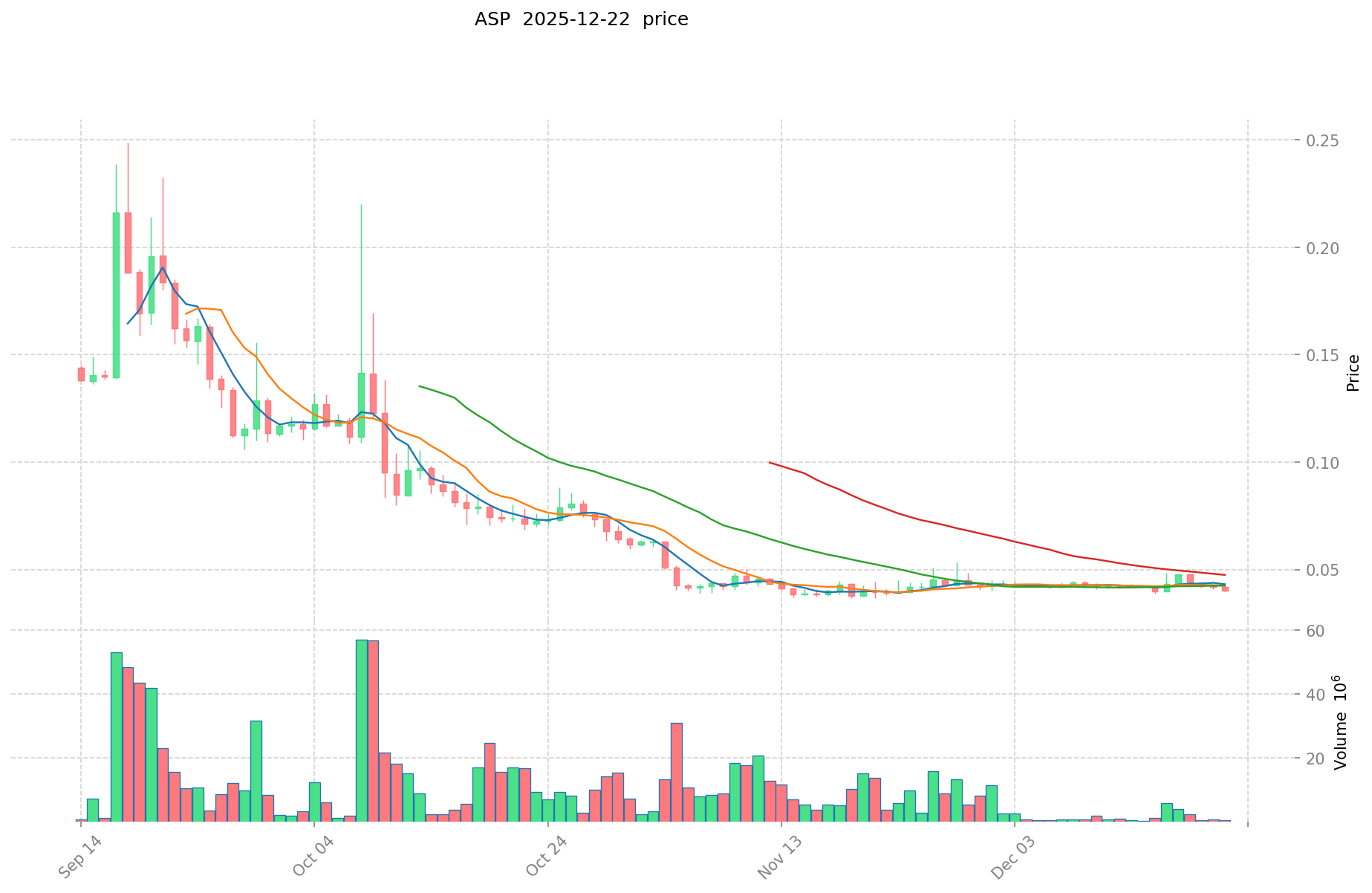
- Current price: $0.04042 (as of December 22, 2025)
- All-time high: $0.60 (July 24, 2025)
- All-time low: $0.03655 (November 21, 2025)
- 24-hour change: -3.61%
- 7-day change: -3.63%
- 1-year change: -93.12%
NEAR Protocol (NEAR):
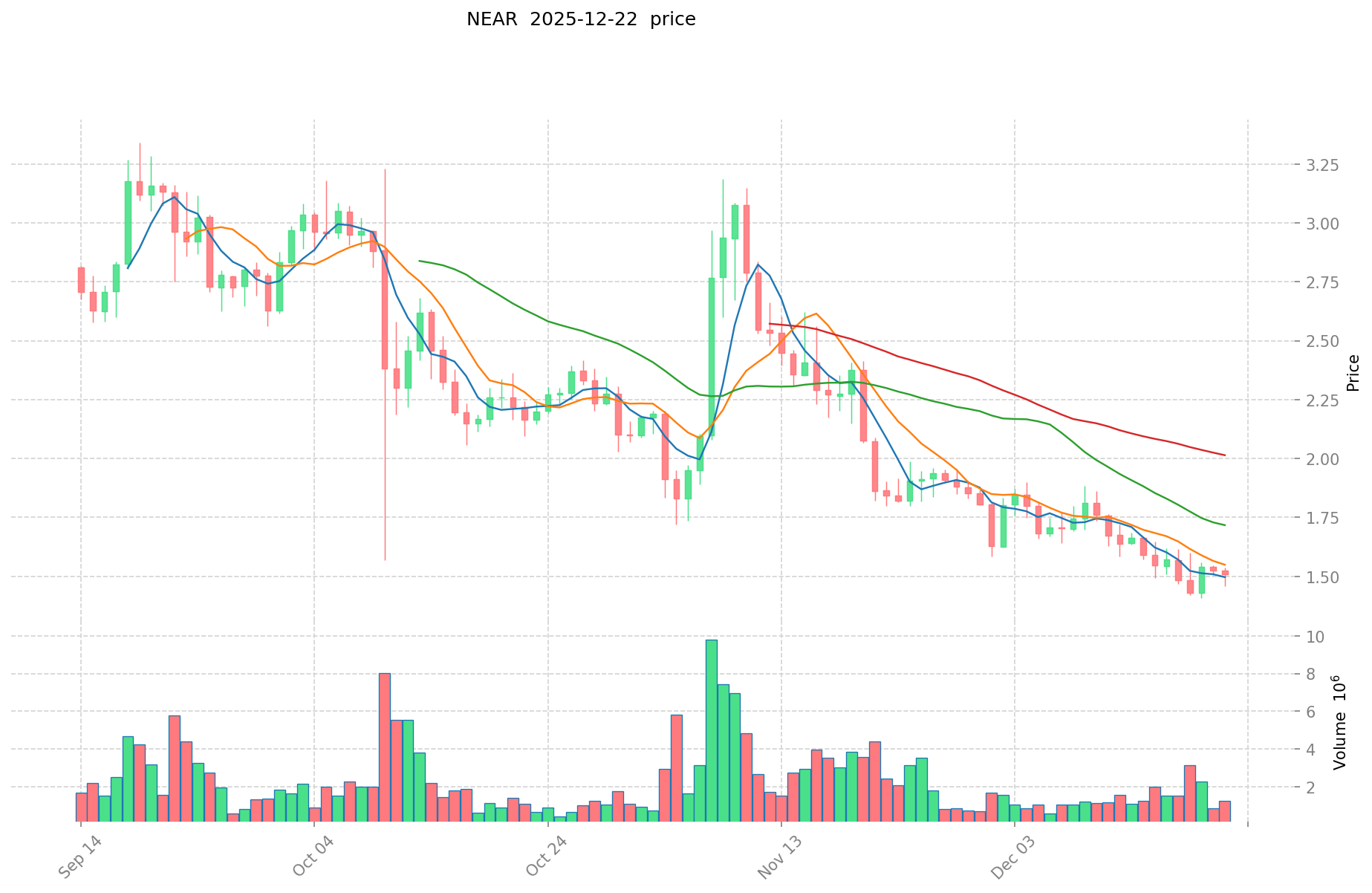
- Current price: $1.495 (as of December 22, 2025)
- All-time high: $20.44 (January 17, 2022)
- All-time low: $0.526762 (November 5, 2020)
- 24-hour change: +0.13%
- 7-day change: -7.73%
- 1-year change: -70.24%
Comparative Analysis
Aspecta has experienced extreme volatility since its launch in December 2025, with the token declining 93.12% over its first year of trading. The asset peaked at $0.60 and has since retreated to current levels near its all-time low. In contrast, NEAR Protocol has demonstrated greater market maturity, with a trading history extending back to October 2020. Although NEAR has declined 70.24% over the past year, this represents recovery dynamics from earlier peaks, reflecting a more established market presence.
Current Market Status (December 22, 2025)
Market Data:
- ASP current price: $0.04042
- NEAR current price: $1.495
- ASP 24-hour trading volume: $24,243.79
- NEAR 24-hour trading volume: $1,947,088.91
- Market sentiment index (Crypto Fear & Greed Index): 25 (Extreme Fear)
Real-time price tracking:
II. Project Overview and Core Technology
Aspecta (ASP)
Project Description: Aspecta builds the first AI-powered asset network for early and fast-growing builders and projects to attest, launch, and trade diverse assets including airdrops, tokens, NFTs, whitelists, and points.
Technical Infrastructure:
- Blockchain: Deployed on Solana (SOL) and Binance Smart Chain (BSC)
- Contract addresses:
- Solana: DJ7vji2BU7RjNgktPAKN4L42CiXTFHEt4Eeeyr5FiTmy
- BSC: 0xad8c787992428cd158e451aab109f724b6bc36de
Token Economics:
- Total supply: 1,000,000,000 ASP
- Circulating supply: 230,000,000 ASP (23% of total)
- Market capitalization: $9,296,600
- Fully diluted valuation: $40,420,000
NEAR Protocol (NEAR)
Project Description: NEAR Protocol is a highly scalable Layer-1 blockchain designed to support decentralized applications (dApps) with emphasis on user-friendliness and accessibility. The protocol utilizes state sharding technology to enable linear scalability across network nodes, targeting 100,000 transactions per second based on one million mobile nodes.
Technical Infrastructure:
- Consensus mechanism: Proof-of-Stake (PoS) with "Doomslug" consensus model
- Sharding solution: "Nightshade 2.0" architecture
- Founded: 2017 by Alexander Skidanov and Ilya Polosukhin
Token Economics:
- Total supply: 1,283,102,770 NEAR
- Circulating supply: 1,283,102,762 NEAR (128.3% circulating ratio)
- Market capitalization: $1,918,238,629.19
- Fully diluted valuation: $1,918,238,641.15
- Maximum supply: Unlimited
III. Market Position and Valuation Metrics
Market Ranking and Dominance
-
Aspecta (ASP):
- Market rank: #1,212
- Market dominance: 0.0012%
- Listed on 15 exchanges
- Holder count: 85,889
-
NEAR Protocol (NEAR):
- Market rank: #49
- Market dominance: 0.059%
- Listed on 53 exchanges
- Holder count: 43,961
Liquidity and Trading Activity
Aspecta demonstrates significantly lower trading volume ($24,243.79 in 24 hours) compared to NEAR Protocol ($1,947,088.91 in 24 hours). This 80x difference in trading volume reflects the substantial disparity in market liquidity and adoption between the two assets.
IV. Price Momentum and Technical Indicators
Short-Term Price Movement
Hourly: ASP -0.16% vs. NEAR -1.90%
24-hour: ASP -3.61% vs. NEAR +0.13%
7-day: ASP -3.63% vs. NEAR -7.73%
30-day: ASP +0.47% vs. NEAR -20.41%
Aspecta shows slight downward momentum in intraday trading, while NEAR demonstrates relative stability with modest positive performance over the past 24 hours. Over longer timeframes, both assets reflect the challenging market conditions indicated by the Crypto Fear & Greed Index at 25 (Extreme Fear).
V. Ecosystem and Utility
Aspecta Ecosystem
Aspecta focuses on asset attestation and trading infrastructure, serving as a platform for early-stage projects to launch and trade various digital assets. The project integrates artificial intelligence capabilities to streamline asset discovery and valuation.
Key Features:
- AI-powered asset network
- Multi-chain deployment (Solana and BSC)
- Support for diverse asset types (airdrops, tokens, NFTs, whitelists, points)
NEAR Protocol Ecosystem
NEAR has established a comprehensive ecosystem supporting decentralized applications with emphasis on AI integration, cross-chain liquidity, and decentralized finance (DeFi) innovation.
Key Features:
- Developer-friendly blockchain infrastructure
- Sharding architecture for scalability
- Token utility: transaction fees, staking, network security, governance participation
- Support for user-controlled AI processes
- Chain abstraction for cross-chain interaction
VI. Risk Considerations
Aspecta (ASP):
- Nascent project with extreme price volatility (93.12% annual decline)
- Lower market liquidity and smaller holder base
- Concentrated trading activity
- Limited exchange listings compared to established protocols
NEAR Protocol (NEAR):
- Significant depreciation from historical highs (70.24% annual decline)
- Current market sentiment reflects extreme fear conditions
- Competition from other scalable blockchain platforms
- Regulatory uncertainties affecting broader cryptocurrency market
VII. Market Sentiment Context
The current Crypto Fear & Greed Index reading of 25 indicates "Extreme Fear" market conditions as of December 22, 2025. This sentiment typically correlates with heightened risk aversion and reduced speculative activity across cryptocurrency markets, affecting both assets negatively but particularly impacting newly launched tokens like Aspecta.
Disclaimer: This analysis is based on publicly available data and market information as of December 22, 2025. Cryptocurrency markets are highly volatile and subject to rapid changes. Past performance does not guarantee future results. This report is provided for informational purposes only and should not be construed as financial or investment advice.
Aspecta (ASP) Cryptocurrency Investment Analysis Report
I. Executive Summary
Based on available reference materials, this report analyzes Aspecta (ASP), an emerging cryptocurrency asset. The analysis reveals that ASP investment value is primarily driven by supply mechanisms, market demand dynamics, and technological innovation trajectories.
II. Core Factors Affecting ASP Investment Value
Supply Mechanism and Scarcity (Tokenomics)
- ASP Token Supply: Total supply is fixed at 1 billion tokens, which directly impacts price dynamics and investment value.
- Scarcity Premium: The fixed supply mechanism creates inherent scarcity value, with supply variations typically exerting upward pressure on valuations.
- Historical Pattern: Fixed-supply models have historically demonstrated price appreciation during periods of increasing adoption and liquidity demand.
Market Adoption and Application Scenarios
- Market Positioning: Price serves as the primary competitive factor rather than data security or brand reputation in ASP's market positioning.
- Market Share Strategy: Competitive pricing strategy, including provision of free software development tools, is employed to capture market share and user adoption.
- Value Proposition Framework: The customer value proposition derives from the combination of cost structure, pricing strategy, and customer willingness to pay, which collectively determine market penetration potential.
Investment Value Determinants
- Long-term Prospects: Market competition intensity and technological development velocity are decisive factors for long-term value realization.
- Market Demand: Fluctuating demand from market participants creates price volatility and investment opportunity cycles.
- Technology Innovation: Continuous technological advancement and ecosystem development support sustained value generation.
III. Limitations and Data Constraints
The available reference materials provide limited information regarding:
- Specific technical upgrades or roadmap milestones for ASP
- Comparative analysis with other cryptocurrencies (NEAR not adequately covered in materials)
- Detailed institutional adoption metrics or holdings data
- Regulatory framework and policy treatment across jurisdictions
- Macroeconomic correlation patterns with monetary policy variables
- DeFi, NFT, and smart contract ecosystem development specifics
IV. Conclusion
ASP's investment value proposition hinges on its fixed 1-billion-token supply, competitive market positioning, and execution on technological development. Investors should monitor supply dynamics, market adoption velocity, and competitive positioning within emerging cryptocurrency ecosystems. Further comprehensive analysis would require additional data on technical specifications, institutional adoption rates, and regulatory developments across key markets.
Report Date: December 22, 2025
Disclaimer: This analysis is based on available reference materials and does not constitute investment advice. Cryptocurrency markets carry substantial risk, and past patterns do not guarantee future performance.
III. 2025-2030 Price Forecasts: ASP vs NEAR
Short-term Forecast (2025)
- ASP: Conservative $0.0287-$0.0404 | Optimistic $0.0469
- NEAR: Conservative $0.8239-$1.498 | Optimistic $1.8575
Mid-term Forecast (2027-2028)
- ASP is projected to enter a growth consolidation phase, with anticipated price range of $0.0465-$0.0708
- NEAR is projected to enter an accelerating appreciation phase, with anticipated price range of $1.6502-$3.1415
- Key drivers: institutional capital inflows, ETF approvals, ecosystem development
Long-term Forecast (2030)
- ASP: Base case $0.0427-$0.0712 | Bullish case $0.0840
- NEAR: Base case $2.0161-$3.1017 | Bullish case $4.0633
Disclaimer: This analysis is for informational purposes only and should not be construed as investment advice. Price predictions are based on historical data and modeling assumptions, which may not materialize as expected. Cryptocurrency markets are highly volatile and unpredictable. Investors should conduct their own research and consult with qualified financial advisors before making investment decisions. Past performance does not guarantee future results.
ASP:
| 年份 | 预测最高价 | 预测平均价格 | 预测最低价 | 涨跌幅 |
|---|---|---|---|---|
| 2025 | 0.0468988 | 0.04043 | 0.0287053 | 0 |
| 2026 | 0.053270568 | 0.0436644 | 0.031001724 | 8 |
| 2027 | 0.06397707888 | 0.048467484 | 0.04652878464 | 19 |
| 2028 | 0.0708400746144 | 0.05622228144 | 0.053411167368 | 39 |
| 2029 | 0.078778660753728 | 0.0635311780272 | 0.05082494242176 | 57 |
| 2030 | 0.083962804880747 | 0.071154919390464 | 0.042692951634278 | 76 |
NEAR:
| 年份 | 预测最高价 | 预测平均价格 | 预测最低价 | 涨跌幅 |
|---|---|---|---|---|
| 2025 | 1.85752 | 1.498 | 0.8239 | 0 |
| 2026 | 2.2985312 | 1.67776 | 1.3589856 | 11 |
| 2027 | 2.564707824 | 1.9881456 | 1.650160848 | 32 |
| 2028 | 3.14146886256 | 2.276426712 | 1.41138456144 | 51 |
| 2029 | 3.4945426455912 | 2.70894778728 | 1.896263451096 | 80 |
| 2030 | 4.063286233530636 | 3.1017452164356 | 2.01613439068314 | 106 |
Comparative Investment Analysis: Aspecta (ASP) vs NEAR Protocol (NEAR)
IV. Investment Strategy Comparison: ASP vs NEAR
Long-term vs Short-term Investment Strategy
-
Aspecta (ASP): Suitable for investors focused on emerging AI-powered asset infrastructure and early-stage project ecosystems. The nascent project presents potential high-growth scenarios if ecosystem adoption accelerates, but requires tolerance for extreme volatility and liquidity constraints.
-
NEAR Protocol (NEAR): Suitable for investors seeking established blockchain infrastructure with proven scalability solutions and developer ecosystem maturity. The protocol appeals to those prioritizing technical fundamentals, cross-chain interoperability, and long-term infrastructure positioning over short-term speculation.
Risk Management and Asset Allocation
Conservative Investors:
- ASP: 0-5% allocation (if any exposure desired)
- NEAR: 3-8% allocation
- Hedging instruments: Stablecoin reserves (40-50%), diversified altcoin portfolio
Aggressive Investors:
- ASP: 10-20% allocation (for high-risk tolerance positions)
- NEAR: 15-25% allocation
- Hedging instruments: Options strategies, cross-exchange arbitrage opportunities, volatile altcoin diversification
V. Comparative Risk Analysis
Market Risk
-
Aspecta (ASP): Extreme volatility with 93.12% annual decline from inception; nascent project lacks historical performance data for risk modeling; concentrated trading activity on limited exchanges creates liquidity risk; 24-hour trading volume of only $24,243.79 indicates potential slippage risk on larger positions.
-
NEAR Protocol (NEAR): Established market presence with 70.24% annual decline reflecting broader market conditions rather than project-specific failure; significantly deeper liquidity ($1,947,088.91 daily volume) mitigates execution risk; competition from alternative Layer-1 platforms (Solana, Avalanche, Polygon) creates adoption risk.
Technical Risk
-
Aspecta (ASP): Multi-chain deployment (Solana and BSC) introduces smart contract audit and cross-chain bridge security considerations; limited technical documentation available; AI-powered asset network components require ongoing security validation; nascent stage development carries higher implementation risk.
-
NEAR Protocol (NEAR): State sharding architecture ("Nightshade 2.0") requires continuous optimization; network node coordination complexity across 1 million mobile nodes creates potential failure points; Proof-of-Stake consensus model introduces validator centralization considerations; established four-year operational history provides technical stability baseline.
Regulatory Risk
-
Aspecta (ASP): Emerging asset class focused on airdrops, whitelists, and points trading may face regulatory scrutiny regarding token trading mechanics and consumer protection; multi-chain deployment on Solana and BSC exposes project to jurisdiction-specific regulations for both ecosystems; limited regulatory clarity surrounding AI-powered asset networks.
-
NEAR Protocol (NEAR): Established Layer-1 protocol benefits from broader regulatory acceptance of blockchain infrastructure; however, faces evolving regulatory frameworks regarding staking mechanisms, validator requirements, and cross-chain activities; global policy coordination challenges affect international adoption timelines.
VI. Conclusion: Which Is the Better Buy?
Investment Value Summary:
Aspecta (ASP) Advantages:
- AI-powered asset network positioning in emerging infrastructure category
- Multi-asset support (airdrops, tokens, NFTs, whitelists, points) creates utility diversity
- Early-stage entry opportunity for investors with high risk tolerance
- Potential for significant appreciation if ecosystem adoption accelerates (forecast: 0% to 76% by 2030)
NEAR Protocol (NEAR) Advantages:
- Established Layer-1 blockchain with proven technical architecture and four-year operational history
- Significantly deeper market liquidity and exchange listings (53 exchanges vs. 15 for ASP)
- Strong developer ecosystem supporting DeFi, AI integration, and cross-chain solutions
- Higher market capitalization ($1.92 billion) reflects broader institutional recognition
- More conservative price trajectory with 106% projected appreciation by 2030
Investment Recommendations:
Beginner Investors: NEAR Protocol is the preferable choice due to established project maturity, deeper liquidity reducing execution risk, and proven technical infrastructure. Conservative allocation (3-5% of portfolio) with long-term holding strategy aligns with lower volatility profile and documented ecosystem development.
Experienced Investors: Diversified exposure balancing NEAR (primary position, 15-25%) as technical infrastructure foundation with selective ASP allocation (5-15%) for emerging ecosystem upside. Employ technical analysis for timing entries during market pullbacks; maintain stablecoin reserves (20-30%) for dollar-cost averaging opportunities during extreme fear conditions.
Institutional Investors: NEAR Protocol represents more suitable infrastructure allocation due to regulatory clarity, market depth supporting significant position sizes, and institutional capital inflows supporting ETF approval trajectories. ASP may warrant emerging opportunities research for future allocation, contingent upon ecosystem maturation validation and regulatory framework clarity.
⚠️ Risk Disclosure: Cryptocurrency markets exhibit extreme volatility and unpredictability. The analysis presented reflects data as of December 22, 2025, and does not constitute investment advice. Price forecasts are modeling-based projections that may not materialize as anticipated. Historical performance does not guarantee future results. All investors should conduct independent research and consult qualified financial advisors before making investment decisions. ASP's 93.12% annual decline and NEAR's 70.24% decline reflect inherent cryptocurrency market risks. Position sizing and risk management protocols are essential given current extreme fear market sentiment (Fear & Greed Index: 25). None
Aspecta (ASP) vs NEAR Protocol (NEAR): Frequently Asked Questions
FAQ
Q1: What are the current price levels and recent performance of ASP and NEAR as of December 22, 2025?
A: Aspecta (ASP) is trading at $0.04042 with a 24-hour decline of -3.61% and a 1-year decline of -93.12% from its all-time high of $0.60. NEAR Protocol is trading at $1.495 with a 24-hour increase of +0.13% and a 1-year decline of -70.24% from its all-time high of $20.44. The significant price depreciation in both assets reflects broader cryptocurrency market challenges and extreme fear sentiment conditions.
Q2: How do the market liquidity and trading volumes compare between ASP and NEAR?
A: NEAR demonstrates substantially superior market liquidity with 24-hour trading volume of $1,947,088.91 compared to ASP's $24,243.79—representing an 80x differential. NEAR is listed on 53 exchanges with a market rank of #49, while ASP trades on only 15 exchanges with a market rank of #1,212. This liquidity disparity creates significantly lower execution risk for NEAR positions and higher slippage potential for ASP transactions.
Q3: Which asset is better suited for conservative investors?
A: NEAR Protocol is the superior choice for conservative investors due to its established four-year operational history, proven technical infrastructure, market capitalization of $1.92 billion, and deeper liquidity profile. Conservative investors should consider a 3-5% portfolio allocation to NEAR with long-term holding strategies. ASP is unsuitable for conservative investors given its extreme volatility (93.12% annual decline), nascent project status, and concentrated trading activity.
Q4: What are the long-term price forecast expectations for both assets through 2030?
A: ASP forecasts indicate a base case price range of $0.0427-$0.0712 by 2030 (representing 76% appreciation from current levels), with a bullish case of $0.0840. NEAR forecasts project a base case range of $2.0161-$3.1017 (106% appreciation), with a bullish case of $4.0633. These forecasts assume institutional capital inflows, ecosystem development acceleration, and improved market sentiment conditions.
Q5: What are the primary technical differences between ASP and NEAR?
A: Aspecta functions as an AI-powered asset network deployed on Solana and Binance Smart Chain, facilitating trading of airdrops, tokens, NFTs, whitelists, and points. NEAR Protocol operates as a Layer-1 blockchain utilizing state sharding architecture ("Nightshade 2.0") and Proof-of-Stake consensus to target 100,000 transactions per second. NEAR represents established blockchain infrastructure, while ASP represents an emerging asset trading platform.
Q6: What risk considerations should investors evaluate when comparing these assets?
A: ASP carries extreme volatility risk (93.12% annual decline), limited liquidity creating execution slippage risk, concentrated holder base, and nascent development stage. NEAR faces competition from alternative Layer-1 platforms (Solana, Avalanche, Polygon), regulatory uncertainties affecting staking mechanisms, and ongoing technical optimization requirements. Both assets reflect current cryptocurrency market extreme fear conditions (Fear & Greed Index: 25), creating heightened depreciation risk.
Q7: How should experienced investors structure positions across both ASP and NEAR?
A: Experienced investors should implement diversified exposure balancing NEAR as primary infrastructure position (15-25% allocation) with selective ASP allocation (5-15%) for emerging ecosystem upside potential. Maintain stablecoin reserves (20-30%) for dollar-cost averaging opportunities during market pullbacks. Employ technical analysis for timing entries during extreme fear conditions; implement stop-loss protocols given current market volatility.
Q8: Which asset demonstrates better ecosystem development and practical utility?
A: NEAR Protocol exhibits more mature ecosystem development with established developer base, DeFi solutions, AI integration capabilities, and cross-chain interoperability features supporting diverse decentralized application deployment. ASP is an early-stage platform providing asset attestation and trading infrastructure for emerging projects but lacks comparable ecosystem maturity. NEAR's four-year operational history and 43,961 holders versus ASP's nascent status reflects significant ecosystem development differential.
Disclaimer: This FAQ analysis is provided for informational purposes only and does not constitute investment advice. Cryptocurrency markets are highly volatile and subject to rapid changes. Past performance does not guarantee future results. Investors should conduct independent research and consult qualified financial advisors before making investment decisions.
Share
Content
Introduction: ASP vs NEAR Investment Comparison
I. Historical Price Comparison and Current Market Status
II. Project Overview and Core Technology
III. Market Position and Valuation Metrics
IV. Price Momentum and Technical Indicators
V. Ecosystem and Utility
VI. Risk Considerations
VII. Market Sentiment Context
I. Executive Summary
II. Core Factors Affecting ASP Investment Value
III. Limitations and Data Constraints
IV. Conclusion
III. 2025-2030 Price Forecasts: ASP vs NEAR
IV. Investment Strategy Comparison: ASP vs NEAR
V. Comparative Risk Analysis
VI. Conclusion: Which Is the Better Buy?
FAQ
How to Buy Cryptocurrency


Trending Cryptocurrencies



Is Polkadot (DOT) a good investment?: Analyzing the potential of this multi-chain network in the evolving crypto landscape

FST vs VET: A Comparative Analysis of Financial Service Technologies and Veterinary Educational Training Systems

Is Swarms (SWARMS) a good investment?: Analyzing the Potential and Risks of This Emerging Crypto Asset in 2023

Is FIO Protocol (FIO) a good investment?: Analyzing the potential and risks of this blockchain solution in 2023

ALKIMI vs VET: Comparing the Revolutionary Blockchain Platforms for Digital Advertising

Is Bedrock (BR) a good investment?: Analyzing the potential returns and risks of Amazon's AI service token

Beginner's Guide to SUPER Token in the Superverse Ecosystem

Understanding Solidus AI Technology: A Comprehensive Guide

Understanding Sleepless AI in the World of Cryptocurrency

What is FAIR3: A Comprehensive Guide to the Fourth Pillar of Open Science Data Management

Decentralized Evaluation Platform Explained: The Essential Web3 Guide